


 Francais
 Deutsch
 Italiano
Refine Your Search
-Cebu,-Philippines stock footage and images
- Showing 13207 to 13212 of 58885 results more
more Hide
Hide
A USAAS engineer sits on a three axes chair and demonstrates the examination for applicants for flying in the Unites States.
U.S. Army Air Service engineers demonstrate the Ruggels Orientation which is used to check the fitness of applicants for flying in the United States. The engineers stand near the machine used for the Ruggels Orientation. An engineer sits on a three axes chair and demonstrate its operation. An engineer sits in the machine and demonstrates the examination.
A PW-8 aircraft performs a barrel roll, a double roll and a tail spin while in flight in the United States.
Activities of the U.S. Army Air Service in the United States. A Curtiss PW-8 in flight. The PW-8 performs a barrel roll, a double roll and a tail spin while in flight. An aerial view of houses and buildings. The PW-8 flies on its back and the pilot controls it perfectly.
Insecticide being loaded in a DH-4 and dusted over lakes and swamps in Tallulah, Louisinia to kill malaria mosquitoes.
Activities of the U.S. Army Air Service in Tallulah, Louisinia. Insecticide being loaded into a hooper on a modified DH-4 De Havilland. The DH-4 in flight over lakes and swamps. It dusts the insecticide to kill malaria mosquitoes.
Two patients in an XA-1 ambulance plane in the United States.
Activities of the U.S. Army Air Service in the United States. An XA-1 ambulance plane taxis. Two patients in the plane. The XA-1 in flight.
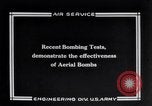
A phosphorus bomb explosion on the USS Alabama and a smoke screen is laid up during a bombing test in the United States.
The U.S. Army Air Service demonstrates the effectiveness of aerial bombing in the United States. A phosphorus bomb explosion on the mast of the USS Alabama battleship. A smoke screen is laid up during the bombing test.

Montage of Wright brothers and their airplanes in France and at Ft. Myer, Arlington, Virginia.
As a contrast to the early pioneering airplanes, passengers are seen seated inside cabin of a "modern" airplane (Douglas DC-4E). View of the DC-4E in flight. A view of Orville Wright. Wilbur Wright gesturing as he talks with officials in France about an aerial course to be flown. Wilbur Wright placing wheels under a Wright Flyer before it is moved across a muddy field in France. A team of men pull a rope raising a catapult weight in a tower. The weight falls, catapulting the Wright Flyer airplane into the air. Soldiers remove a Wright Flyer airplane from a storage building onto the parade grounds at Ft. Myer, Virginia. The airplane is seen in flight with Orville Wright alone, at the controls, On July 30, 1909, soldiers are seen moving a Wright Flyer from its shed for its final acceptance test. President William Howard Taft, U.S. Army Major George Owen Squier, U.S. Army Major Charles E. Saltzman and Wilbur Wright are among those standing with the President, as the Wright Flyer is moved toward the parade ground. Views of the monorail and weight and catapult used for launching an airplane. Men turn the two propellers on a Wright Flyer, as Wilbur Wright stands at the rear of the aircraft engine and makes an adjustment. . On September 9, 1908. U.S. Army Lt. Frank P. Lanham, seen in uniform, seated on a Wright Flyer, is joined by Orville Wright. Wilbur. They take off and set a new airborne endurance record, and Lt. Lanham becomes the first Military officer to fly in an airplane. On July 30th, as part of the final acceptance test, Orville Wright takes Army Lt. Benjamin D. Foulois on a cross country flight to Alexandria, Virginia, and back again. They are seen aboard the Wright Flyer, and then high in the air on their way to Alexandria.
CRITICALPAST.COM: About Us | Contact Us | FAQs - How to Order | License Agreement | My Account | My Lightboxes | Shopping Cart | Advanced Search | Featured Collections | Website Terms & Conditions | Privacy Policy ©2026 CriticalPast LLC.
License Agreement |
Terms & Conditions |
Privacy Policy
©2026 CriticalPast LLC.