


 Francais
 Deutsch
 Italiano
Refine Your Search
-Cebu,-Philippines stock footage and images
- Showing 14605 to 14610 of 58885 results more
more Hide
Hide
RMS Lusitania ship's survivors on a ship in Ireland.
RMS Lusitania ship's survivors on a ship in Ireland. Men come on the ship carrying bags. People sit on the deck. Children sit and one of them put her hand on another's shoulder. (World War I; World War 1; WWI; WW1)
Destruction from 1917 Kingsland Explosion; and aftermath of 1918 Gillespie Shell Loading plant explosion in World War I
Scenes in Lyndhurst, New Jersey after explosion in the Canadian Car and Foundry Company in Kingsland (in Meadowlands of New Jersey) during World War 1. The company built shells for shipment to Russia in World War I. Over 500,000 shells were destroyed in the blast and fire, bombarding the surrounding areas in Kingsland - Lyndhurst. Black smoke rising in the distance, at night, seen from the coast. Close views of industrial buildings and homes on fire. Night views of homes and buildings engulfed in flames. People walk through smoking wreckage afterwards and pick through debris. Devastation covers area flattened by explosion and fire. Twisted railroad tracks covered by debris. A pile of munitions shells in a heap in the burned out shell of a building. View of the D.L.&W (Delaware, Lackawanna & Western) Railroad Shops building at Kingsland (now Lyndhurst), with DL&W train car 605 parked in front. Railroad Shops building is pitted with holes and broken glass from 3-inch shell bombardment. Two men inspect a damaged railroad car with broken glass and a 3-inch shell embedded in the side of the car. A heavily damaged residential house with holes and blown-out windows, and a shell embedded in the front door. Citizens pick through wreckage in front of a building where only cement pilings remain. Scene shifts to Perth Amboy area, October 1918. View of displaced families made homeless by the T.A. Gillespie Shell Loading Plant explosion (Morgan Depot Explosion; largest munitions factory in the world). Refugees sit in a town square. Men, women, and children among the refugees. An Army soldier and Navy sailor seen near refugees as they eat and drink. View of Smith Street in Perth Amboy with shops damaged by the blast. Under Martial Law, U.S. Army troops patrol with rifles to prevent looting. Pedestrians and a streetcar pass. Sign along sidewalk for entrance to Michaels & Co. at 178 Smith Street. (Suspected cause of incidents: Gillespie - worker error; Kingsland - sabotage as in the 1916 Black Tom explosion.)
American Expeditionary Forces (AEF) soldiers return to an Army base in the Western U.S. at end of World War I
U.S. Army brass band leads American troops marching along a wide dirt road with high berms on either side. They raise dust as they march. The troops march with shouldered arms. Scene shifts to what might be the entrance of an Army Base, somewhere in the arid Western United States. An open wooden structure (possibly a guard post) is seen wrapped with American flags. Soldiers and some civilians are gathered near a Welcome Banner stretched across the road. The troops march under the Welcome Banner. (World War I; World War 1; WWI; WW1)
Women greet returning U.S. soldiers at Army base in World War I
Women greet soldiers. A soldier greets his two daughters and wife. He lifts his girls up and kisses his wife. The scene is an Army camp with tents behind the soldier and his family. (World War I; World War 1; WWI; WW1)
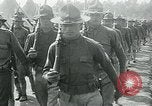
President Woodrow Wilson reviews marching U.S. Army troops in the United States during World War I.
U.S. Army Troops (American Expeditionary Force World War I) march with rifles on a parade ground in the United States during World War 1. Close-up view of column of American Army troops marching toward camera position. President Woodrow Wilson formally dressed in high top hat mounts horse and rides out to review the troops. A dog seen walking by the parading troops. (World War I; World War 1; WWI; WW1)
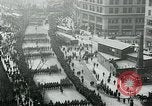
Crowd including veterans of Civil War and Spanish American War watch troops parade in New York City
Crowd including United States Civil War and Spanish-American War veterans in uniform watch troops march on streets in New York. Large crowd gathers. U.S. flag at a building. Civil War veterans in uniform stand on side and cheer the troops. (World War I; World War 1; WWI; WW1)
CRITICALPAST.COM: About Us | Contact Us | FAQs - How to Order | License Agreement | My Account | My Lightboxes | Shopping Cart | Advanced Search | Featured Collections | Website Terms & Conditions | Privacy Policy ©2026 CriticalPast LLC.
License Agreement |
Terms & Conditions |
Privacy Policy
©2026 CriticalPast LLC.