


 Francais
 Deutsch
 Italiano
Refine Your Search
-Cebu,-Philippines stock footage and images
- Showing 17095 to 17100 of 58885 results more
more Hide
Hide
Allied aircraft bomb the City of Dresden in Germany on February 13, 1945 (British) and again on February 15 (American)
Aerial views of British Royal Air Force Lancaster bomber aircraft heading toward Dresden. View of the Lancaster bombers as they drop bombs over German targets in Dresden during night of February 13-14, 1945, during World War 2. Bombs impact and view of explosions and smoke. Two views of German scarecrow bombs exploding, designed to look like the explosion of an Allied bomber aircraft in order to intimidate the enemy. Next scene is two days later, with aerial views of United States Army Air Force B-17 bombers in flight toward Dresden. They attack the city again on February 15-16, 1945, focusing on railroad marshaling yards. Narrator notes that the population of Dresden before the war was 625,000 people, and that the combined bombing by the American and British forces is estimated to have destroyed virtually the entire city.
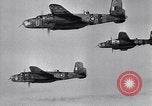
Allied British and American aircraft bomb industrial town of Pforzeheim in Germany
British Royal Air Force Lancaster bomber aircraft drop bombs over German targets during World War II. Bombs impact causing a pillar of smoke to rise up. United States Army Air Force 8th and 15th Air Force using B-17 bombers attack the industrial town of Pforzeheim at night. British Lancaster bomber aircraft also assist the American forces, destroying the city completely.
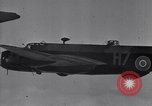
British Royal Air Force aircraft conduct 700-airplane bombing raid over Cologne during World War II
Narrator states that on March 2, 1945, during World War 2, 700 Lancaster and Halifax bombers of the British Royal Air Force fly over Cologne, Germany, to bomb roads and bridges leading across the Rhine River. Closeup aerial view of a British Halifax bomber with H7 painted on its fuselage, identifying it as belonging to No.346 Squadron RAF. (This is a Free French bomber squadron incorporated into the Royal Air Force and operating out of RAF Station Elvington.) View from one of the aircraft looking down on the city below as bombs fall from the plane. Narrator refers to U.S. 1st Army attacking Cologne and this bombing to strike German forces fleeing the city. Heavy smoke seen rising from bomb explosions below. A huge black cloud is seen in the air as a German scarecrow bomb hits a Lancaster bomber and destroys it (Narrator calls it a scarecrow bomb. Later analysis concluded that "scarecrow" bombs may have been attacks by Luftwaffe aircraft equipped with upward facing cannons, or so called "Schräge Musik" attacks.) Smoke rising from the city. Narrator emphasizes that the Cologne Cathedral is not touched.

Allied forces commence operations crossing the Ruhr River in Germany during World War II
On February 23, 1945, Allies commence operations to cross the Ruhr River in Germany, during World War 2. U.S. artillery soldiers fire 155mm guns from West bank of Ruhr River, against German lines on the East bank. Troops of Allied 1st and 9th Armies await signal to follow advance platoons that crossed the Ruhr earlier. Compelling close-up views of serious expressions on faces of U.S. Army soldiers as they prepare to move forward. M4 Sherman tanks fire guns at the river edge. Through misty conditions, troops of 104th Infantry Division, 415th Regiment, carry assault craft and begin crossing the river and attacking the industrial area of North Duren. U.S. soldiers are seen running across fields near large factory buildings and firing from them. Troops walk along street in Duren, after its capture. U.S. troops seen entrenched. A medic adjusts his personal flotation belt. Two U.S. Army soldiers smoking cigarettes while standing in a ditch with flotation devices around their waists as they wait the moment for the river crossing. They leave their positions and move along a road to cross the river at Linnich. All soldiers are wearing personal flotation belts as they paddle small assault boats across the swift moving river under enemy fire. One assault boat is overturned. Drenched soldiers make it to land and continue their advance. Army engineers construct a floating footbridge, under enemy fire. A soldier runs across the bridge as an American light airplane flies low overhead, surveying the operation. U.S. troops move through destroyed towns and villages. Large column of captured German prisoners of war is marched toward the rear, with arms held above their heads, passing by giant piles of debris and wreckage from bombing of the town.
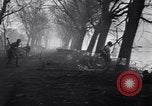
U.S. 29th Infantry Division crosses Ruhr River and captures Jülich, Germany during World War II
Troops of the U.S. 29th Infantry Division cross a floating footbridge erected by U.S. Army engineers across the Ruhr river at Linnich, Germany, during World War 2. Their mission is to capture the fortress town of Jülich. They hurry across the bridge under enemy fire. Major General Charles Gerhardt, Commander of the 29th Infantry, crosses the footbridge along with his troops. Troops enter the city, which has been destroyed by prior Allied bombing, and flush out remaining German snipers from basements of ruined buildings. Soldier seen firing into a basement. Remains of footbridge across the Ruhr river, destroyed by Germans during the night. Combat engineers work building a new heavy pontoon bridge across the river. A German soldier (narrator states: in an American uniform) carrying a white flag, walks towards U.S. soldiers on the opposite bank of the river, and is shot by one of them. U.S. troops cross the new heavier bridge across the river. A U.S. tank that had crossed the river, is seen. A banner is seen, fastened above a stone arch, reading: "This is Julich Germany. Sorry it is so messed up. But we were in a hurry! 29th (Blue & Grey) Div." The Division insignia appears on the banner.
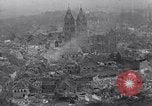
Ruins of the city of Jülich, Germany, after repeated air attacks by the U.S. 9th Air Force, during World War II.
Aerial views from an airplane flying over the city of Jülich, Germany, showing destruction from American 9th Air Force bombings during World War II. Smoke is still rising from some of the wrecked buildings. A cathedral standing amongst the wreckage.
CRITICALPAST.COM: About Us | Contact Us | FAQs - How to Order | License Agreement | My Account | My Lightboxes | Shopping Cart | Advanced Search | Featured Collections | Website Terms & Conditions | Privacy Policy ©2026 CriticalPast LLC.
License Agreement |
Terms & Conditions |
Privacy Policy
©2026 CriticalPast LLC.