


 Francais
 Deutsch
 Italiano
Refine Your Search
-Cebu,-Philippines stock footage and images
- Showing 17989 to 17994 of 58885 results more
more Hide
Hide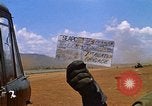
Aircraft operations of the 1st U.S. Army Aviation Brigade, at Camp Holloway, Pleiku, during Vietnam War
A CH-47 Chinook helicopter of the U.S. Army First Aviation Brigade, flies overhead, at Camp Holloway, Pleiku, Vietnam. Blue, sky and white clouds seen above it. Next, it is seen descending vertically over the large bare earth field at the camp, near a white wind sock at the end of a section of the camp paved with pierced steel planking (PSP) aka Marsden matting. The chopper raises huge clouds of red clay dust. Scene shifts to the CH-47 settling down on part of field paved with PSP. A helicopter crewman walks past a parked UH-1 Huey helicopter, as a Lockheed C-130 Hercules transport takes off on the camp runway. Camera follows the departing aircraft. Two CH-47s land near the runway. A Cessna O-2 Skymaster plane takes off on the runway. Three UH-1s with engines running, one airborne, near edge of PSP ramp. A UH-1 with engine running near revetments, as soldiers manually move a Hughes OH-6 Cayuse parked nearby. A CH-47 descending to land. Mountains seen in background.
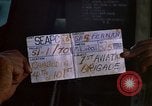
Helicopters of the First Aviation Brigade operating in and around Camp Holloway, Pleiku, during the Vietnam War
A long line of UH-1 Helicopters, from the U.S. Army 1st Aviation Brigade, is seen parked beside the runway, with engines running, at Camp Holloway, Pleiku, Vietnam. One is moving slowly a few feet above the runway. Scene shifts to view from open door of an UH-1 Huey helicopter, flying overhead. View of the long runway with some red dust above it. View of misty mountains. View of narrow curving stream cutting through green brush below. Image stops from TC: 00:53 to 01:15, where another aircraft passes at a distance and a river and jungle are seen below. Next, numerous UH-1s are seen on the red earth fields of Camp Holloway, as the camera chopper settles over the camp runway and then air taxis along a ramp paved with PSP (pierced steel plank aka Marsden matting).
The use of RADAR by Allied forces throughout World War 2
Film made in 1946 recounts use of RADAR in World War 2. Air raid sirens sounding in London, England,1940, during Battle of Britain. Air raid warden helps people to shelters during blitz bombing run by German Luftwaffe aircraft. German He 111 bombers in formation overhead. Woman scoops up child. British gunners man a 3.7 inch antiaircraft gun. Farmer rides horse-drawn plow. RAF airman rings alert bell that reads: "Don't come and tell.Ring this like hell." RAF pilots scramble to their Spitfire fighter planes and take to the air from a British airbase or aerodrome. German He 111 bombers being intercepted.Wreckage of German bombers. Evening views of London. Prime Minister Winston Churchill contributing to a war drive and receiving a pin from a woman. He doffs or tips his hat. Technician using a slide rule. Early British radar antenna tower. A U.S. P-38 aircraft in flight. Animated diagrams explaining how radar works. Radar operators at their screens receiving radar transmissions. U.S. Army soldier operating antiaircraft radar in the field. Antiaircraft gun firing and downing an airplane. Artllerymen decorate gun barrel with symbols for enemy aircraft downed. A U.S. B-29 bomber in flight with bomb bays open. Bombardier with bomb sight having radar and optic options, using radar to sight target. Bombs away view of bombs falling from aircraft through clouds. A U.S. P-61 night fighter aircraft equipped with airborne radar. Hand of pilot of P-61 pressing button to fire on enemy aircraft at night. A C-47 transport aircraft flying in poor visibility makes a ground controlled approach and landing enabled by radar. A U.S. Navy F6F landing with radar help, on an aircraft carrier. A U.S. battleship. Sailors quickly get up from sleeping bunks responding to battle stations at night. Radar antenna rotating on a U.S. warship. Naval guns firing at night. U.S. heavy cruisers bombarding a shoreline. A submarine underway submerged. Navy ship tracking enemy submarine. Destroyer firing depth charges. A PBY Catalina flying over a convoy of ships.
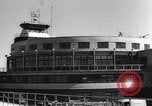
Military and civilian applications of radar and electronics
1946 Film about military and civilian applications of radar and electronics. View of the LaGuardia Airport Administration Building (passenger terminal) in New York, with control tower and various antennas on its roof. A TWA Constellation and DC-3 airplane on the airport ramp, as another aircraft is on the final approach to land. Commercial cargo vessels in New York harbor (Statue of Liberty barely seen in the misty background). A passenger railroad train speeding along the tracks. Radar returns shown on a plan position radar scope, tracking weather returns. Tropical storm hitting a seaside area. Scientists and technicians at work in a laboratory filled with electronic equipment. View of buildings at U.S. Army Signal Corps' Camp Evans, New Jersey. Sign above one entrance reads: "Evans Signal Laboratory." Inside the laboratory, images created by radar signals bounced off the moon are seen on a radar scope, during "Project Diana," on January 10, 1946. View of the Army's GB-4 radio controlled television glide bomb, suspended on a chain inside a building. It rotates around showing various views. Scene shifts to a launching track outdoors at a coastal facility, where a glide bomb takes off raising smoke as it accelerates along the launch path. Next, a GB-4 glide bomb is released from underneath a B-17 bomber in flight. It is seen flying away from the aircraft. Inside the aircraft, a crew member views its progress by means of television images received from a transmitter in the front of the bomb. Glimpse of the television images. View from the ground of the GB-4 bomb gliding to the ground and exploding. Views of a German V-2 rocket at Launch Complex 33, White Sands Proving Ground , New Mexico, where it was being tested by the U.S. Army Ordnance Department in 1946. Inside a control room, an Army technician gives the signal to launch, and the V-2 rocket fires and rises straight into the sky, with its fiery tail visible as it gains altitude. More views of scientists, engineers, and technicians inside a Signal Corps electronics laboratory. Soldiers being trained in radar technology, seated at an electronic array. An army staff sergeant technician working on radar components. A variety of different radar antennas rotating outdoors.

Private Snafu cartoon character promotes the U.S. Army infantry over other service branches
Private Snafu, an animated cartoon character tries out different branches of military but returns to infantry, thus proving its importance. He becomes an airman, a sailor but finally turns back to the infantry.
Marine Private Albert Smith shares experiences of the Gaudal canal battle
A group of United States marines, some of them injured. Marine Private Albert Smith narrates experiences about Gaudal canal campaign. He explains the exchange of fires between Japan and Allied troops. (World War II period).
CRITICALPAST.COM: About Us | Contact Us | FAQs - How to Order | License Agreement | My Account | My Lightboxes | Shopping Cart | Advanced Search | Featured Collections | Website Terms & Conditions | Privacy Policy ©2026 CriticalPast LLC.
License Agreement |
Terms & Conditions |
Privacy Policy
©2026 CriticalPast LLC.