


 Francais
 Deutsch
 Italiano
Refine Your Search
-Cebu,-Philippines stock footage and images
- Showing 17995 to 18000 of 58885 results more
more Hide
Hide
B-17 and B-24 bomber drop bombs over Japanese positions in Aleutian Islands, Alaska
United States B-17 and B-24 bombers loaded with bombs to be dropped over Japanese position in Aleutian Island during World War II. Planes take off and drop bombs over Japanese position and return after the air strike.
A United States unmanned spy plane manufactured and tested
United States unmanned spy plane manufactured at a plant. Parachute attached to the plane. Plane tested as it takes off. A soldier fires machine gun at it and plane descends as a parachute opens. (World War II period).
Wartime nutrition public service film focuses on improving nutrition of American and British people. Also shows British war scenes.
Film on importance of good food and good eating habits during World War 2. Sweeping views of open farm land in the United States. Wheat harvesting by a harvester machine on a farm. Corn picked from stalks. Pigs in a pen. Cattle eat at a trough. Fish leaping on deck of a boat after being emptied from a net. Butcher weighs meat on a scale for a woman customer. Grocer puts meat, sugar, eggs, and other rationed items in a grocery bag. Scene changes to England, probably London, with smoking rubble on the ground from a blitz bombing run by German forces during World War 2. British firemen pour water on a blaze from fire hoses. A queue of British women and children citizens waits to receive food aid. Many of the British civilians look tired. A girl holds a large doll in her arms. A woman with a bandaged head holds a young girl child. Scene shows a British family at a table eating ration reduced portions of eggs, butter, and cheese. A British scientist holds a beaker and adds it to a large food preparation drum, adding vitamin enriched material to a food such as margarine, to aid with improving nutrition despite scarcity in the United Kingdom during World War 2. A box of butter is shown. Hand flips butter packet over to show label "Contains Vitamins A and D". British staples such as a wheat bread loaf and also beans, peas, and cereals are credited by the narrator as being "nerve conditioners, at a time when iron nerves are needed most." Footage of a British paratrooper in training jumping from a British aircraft. Next scene is in a steel mill as British men wearing protective glasses use shovels near a furnace. Scene of a British woman receiving cod liver oil and milk as a ration for a young child. Grocer at produce stand hangs sign saying "no tomatoes". But a victory garden sign behind shows someone pushing a shovel into the earth. People are shown working in victory gardens to grow fresh vegetables. All ages of older men and women and young children in England are shown working to tend victory gardens in plots large and small. Soldiers beneath a barrage balloon tend a garden with hoes. Scene in a community kitchen with a group of British citizens eating a meal. Next scene shows Americans in a restaurant and then in a diner ordering food at the diner counter. A woman orders and coffee is poured for her and two donuts are served. Narrator notes that the food nutrition choices made by many Americans are not good, and notes that malnutrition saps the strength of Americans. A woman secretary is seen typing and being frustrated and tired. A man welding lifts his helmet and rubs his head and face in exhaustion. A doctor and nurse examine and treat an eye of an American war worker. A U.S. Army recruitment or induction center is shown, with new recruits receiving medical examinations. Doctor uses a tongue depressor and examines a person's throat. A blood pressure machine takes a reading. An eye chart is shown. Doctor uses a stethoscope on a recruit's chest. Group of U.S. Army soldiers marching in formation. A group of new citizen recruits without uniforms marches.
Dr. Thomas Parran, Surgeon general of United States Public Health Service advises to take a nutritious diet
Doctor Thomas Parran, Surgeon General of the United States Public Health Service speaks from a desk and advises Americans to eat a nutritious diet and to study the nutrition values of various foods available. He notes that war demands that we do not waste food. Women in a classroom learn about nutrition. Message on blackboard says: Protective Foods: Fruits, Vegetables, milk. Women taught how to prepare food with economy and about the ingredients of a balanced diet. Women are taught how to prepare food in an economical way that preserves nutrition. Women are taught about a balanced diet in which variety is essential. They are taught how to substitute various ingredients while some ingredients are unavailable due to wartime shortages during World War 2. Camera pans slowly across a poster with words and food pictures entitled "Foods that are the Principal Sources of the Food Constituents."
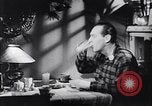
Importance of well balanced diet for American citizens at home and at work during World War II
Importance of well balanced diet during World War 2. American man seated at a table eats food. A housewife serves more food to him. Narrator talks about importance of nutrition, having three square meals each day, eggs and other protein foods, and vitamin B rich foods such as cereal of whole wheat, or enriched white bread. A worker on the job is shown taking a lunch break. Close up view of his open thermos with a hot drink and his sandwich and fruit and a chocolate bar. A couple dining together at a table for dinner are seen. Narrator suggest chicken, fish, liver, or sweetbreads as a main course, served with green leafy salad and also cooked vegetables like peas or carrots. A man carves meat. Men walk near a war materiel production factory gate, with a sign, "Let's step it up." Women at a factory production plant prepare large numbers of sandwiches for workers, with the help of automated machinery. Narrator says average workers need twice as many vegetables and fruits as they now consume. A group of men in an industrial kitchen work to prepare carrots, spinach, cauliflower, and other vegetables like squash, parsnips, and lima beans. African American cooks prepare food. Factory workers line up and take prepared food trays at a factory kitchen. Workers sit outside and enjoy food during a lunch break. Young men and women in a cafeteria line select foods to eat. War workers exit at the end of a work day. View of the U.S. Capitol dome. On screen public service message text says "U.S. Needs US strong. Eat nutritional food."
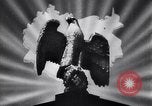
German film describing Allied attack on Dieppe, August 19, 1942, during World War II.
Film opens showing a map of French and English coasts bordering the English Channel. Dieppe is the focus of attention. Narrator states that British, American, and Free French forces, totaling a Division strength, attempted a landing at Dieppe. Animated map illustrates hundreds of Allied landing craft off the coast, protected by Cruisers and Destroyers. A reserve of transport vessels is shown in the Channel and a strong supporting force of Allied bombers and fighter aircraft. Active scene shows German coastal guns firing from bunkers on the French coast and German soldiers deploying to defensive positions commanding the beaches They fire MG 42 machine guns and a 77mm field gun. Shells from British naval artillery explode near German soldiers at shoreline. Explosions at Dieppe harbor from British aircraft bombs. German anti-aircraft fire directed against them. View of Dieppe castle. German soldiers taking up defensive positions on a city street. More explosions from Allied bombers. German soldiers firing a 12.8 Cm Flak 40 anti aircraft gun and black Flak clouds seen in midst of attacking Allied aircraft. German soldiers firing a vehicle mounted 2 Cm Flak 38 gun and quad versions of the same. Allied aircraft struck and trailing white smoke as it falls toward the water offshore. Glimpse of German soldiers in center of town. Low flying Allied aircraft and explosions from their bombs. German Fw 190 fighter planes heading to engage the Allied aircraft. Contrails at altitude from dogfights between Allied and German fighter aircraft. An aircraft struck and falling. Closeup of a burning British aircraft on the ground. Camera pans across German soldiers and buildings damaged and destroyed by Allied bombing. British soldiers (mostly Canadian soldiers) being taken prisoner at the beachhead and later marched under guard in the town. A German General visits his troops at the beach front. Scenes of destruction after the battle. Dead bodies of Canadian and British Allied soldiers floating near the shore. Fire burning on a dock. Burning British Mark 8 Landing Craft Tank (LCT Mark VIII) with shell holes in it. More bodies of dead Canadian soldiers strewn on beach. Knocked out British Churchill tank displaying number 9. Several destroyed and damaged British LCT Mark 8s. Names: "Calgary" and "Beefy"on destroyed Canadian Churchill tanks of the 14th Canadian Tank Regiment. Destroyed British speed boat with sailor's body on it. Other destroyed invasion craft. Several crashed British aircraft at water edge. Closeup of bullet holes near British roundel on one. More destroyed British Churchill and other tanks. Beaches covered with fallen Allied soldiers. British soldier helmets caught in barbed wire.
CRITICALPAST.COM: About Us | Contact Us | FAQs - How to Order | License Agreement | My Account | My Lightboxes | Shopping Cart | Advanced Search | Featured Collections | Website Terms & Conditions | Privacy Policy ©2026 CriticalPast LLC.
License Agreement |
Terms & Conditions |
Privacy Policy
©2026 CriticalPast LLC.