


 Francais
 Deutsch
 Italiano
Refine Your Search
-Cebu,-Philippines stock footage and images
- Showing 1807 to 1812 of 58885 results more
more Hide
Hide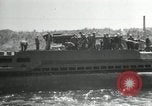
U.S. Military inspection of Japanese submarine aircraft carrier at Sasebo Bay, Japan during Operation "Road's End."
Operation "Roads End,"involving the post-war scuttling of the Japanese submarine fleet. U.S. sailors opening boxes of demolition charges on the deck of Japanese Sen Toku I-400-class submarine aircraft carrier, number I-402, moored in Sasebo Bay, Japan. (It was converted to a tanker sub, and completed only 3 weeks before the end of the war, and never placed in service. I-402 is one of only 3 such boats ever completed.) A U.S. Navy launch, approaches and ties up to the I-402. Close view of the submarine as the launch approaches. Vice Admiral Robert M. Griffin, commander of U.S. Naval Forces,Japan, a Rear Admiral, and a Captain, climb from the launch onto the submarine. Scene shifts to a smaller sub ,tied up next to the I-402, where an U.S. Army Colonel, and Navy Captain, are conferring with a Japanese officer. A utility boat is tied up in the background. The Army colonel goes into a hatch leading below decks followed by the Navy Captain. Next scene shows Admiral Griffin emerging from an open hatch on the deck of the I-402. He speaks to a navy Commander standing nearby. Empty explosives boxes, previously seen, are now stacked in a pile near the boat's conning tower. Camera shows a Japanese aircraft carrier moving past a Japanese submarine. View from deck of the I-402, showing the smaller sub to the right, and another Japanese sub, behind, with smoke rising from it. High hills overlooking the bay, in background. Admiral Griffin conversing with the Rear Admiral. Japanese crew lounging on the utility boat next to the I-402. Group of American officers conversing near the hangar door of the I-402. View downward from the conning tower, of the admirals and other officers. U.S. Army Colonel points out something on deck of nearby small submarine. An I-400 class submarine and a Japanese cruiser. Japanese sailor opens hangar door of I-402. Admiral Griffin and his aide, inspect inside. The two admirals and the Captain examining the hangar.All the American officers gathered on deck of the I-402.
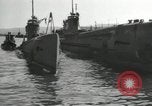
Operation Road's End, preparing to destroy Japan's submarine fleet. Crews decorate their submarines with cherry blossoms
Operation Road's End. Inspection of Japanese submarines,moored in Sasebo Bay, Japan, that are scheduled for destruction, after World War 2. View from a boat passing several of these submarines. One has a group of U.S. Naval officers and others on its deck. View of Japanese submarines I-366 and Number 107. Japanese sailors are decorating the submarines with branches of cherry blossoms. A Japanese officer looking down from boat I-402, as the camera passes below. Closeup of him posing on his boat for the camera.. Captain Atogi Nakamura, Lt. Tashio Tanaka and crew members posing aboard Japanese submarine I-58 (that sank the USS Indianapolis on July 30, 1945 with torpedos fired by Lt. Tanaka).
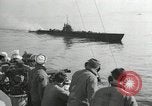
Operation Road's End, the destruction of the Japanese submarine fleet. Views from USS Everett F Larson escorting the submarines
April 1, 1946: “Operation “Road’s End.” View from the Destroyer, USS Everett F. Larson (DD-830) as it accompanies Imperial Japanese Navy submarines headed out of Sasebo Bay, headed to "Point Deep Six," (reportedly about 60 km west of Nagasaki and off the Gotō Islands) where they are to be scuttled by demolition charges and/or gunfire from the Larson or the USS Nereus (AS-17) (not seen). Captain Bell and Commander D.A. Mckee are seen on deck of the Larson with a Japanese interpreter who is issuing instructions to the skeleton Japanese crews through a megaphone. Views of the submarines underway.
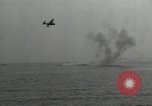
Submarines of the Japanese fleet, being sunk during Operation Road's End, after World War II
Operation Road's End. Japanese submarines being sunk after World War II. A U.S. Navy Martin PBM Mariner flying boat circles over several Imperial Japanese submarines as they are being scuttled and/or sunk by gunfire on April 1, 1946, off the Goto Islands, of Japan. Smoke drifts over the water from charges ignited aboard a sub. One of the submarines explodes raising a surge of water and huge black cloud. Clear view of a U.S. Baltimore class Cruiser with two scout planes aboard. Sailors watch from the U.S. Destroyer, USS Everett F. Larson (DD-830) as a submarine slips below the surface. Another submarine explodes and sinks. Gunfire from the Larson strikes another submarine. Smoke from the Larson's guns drifts in front of the camera. Closeup of the Larson's forward 5-inch guns, turned to starboard, firing.
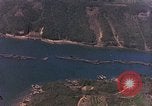
Operation Roads End: Japanese submarines being taken from Sasebo Bay to the sea for destruction by United States Navy.
Aerial view shows fleet of captured Japanese Submarines at Sasebo Bay, Japan. The Japanese submarines with skeleton crews being escorted from Sasebo Bay to the sea for destruction by the United States Navy as part of Operation Road's End.
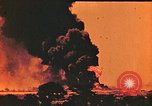
Smoke and fire rising at Pearl Harbor, Hawaii from an oil fire and ammunition explosion
Huge smoke and fire rising at Pearl Harbor, Hawaii. View of thick, black smoke rising. Water hoses directed at the fire. An ammunition explosion and fireball from the expanding oil fire is seen near the end of the clip.
CRITICALPAST.COM: About Us | Contact Us | FAQs - How to Order | License Agreement | My Account | My Lightboxes | Shopping Cart | Advanced Search | Featured Collections | Website Terms & Conditions | Privacy Policy ©2026 CriticalPast LLC.
License Agreement |
Terms & Conditions |
Privacy Policy
©2026 CriticalPast LLC.