


 Francais
 Deutsch
 Italiano
Refine Your Search
-Cebu,-Philippines stock footage and images
- Showing 21703 to 21708 of 58887 results more
more Hide
Hide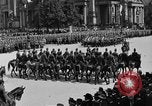
Celebrations in Berlin, Germany, for new German Republic and flag; Freikorps members parade.
Celebrations in Berlin upon adoption (in Weimar) of the new Constitution of the Republic of Germany. A large number of people gather to partake in festivities. Freikorps members parade in uniform, including some cavalry, on horseback. The crowds slowly envelope and mingle with the marchers. Civilians carrying signs move through the throng. Various groups move through the crowds like streams. Finally, the people condense into a huge mass, as seen from a high point above. Celebrations continue into the night. Torches are waved in the dark and a large firework sign announces the flag of the new Republic as Black, Red, and Gold.
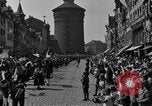
Many different groups parade with different flags in German City. Prussian officers participate
Large crowds of spectators watch a parade through streets of a German City, on a pleasant summer day. Citizens in old-fashioned traditional costumes carry bicolor flags. View of parade below from window of high building.Marchers fill street and spectators fill sidewalks. Many kinds of flags are carried and flown from buildings bordering the street. Prussian Officers stand in a group. Men in business suits, with armbands, parade carrying flags similar to German Naval Ensigns, but with dark field. Prussian officers ride through town in open car.
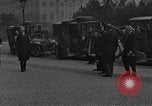
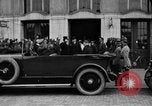
Kaiser Wilhelm II and wife, Augusta Victoria, visit Royal Library in Berlin, Germany
Three motorcars are parked behind one another at a curb, in Kaiser-Franz-Josef-Platz, Berlin, Germany. Two are completely enclosed sedans. But one is a Saloon-landoulet, with open seat in the rear. Kaiser Wilhelm II of Germany, and his wife, Augusta Victoria of Schleswig-Holstein-Sonderburg-Augustenburg, walk from that car, toward the entrance of the Königliche Bibliothek (Bebelpl. 2, 10117 Berlin, Germany) accompanied by two civilian officials. Later, Empress Augusta Victoria and Kaiser Wilhelm II emerge from its doorway. They proceed toward their motorcar. The Humboldt University building (Unter den Linden 6, 10117 Berlin, Germany) along Unter den Linden is visible in the background, with a statue of Wilhelm von Humboldt in front of it.
Paul von Hindenburg, President of German Reich, in a motorcade moves past the Brandenburg Gate in Berlin, Germany.
Paul von Hindenburg, second President of the German Reich,enters a car and rides in a motorcade, accompanied by Horse Guards and motorcycle escorts. Spectators line the streets to watch. Crowds fill a square. The procession passes through the Brandenburg Gate. Hindenburg leads group of politicians down the stairs of a building, where they stop and
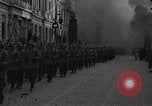
State funeral cortege for German Chancellor Gustav Stresemann. Procession to Luisenstadtischer Friedhof
State funeral procession for German Chancellor, Gustav Stresemann, in Berlin, Germany. Soldiers slow step down a street. Concrete pillars, at sides of roadway, emit dense black smoke. Statesmen in top hats walk in the procession, behind black casket, on black carriage drawn by black horses. German citizens line the streets in mourning. The cortege passes the Brandenburg Gate and proceeds through Berlin-Kreuzberg to the cemetery at Luisenstadtischer Friedhof, where many citizen mourners pass by the open grave.
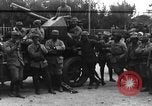
Scenes of Berlin Germany during the Kapp Putsch of 1920
The Kapp Putsch in Berlin during the Weimar Republic period. In opening scene about 20 Freikorps soldiers in uniform, are seen gathered around a motor vehicle on which an anti aircraft gun is mounted. One wears a fez. One soldier cranks a handle to raise the elevation of the gun to a high angle. Civilian spectators watch the demonstration. A warship can be seen in water behind the soldiers. Masts of docked sailing vessels are seen close behind them. Freikorps soldiers walk about. A military band plays as some of the soldiers stop and listen to them and pedestrians and motorists pass by. Flag of Prussia flies over top of a building. Helmeted German soldiers with rifles, stand about, casually, at the gates of a building. Soldiers, loaded onto a Benz truck, pass out newspaper flyers to passersby. People milling about in the street. Freikorps soldiers lined up as an officer inspects their rifles. Their insignia is visible on their left coat sleeves. Crowd of spectators stand behind barbed wire barrier surrounding a cleared square in the city secured by Army soldiers in steel helmets. One of them has Freikorps insignia on his left sleeve. Weimar Republic officials, including Philipp Scheidemann stroll across the square and proceed through the crowd outside the barbed wire barrier. Soldiers examine papers of civilian officials trying to enter the restricted area. One of them is allowed access. Army troops and Freikorps soldiers mingle together as civilians pass by them.
CRITICALPAST.COM: About Us | Contact Us | FAQs - How to Order | License Agreement | My Account | My Lightboxes | Shopping Cart | Advanced Search | Featured Collections | Website Terms & Conditions | Privacy Policy ©2026 CriticalPast LLC.
License Agreement |
Terms & Conditions |
Privacy Policy
©2026 CriticalPast LLC.