


 Francais
 Deutsch
 Italiano

Refine Your Search
-Cebu,-Philippines stock footage and images
- Showing 24505 to 24510 of 58986 results more
 Hide

U.S. Air Force fire trucks extinguish blaze with foam after an F-100 crashes on runway during emergeny landing at Edwards AFB
A U.S. air Force F-100 Super Sabre rounds out high during landing approach and hovers over the runway in a nose-high attitude. The pilot attempts to recover under full power but the aircraft continues in condition known as "sabre dance." It falls off on its right wind and crashes in flame and smoke. Smoke and flame shoot skyward from an area burning on ground. U.S. Air Force fire trucks and emergency vehicles respond immediately and firemen fight blaze with foam. Scattered fires seen throughout the area. Smoke rises from fires. Several men jump down from trucks as other trucks and an ambulance arrive. Medical personnel run from an ambulance towards crash site, fire trucks spray area with foam. Mountains seen in the background. Many fire trucks at crash site. Small fires seen. Part of fuselage and several personnel in area amongst fire trucks.

Crash of U.S. Air Force F-100 Super Sabre aircraft, at dusk, Edwards Air Force Base, California
During period of semidarkness, at dusk, blinking red lights are seen. Then an aircraft is silhouetted low over the runway. It proceeds slowly, only a few feet above the runway, and then crashes in a spectacular ball of flames, followed by a huge cloud of black smoke. (Note: The aircraft, an F-100 Supersabre was being ferried from Palmdale, California, when the pilot elected to make an emergency landing at Edwards AFB.)
USAF Brigadier Generals James Parker and Dale Gaffney are introduced prior to air show in Spokane, Washington, during World War II
At the start of an air show in Spokane, Washington, during World War 2, a U.S..Army Air Force Colonel introduces Brigadier General James G. Parker, Commanding General of the 4th Air Force, headquartered in San Francisco. General Parker says a few words of greeting. People applaud. The Colonel then introduces Air Force Brigadier General Dale V. Gaffney, Commanding General of the Alaska Wing, Air Transport Command. He also says a few words. Then, (sound only) the Colonel introduces a Major, from Spokane, who had survived the Bataan Death March and also successfully escaped from a Japanese prison camp.
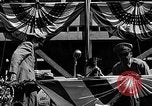
At an Air Show in Spokane, Washington, Major Samuel Grashio, survivor of Bataan Death March, speaks during World War II
Army Air Force Major Samuel Grashio speaks prior to an air show in Spokane, Washington, during World War 2. He is from Spokane, a survivor of the Bataan Death March, and had successfully escaped from a Japanese prison camp. The Major begins to describe his experiences during the fall of Corregidor and Bataan, during the Japanese invasion at the start of World War II in the Pacific. Unfortunately, the sound stops (purposely ?) as he gets into the details of his story.
Two A-25s from formation of three collide, crash and explode during U.S. Army Air Force air show in Spokane Washington
U.S. Army Air Force air show in Spokane, Washington. Formation of three U.S. L-6s flying directly over crowd. Formation of three A-25s coming in and flying low across in front of the crowd. Two A-25s collide in mid-air and breakup in pieces. One A-25 hits ground and explodes. Other A-25 falls close by, explodes when it hits ground. Burning area where aircraft crashed. Large clouds of black smoke rise from the area. Air Force crew members killed in this tragedy were: Capt Ford K. Sayre, Lt. George Chrep, Lt. William R. Scott, and Sgt. Joseph M. Revinskas.
Destroyed B-29, its parts and scattered debris viewed the day after it crashed on Tinian in the Northern Marianas Islands.
Remains of United States Army Air Forces B-29A Super fortress that crashed on March 30, 1945, at North Field, Tinian,in the Northern Mariana Islands, during World War 2. Scattered debris on ground. Remaining piece of tail section displays serial number 265283 indicating it is B-29 number 42-65283, nicknamed "Big Wheel," from the 9th Bomb Group, 99th Bomb Squadron. Reportedly, it experienced mechanical problems during a mission to drop mines in Japanese waters. After jettisoning its munitions, it returned to Tinian, but crashed on the shore. Of the 12 crew, only the radar operator survived.
CRITICALPAST.COM: About Us | Contact Us | FAQs - How to Order | License Agreement | My Account | My Lightboxes | Shopping Cart | Advanced Search | Featured Collections | Website Terms & Conditions | Privacy Policy ©2026 CriticalPast LLC.
License Agreement |
Terms & Conditions |
Privacy Policy
©2026 CriticalPast LLC.