


 Francais
 Deutsch
 Italiano

Refine Your Search
-Cebu,-Philippines stock footage and images
- Showing 28399 to 28404 of 58987 results more
 Hide
Color Sound
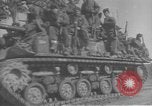
UN Operation Doughnut designed to seize dominating terrain of Sobang Mountains around the Iron Triangle, 1-4 July 1951
U.S. forces on the move to encircle the Iron Triangle, and blast the enemy from the hilltops during the Korean War. The first scene shows a U.S. Sherman tank carrying about 15 American infantrymen who occupy every possible space atop the tank. It is followed by a Patton tank, also covered with American infantry getting a ride. Fuzzy view of a tank in field with traces of snow. U.S. gun crew firing a towed field howitzer. Closeup of American Lieutenant commanding artillery. He is using a field telephone. Another crew firing a mortar. Shells exploding on the hilltops. U.S. soldiers observing with binoculars from a bunker. Numerous explosions of many kinds of ordnance in the hills. Soldier firing a 30-caliber Browning air-cooled machine gun. Another American soldier firing a sub-machine gun. Other infantrymen firing fully automatic rifles. A U.S. Air Force F-51 Mustang fighter plane drops napalm on a target. Another Mustang fighter dives low to fire rockets and strafe an enemy position. Many more views of American artillery, tanks, and machine guns firing at the hills. Infantry move uphill to occupy the hilltops. Two are seen carrying flame throwers. As the infantry enter woods on a hillside, a flamethrower is employed. Troops in a sandbagged position in a town. Sick and wounded Korean civilians lie on litters in a paved area from where they are being placed into trucks.

A USO troupe, starring Jack Benny, entertains American troops in Korea, after the armistice
In opening scene, as many as 20 thousand American troops are seen seated in sand at the base of a mountain. They watch as comedian, Jack Benny does a monologue. Camera focuses on two senior officers of the Third Infantry Division sitting with the troops. On the right is Major General Haydon L. Boatner, who assumed Command of the 3rd Division in December 1954. Rank insignia of the officer to his right is not discernible in the images. The next scene shows a woman dancer performing as another woman plays an accordion. Another view of the vast audience, with senior officers seated in the front row.
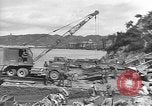
U.S. Corps of Engineers rebuilds bridge while U.S. troops engage the enemy during the Korean War
U.S. Army Corps of Engineers use a mobile crane and other construction equipment to rebuild a bridge during the Korean War. Closeup of engineers standing on the edge of a newly built section of the bridge. Wheels of the mobile crane are nearby. They lower a cable as an inflatable boat arrives carrying steel sections for the construction. The boat and its cargo is pulled in and tied up to the existing structure. Scene shifts to a dirt road, where several Patton tanks are clustered near a large tent. Tank crews are checking their guns and equipment. Closeup of Lieutenant General James Van Fleet, newly appointed Commander of the U.S. Eighth Army, at the construction site. Closeup of a Patton tank with crew members visible, as it passes the camera. Its main gun is wrapped in tarpaulin covering. Next, a Patton tank is seen crossing a pontoon bridge. U.S. troops firing an M20 75mm recoilless rifle at enemy positions from a temporary hillside base. American troops firing a mortar. Scene shifts completely to Korean refugees fleeing the battlefields. They and their belongings are loaded into trucks, along with food and other supplies. Closeups of some of the refugees. A column of trucks filled with refugees is seen making its way along a dirt road. United Nations troops investigate possible infiltrators from the North, They are seen searching and questioning some. A sign at one area reads: "65th PW Cage. Keep Out." Some in the prisoner area are seen being interrogated and writing answers to questions.

A U.S. Army General announces to bring a ceasefire agreement into effect in Korea during the Korean War.
U.S. infantrymen wading across a flooded region during the Korean War. They emerge on a sandy beach near a mountain. Next, they are seen heading up a hillside. A soldier arranges mortar shells in a bunker. He then begins firing them in rapid succession at an enemy held hill. Scene shifts to U.S. Army General Mark Clark announcing the armistice ending hostilities, in July, 1953. He speaks in a hall packed with military personnel.

People gather to greet United States 3rd Infantry Division in New Orleans, Louisiana after they return from the Korean War.
October 29, 1954, General Maxwell B. Taylor, Commander of the U.S. 8th Army, in Korea, escorts a South Korean diplomat up the stairs to a reviewing stand. A color guard is seen and then a view of the Korean representative, General Taylor, and Major General Charles D.W. Canham, Commander of the Third U.S. Infantry Division, saluting as soldiers of the 3rd Division begin marching in review. Camera focuses on the seated Army band, playing for the marchers. Soldiers of the 3rd Division are seen passing behind the band, carrying their Duffel bags and other belongings on their way to board the U.S. Navy transport ship USS General M. B. Stewart (AP-140) which would take them home to the USA. The next scene shows 3rd Division soldiers leaving the the USS M.B. Stewart at New Orleans, Louisiana. A huge banner hangs on a port building welcoming the Division. American troops with massed flags stand with Audie Murphy, on a bunting covered porch to welcome the returning 3rd Division troops. An Army marching band plays as they parade across the dock. Several motorcycle policemen lead a parade or the returning troops along the streets of New Orleans. Scene shifts to Master Sergeant Queen at the filming location for the Army production, "The Big Picture." Audie Murphy is with him, and praises the Army's 3rd Infantry Division, noting that he had served as one of its soldiers.

People suffer heavy damages due to a cataclysm various areas of the Pacific Ocean.
Damage due to earthquakes and tidal waves in various parts of the Pacific Ocean. A high altitude view of an area. Damage due to volcanic eruptions and earthquakes in Chile. Destroyed houses and wrecked vehicles on the streets. Damage due to tidal waves in Hawaii, Japan and Okinawa. Homeless people on the streets and in the field hospitals.
CRITICALPAST.COM: About Us | Contact Us | FAQs - How to Order | License Agreement | My Account | My Lightboxes | Shopping Cart | Advanced Search | Featured Collections | Website Terms & Conditions | Privacy Policy ©2026 CriticalPast LLC.
License Agreement |
Terms & Conditions |
Privacy Policy
©2026 CriticalPast LLC.