


 Francais
 Deutsch
 Italiano
Refine Your Search
-Cebu,-Philippines stock footage and images
- Showing 3943 to 3948 of 58885 results more
more Hide
Hide
German rocket pioneer, Klaus Riedel and associates testing an Achenstaber rocket in 1931
First test of a precursor to the Mirak rocket in Germany. Diagram of the so-called Achenstaber rocket.. Rocket pioneer, Klaus Riedel, and an associate, hold the long slender rocket. A barn with sandbagged window is seen behind them. The men lower the rocket through guidance brackets in a wooden pole. The rocket fuse is ignited and the rocket rises fairly high into the sky but tilts over and dives, crashing into the ground. Riedel and associates stand near a truck carrying metal framework designed to guide a rocket.

Rocket development leading to test of 250-Kg-thrust prototype rocket in Magdeburg, Germany
Third test of an Achenstaber rocket by Klaus Riedel, and associates. View of another test stand structure, inside a small metal building. The test stand erected outside the building, next to a steep hill, where a group of people are assembled to witness the test rocket firing. Interior view of the operating station, with liquid oxygen and another pressure tank seen along with pressure gauges. A dynamometer for measuring the rocket thrust. The smallest and largest combustion chambers. Model of the Pilot Rocket having 750 Kg thrust, the starting point for a manned rocket. A man poses with the prototype rocket motor. A precursor for the Pilot Rocket, with thrust of 250 Kg is seen laid out horizontally on a stand and then in a launch test stand. Closeup on the test stand. A crew loading the precursor Pilot Rocket and a pre-fabricated test stand, onto a truck for transport to a site in Magdeburg, Germany. The crew setting the test stand and 250-Kg-thrust rocket in place at Magdeburg. Fueling the rocket with liquid oxygen. Condensate fumes rising. Test firing of the rocket motor while fastened to the test stand. The rocket burns smoothly, as seen from afar. Next is the first test firing of a large liquid-fueled rocket, on June 29, 1933, at Magdeburg. A large crowd of spectators gathered around the rocket and stand, as technicians do final refueling. Rudolf Nebel explaining the rocket to members of press and officials. Nebel giving signal to fire the rocket engine. View of fire streaming from the 250-Kg-thrust rocket on the stand as it slowly rises and heads horizontally, to impact the ground about 50 yards away.
Tests of the Vierstabers, 4-nozzle rockets in Germany
Several views of preparations for the 10th test of a four nozzle (Vierstaber) rocket at Klaus Riedel's farm in Germany. Refueling the rocket. A young man standing with pieces of the rocket that exploded during the test. Change to another test, the first test of the Vierstabers rockets,on Lindwerder Island in Lake Tegel, Berlin, on July 14, 1933. The rocket set up for launch and being refueled. Lake Tegel in background. People gathered around it during refueling. Dense clouds of condensation around the rocket. The rocket is launched and rises high into the sky before falling into the lake with a splash. View of the rocket upside down in shallow waters of the lake.
Tests of Vierstabers rockets at lakes in Germany
Vierstabers rocket standing on its four legs on Lindwerder Island in Lake Tegel, Berlin. Men gathered around as the rocket is being fueled. Fumes from condensation seen. The rocket is fired and rises a considerable distance in the air before falling into the lake. Sketches of the rocket. Heavy steam fumes rising where the rocket has fallen into the water, because the motor appears to be still burning. Two more sequences of rockets launching from the island and falling into the lake. Men in a motorboat retrieving a rocket from the water. Another test launch of a Vierstabers rocket from a boat in the Schwielowsee (lake) in Germany. A motor launch traveling out on the lake, with a Vierstaber rocket on its deck and flying the German national flag. The launch next to a larger boat in the lake. The rocket launches high in the sky and falls into the lake.
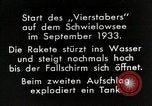
Testing of "Vierstabers" and "Zweistabers" rockets at lake in Germany in 1933
Testing of the "Vierstabers" rockets at the Schwielowsee (lake in State of Brandenburg Germany) by Klaus Riedel and associates, in September, 1933. The rocket set up on its four legs aboard a motor launch in the lake. It launches and flies a short distance to fall into the lake. Another attempt shows a rocket doing the same, except this one explodes upon impact with the water. Scene shifts to October, 1933, with testing of the "Zweistabers" rockets. A motor launch sits in the water, next to a point of land where launch crew is setting up a two-legged rocket.

Contributions to rocket research by German Professor Eugen Sänger in the 1930s
German Professor Eugen Sänger conceived of a rocket-propelled airplane in 1934. View of his sketches and notes.View of a workshop, close to his home, where Sänger developed his ideas. It is a nondescript building with wooden exterior and "Deutsche Raketenflug-Werft, Vien1934" (German Rocketflight shipyard, Vienna,1934) scrawled on its door. Professor Sänger and an assistant are seen in doorway of the workshop. Interior views of machinery. Blueprint cross-section of Sängers first Rocket motor (the S.R.1) from 1932. Drawing of test facility arrangement from 1932. Drawing of the S.R.2 rocket motor from 1933, with high pressure liquid oxygen cooling. Drawing of testing apparatus and arrangement from 1933, including Bosch fuel injection pump.
CRITICALPAST.COM: About Us | Contact Us | FAQs - How to Order | License Agreement | My Account | My Lightboxes | Shopping Cart | Advanced Search | Featured Collections | Website Terms & Conditions | Privacy Policy ©2026 CriticalPast LLC.
License Agreement |
Terms & Conditions |
Privacy Policy
©2026 CriticalPast LLC.