


 Francais
 Deutsch
 Italiano

Refine Your Search
-Cebu,-Philippines stock footage and images
- Showing 43267 to 43272 of 58987 results more
 Hide
Color Sound
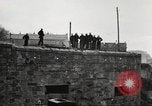
Vice Admiral Henry B Wilson visits a fortress on the coast of France, with members of his staff, at the end of World War I
Vice Admiral Henry B Wilson, Commander of U.S. Naval Forces in France, and about 20 members of his staff, visit a coastal fortress. American sailors walk along a an area overlooking the site's high walls. Camera pans to the left toward a group of Naval Officers climbing a tall berm that runs below the higher wall. The head of the group is Vice Admiral Wilson. A Navy Captain, in lighter color uniform, is acting as a tour guide. He pauses as the remainder of the visiting party catch up. The group poses. The fort wall and tops of buildings appear in the background. Admiral Wilson is flanked by the Captain tour guide and a Captain from his staff, in blues. All members of the party seem amused at being photographed by a cinematographer.

Assortment of unrelated scenes from post-World War 1 period, containing mostly U.S. Navy officers.
A Rear Admiral steps from a doorway, resplendent in special full dress uniform, complete with cocked hat and special embroidered rank insignia on his sleeve. The uniform appears to be European (not American). The scene is repeated in a second take. A French aviator, in leather jacket, walks in front of an early French bi-wing headless pusher airplane parked in an open hangar. (Unlike a Curtiss headless pusher aircraft, this one does not have tricycle landing gear.) He bends to greet a little girl who walks to meet him with a woman, the girl's mother. The three pose for the camera. Next scene shows U.S. Navy Vice Admiral Richard H. Jackson (Commander Battleship Divisions Battle Fleet, 1925-1926). He steps from a building followed by Naval officers. Jackson converses with a young Navy Captain, as others relax behind them. . Closeup of Admiral Jackson and the Captain. The group moves away. Next, a fairly young U.S. Navy Rear Admiral (unidentified) is seen in front of a long, wide, set of granite steps, shaking hands with a Navy Petty officer. They engage in conversation and then the Petty Officer leaves, followed by the Admiral. Next, is seen the entrance to a building numbered 22, that has U.S. Navy signs in its windows. A U.S. Navy Rear Admiral (unidentified) exits the building, accompanied by a Commander and a Lieutenant Commander. The weather is cold enough to show visible moisture from their breath. The three share entertaining conversation, including smiles and laughs.
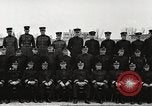
Naval officers photographed at The Naval Operating Base, Hampton Roads, Virginia in 1925.
The Naval Operating Base, Hampton Roads, in 1925 (re-designated "U.S. Naval Station Norfolk," in 1945). Opening scene shows Senior Naval officers (mostly captains plus a couple of rear admirals) seated in front row, and two rows of others officers standing behind them. At one point, they all remove their caps. Behind them is a concrete wall. But tops of some some buildings can be seen behind in the background. Closeup of a seated young rear admiral flanked by captains. In change of scene, all the officers are seen standing at attention, side-by-side on a gravel waterfront area, with a river and numerous buildings on the opposite shore visible in background. The camera pans across the assembled officers. Next, officers are seen on the waterfront, marching in white hats and carrying swords. (In these scenes, the motion is too fast, due to lack of compensation for low hand cranking speed of source camera.) The officers stop and stand in formation, and then march away.
Rear Admiral William Moffett, Chief of U.S. Navy Bureau of Aeronautics. Admiral William Sims, commander of U.S. naval forces in Europe.
Brief glimpse of a U.S. Navy staff car parked in front of a Federal Government building entrance, where several naval officers and at least one army officer prepare to board the car. Attending the car are two sailors wearing dark watch caps. Next, Rear Admiral William A. Moffett, Chief of the U.S. Navy Bureau of Aeronautics, is seen leaving the building on crutches. His right foot is heavily bandaged. A sign in the window of the building reads: "U.S. Navy Aviation." A cadre of naval officers follows the Admiral to the sidewalk, where he cheerfully engages in conversation with several. To his left is a Captain. The other officers are of lessor rank. They appear to be awaiting a car to pick up the admiral. Following a break, two of the naval officers are seen conversing alone at the building entrance. The admiral has left. Change of scene shows a man in military uniform seated at a desk in what appears to be a law office. He is making notes on a pad. The room is filled with shelves full of books. Abrupt change of time and place shows Vice Admiral William S.Sims, Commander of all U.S. Naval forces in Europe, at a railroad train station in London, England, at the end of World War 1. People around him show him some papers and converse with him. A British Bobbie stands nearby. Sims shakes hands with a British official. School boys in the background watch the goings on with interest.
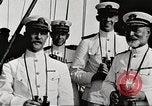
Chief of Naval Operation, Vice Admiral Edward W. Eberle at The Naval Operating Base, Hampton Roads, Virginia in 1925.
Vice Admiral Edward W. Eberle at Naval Operating Base, Hampton Roads in 1925. (The base was re-designated "U.S. Naval Station Norfolk," in 1945). Opening scene shows Admiral Eberle, Chief of Naval Operation, standing on deck of a ship with a captain, a Commander, and a Lieutenant Commander. They are pointing and peering through binoculars at objects (likely aircraft) passing overhead. Next, a Navy launch is seen entering a channel and moving toward the camera. It arrives at a dock is made secure by sailors. Vice Admiral Eberle then steps to the dock, followed by a Captain, a Commander, and several other naval officers, who line up on the dock They exchange salutes with the Admiral, who then ascends stairs followed by his retinue. The last scene is reconstituted and re-filmed. This time, naval staff officers are lined up beside the launch. They salute as Admiral Eberle steps from the launch, followed only by a staff Lieutenant Commander. The admiral then proceeds up steps, followed by officers on his staff. Another scene shows Admiral Eberle, standing on the dock with senior members of his staff behind him.

The USS Dyer and crew pose for photograph in 1919
The U.S. Destroyer, USS Dyer (DD-84) in the Dardanelles, Turkey, after World War 1. The entire ship's conpany is posed on deck for photographers. The officers are seated in front, on deck, with the non-commissioned officers standing behind and the remaining company of sailors occupying the upper structures of the ship. The ship's captain, U.S. Navy Commander Fred H. Poteet is seated front and center in the row of seated officers. The relaxed movements of all aboard suggest they are waiting for a formal still photograph to be taken. The next scene shows Commander Poteet standing with six of the ship's officers. The rest of the ship's company has left their earlier places and are not seen. Closeups of Commander Poteet and each of his staff officers.
CRITICALPAST.COM: About Us | Contact Us | FAQs - How to Order | License Agreement | My Account | My Lightboxes | Shopping Cart | Advanced Search | Featured Collections | Website Terms & Conditions | Privacy Policy ©2026 CriticalPast LLC.
License Agreement |
Terms & Conditions |
Privacy Policy
©2026 CriticalPast LLC.