


 Francais
 Deutsch
 Italiano

Refine Your Search
-Cebu,-Philippines stock footage and images
- Showing 43273 to 43278 of 58987 results more
 Hide
Color Sound

U.S. Naval officers in Europe and the United States at the end of World War I
A glimpse of two U.S. Navy Captains exiting a dark alley, somewhere in France right after World War 1. Scene shifts to U.S. Admiral William S. Benson, the first Chief of Naval Operations, posing with Vice Admiral William S.Sims, Commander of all U.S. Naval forces in Europe. Several French men watch from inside an alley in the background. The two admirals turn to enter the building in the background. Next, a U.S. Navy Captain is seen standing on deck of a ship alongside another officer. Two American Naval officers smile and converse at a waterfront, in the United States. One is dressed in work overalls.A workman sits behind them in a shack that has a hand-scrawled message on the door reading:""No Smoking Allowed in here." Complete change of scene shows a line of young U.S. Naval officers replete with swords, entering a large brick Georgian revival building by way of a stairway at a side door. It appears they are entering an auditorium. What looks like a 1918 Phaeton car is parked at the curb outside. The officers number in the dozens. Another change of scene shows closeup of a an unidentified, relatively young, clean shaven, U.S. Naval Rear Admiral, posing in front of a stone wall behind which the tops of several widely separated buildings are seen. He removes his hat.
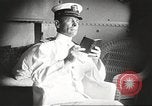
Scenes of Naval Operating Base, Hampton Roads, Virginia in 1925
Naval Operating Base, Hampton Roads, Virginia (renamed U.S. Naval Station Norfolk, in 1945 ). U.S. Navy Commander seated in a chair aboard a ship. A large group of civilian businessmen and officials pose on board a ship with several American Navy officers and one British Naval officer, for a photograph. Some of them stand and some are seated. One civilian stands in front of the group and poses with an American Navy Captain. Change of scene shows Admiral Way on the Navy Base, containing mansions and other structures from the 1907 Jamestown Exposition. It is a very windy day and several civilians are seen on a sidewalk and entering a large building on Admiral Way. Numerous Navy personnel in uniform are seen in the area, including a number of Naval officers entering that building and others heading there along a sidewalk. Residential mansions are seen in the vicinity along Admiral Way.
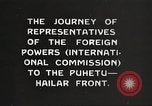
Sino-Soviet Conflict over Manchurian Chinese Eastern Railway. International Commission goes to Hailar Front in China.
Sino-Soviet conflict over the Manchurian Chinese Eastern Railway. Representatives of International Commission prepare to travel to the Hailar Front in China. They place the flags of United States, japan, and France on the locomomotive before passing through Chinese lines. Snow covers the ground. The representatives of America, France and Japan, which include women, leave the staff headquarters of General Hu Yu Kun, Commander-in-Chief of the Western Front.

Ruins and bomb damage at station Puhetu in Manchuria, China from Sino-Soviet conflict.
Bomb damage at station Puhetu in Manchuria, China. The club of employees and workmen of the Chinese Eastern Railway at station Puhetu which was damaged due to aircraft bombing on November 29, 1929. A dining car destroyed by a bomb from a Soviet airplane. The remains of an apartment of a railway employee at station Puhetu robbed by Chinese troops on November 29, 1929.

Private villages of Puhetu and Meintuhe in Manchuria, China after they were pillaged by Chinese troops on 29 November, 1929.
Private villages of Puhetu and Meintuhe in Manchuria, China after they had been pillaged by Chinese troops on 29 November, 1929. Heads of executed marauders hang from a stretched line. Snow covers the ground.

Japanese troops fight in rural areas south of the Yangtze River during the Second Sino-Japanese War.
A film justifying Japanese fight in mainland China during the Second Sino-Japanese War. Japanese soldiers on horseback and foot advance through a field. Japanese troops fire machine guns and artillery on a battlefield. They fire rifles from sandbagged positions. Aircraft in flight. Smoke rises from shell explosions on the field. Mountain in the background. Japanese fleet approaches a shore. Japanese troops fight in rural areas south of the Yangtze River.
CRITICALPAST.COM: About Us | Contact Us | FAQs - How to Order | License Agreement | My Account | My Lightboxes | Shopping Cart | Advanced Search | Featured Collections | Website Terms & Conditions | Privacy Policy ©2026 CriticalPast LLC.
License Agreement |
Terms & Conditions |
Privacy Policy
©2026 CriticalPast LLC.