


 Francais
 Deutsch
 Italiano

Refine Your Search
-Cebu,-Philippines stock footage and images
- Showing 43441 to 43446 of 58987 results more
 Hide
Color Sound
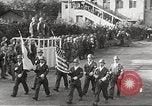
South Korean troops march along a road and U.S. Marines disembark from a ship in Korea during the Korean War.
South Korean troops in Korea during the Korean War. A group of soldiers marches along a road holding the U.S. flags. A band plays. South Korean troops march. U.S. Marines disembark from a ship and advance inland in Korea. The soldiers march along a rocky field. Men carry a boat across the rocky field.
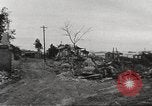
United States Marines distribute clothes to Korean civilians during the Korean War.
U.S. Marines in Korea during the Korean War. Debris and rubble in a coastal town of North Korea. Korean refugees evacuate. A U.S. soldier directs the refugees. U.S. Marines talk to Korean children and distribute clothes. A captured North Korean soldier smokes a cigarette with a U.S. soldier. U.S. Marines make Korean children wear new clothes.

Soviet Army armor and weapons during practice maneuvers
Soviet Army armor and weapons during maneuvers. An M-50 (57 mm) anti-aircraft gun tracks an aerial target. M-38 (122 mm) howitzers fire. Soviet Army gun crews and fire controllers in action. Mobile BM-21 rocket launchers fire rockets. BMP-1S (Armored Personnel Carriers) and T-55 tanks move along a field. ZSU-23s (23 mm self propelled anti-aircraft machine gun) move along the field. Helicopters in flight. T-62 and T-55 tanks parked. Crews leave the tanks and prepare vehicles for CBW (Chemical and Biological Weapons) attack. A T-55 tank moves on a dirt road and passes through CBW agents.

Chemical and biological agents used in chemical and biological warfare and their symptoms and effects in the United States.
A training film based on biological warfare sampling and chemical warfare detection in the United States. Smoke billows up from a nuclear explosion. View of ground based cameras recording blast wave or shock wave impact from atomic bomb as it hits various test buildings and structures, destroying the buildings, including open warehouse type buildings and a house. U.S. Army NBC (Nuclear, Biological, Chemical) disaster control surveyors arrive and use an instrument at a dockside. Shows how easily a chemical gas attack can be made. An aircraft flies low and releases a chemical gas. A small explosion on a field. A man seated in a boat sailing. A car moves along a road. Charts depict agents used in chemical and biological warfare and summarizes their symptoms and effects. A list of diseases as a result of chemical and biological warfare.
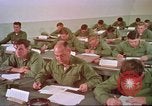
The contents of biological and chemical detection kit used by U.S. Army NBC (Nuclear, Biological, Chemical) survey team.
A training film based on biological warfare sampling and chemical warfare detection in the United States. U.S. Army NBC (Nuclear, Biological, Chemical) disaster control training given to a survey team. The team monitor puts on protective clothing including hood, boots and a gas mask. He carries a radio for communication. Working equipment of the survey team monitor shows a biological sampling kit and chemical detection kit. Contents of the chemical detection kit include test tubes, bags to contain samples, swabs, aspirator bob, sterilized water, nutrient solution and a notebook. Contents of the biological kit includes instruction cards, detection tubes, universal detector papers, plastic container packets, inspection report card and cards to report findings in the field. U.S. Army officers at a wall chart and a desk during an NBC survey. The survey includes the sighting of a low level airplane releasing a chemical gas, a low order explosion on a field and a gas released alongside a road. U.S. soldiers in a jeep come to a stop and talk into a radio. Information reaches an officer at the control center. It is further dispatched to the survey team.
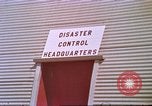
A U.S. Army NBC (Nuclear, Biological, Chemical) disaster control surveyor makes an investigation for chemical agents in the U.S.
A training film based on biological warfare sampling and chemical warfare detection in the United States. A sign reads 'Disaster Control Headquarters'. U.S. Army NBC (Nuclear, Biological, Chemical) disaster control surveyors in protective clothing get into jeeps. The jeeps pull away. A surveyor takes a look at a chemical detection paper placed on a pole, on which normal olive green coating turns red. The surveyor takes the detection paper to his jeep and takes another look. The NBC survey team monitor looks for clues on the side of a road. The monitor tests for chemical agents and inserts a chemically treated ticket in an aspirator bob. He checks if the color of the ticket changes when it comes in contact with a gas. He proceeds further and does other tests. Animation depicts a check on a detector ticket and blue-band and green-band tube tests for nerve agents. The survey team monitor uses a crayon and performs a test along a road. He reports to the disaster control center. The contaminated sector is roped and marked with signs reading 'gas'.
CRITICALPAST.COM: About Us | Contact Us | FAQs - How to Order | License Agreement | My Account | My Lightboxes | Shopping Cart | Advanced Search | Featured Collections | Website Terms & Conditions | Privacy Policy ©2026 CriticalPast LLC.
License Agreement |
Terms & Conditions |
Privacy Policy
©2026 CriticalPast LLC.