


 Francais
 Deutsch
 Italiano
Refine Your Search
-Cebu,-Philippines stock footage and images
- Showing 51757 to 51762 of 58885 results more
more Hide
Hide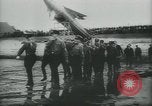
Montage of German rocketry scenes from 1930s through World War II. Nazi surrender. Atomic bomb. Japanese surrender
German rocket pioneer, Gerhard Zucker, attempting to develop postal rockets in the 1930s. Location is Wadden Sea off Cuxhaven, on April 9, 1933, where Zucker follows Nazi Sturmabteilung (also called SA or Stormtroopers) carrying the mail rocket across wet sands. The rocket is set up on a launch stand. Zucker and an assistant ignite the 8 side rockets and the mail rocket takes off. It noses up and loops over backwards, falling to the sand. German Stormtroopers lift up the damaged device. Next, is seen a later, more modern, rocket trial ending in failure. Two German engineers display a model similar to the pulse-jet-powered "buzz bomb" (V-1) employed by the Nazis in World War 2. A brief glimpse of similar American machine on sand flat, as narrator states German acknowledgement of knowledge gleaned from Dr. Robert Goddard's work. A German V-1 flying bomb (aka Doodle Bug) being launched in 1944, during World War 2. View of British houses of Parliament, London, England; an air raid shelter sign in City of Westminster. Londoners waiting out a raid in the shelter. Scenes of fire and destruction during German bombing of London, as narrator speaks about the more advanced German V-2 ballistic missiles employed later in the war. Londoners trudging through debris amongst bombed out buildings. Change of scene to U.S. infantry and armor advancing deep into Germany. Narrator refers to them overrunning rocket bases and other vital war-making facilities, near the end of the war. Glimpse of large number of German prisoners of war. Documents of military surrender being signed by Field Marshal Wilhelm Keitel, in Berlin, May 8, 1945. Closeup of Keitel. Scenes of American forces operating in Pacific theater. Aerial view of atomic bomb explosion. Japanese surrender ceremony on September 2, 1945, aboard the battleship USS Missouri. U.S. soldiers and other service personnel return home and greeting loved ones at end of war. Aerial view of Pentagon building and surrounding area in Arlington Virginia near Washington DC. U.S. troops boarding a ship in San Francisco, bound for war again, this time in Korea (1950).
U.S. soldiers loaded on tanks advance and fire artillery on a battlefield in the Korean Peninsula during the Korean War.
U.S. Army advances in the Korean Peninsula in the year 1952 during the Korean War. U.S. soldiers loaded on tanks advance towards battlefield. U.S. tanks firing artillery and troops firing heavy machine guns from truck. Army sergeant talks over a telephone. Tank burning. African American soldier using sighting device to plan artillery position and aim. Soldiers load shells and fire artillery. Numerous U.S. artillery firings from variety of weapons. A smoke column rises from explosions. U.S. officers observe from command post. A vast quantity of expended shell casings litter a field. Dead soldiers on the ground. North Korean Prisoners of war walk through streets.
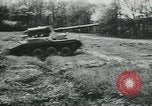
U.S. experimental tank undergoing field test. Army instructors explain new weapon systems. Captured German rockets.Soviet parade
A U.S. experimental tank undergoing field tests in the United States. Soldiers test weapons on a field. An officer demonstrates use of mortar. A flame thrower being fired. Instructors explaining new Army weapon systems. U.S. soldiers pull a captured German V-1 buzz bomb from a shed, for testing. A captured German V-2 rocket is rolled out for testing. The rocket is launched successfully from a launch pad. Soviet Leader Joeseph Stalin and Foreign Minister Minister Vyacheslav M. Molotov together, with two Soviet Generals,are seen on a reviewing balcony, above Lenin's tomb, as they watch a Military parade in Red Square, Moscow. Soldiers holding guns march through streets. Tanks and missiles mounted on flat cars move. Buildings in the background. Russian revolutionary Vladimir Llyich Lenin's poster on a wall.
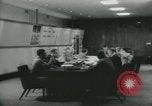
A General demonstrates a missile model, scientists make missile designs and manufacturing of missiles in the United States.
Development, testing and launching of missiles in the United States. Officers seated at a table during a conference. Dr. Werner von Braun rises from seat and explains something, using a model of a missile launch system. American engineers work on missile designs. Chemists work on propellants. Engineers undertake mechanical tests related to missiles. Fabrication and assembling missiles in an industrial plant. Welder doing multiple simultaneous welds on missile housing. U.S. Army 'Redstone' missile on launch pad. Soldiers operate switches and the missile is launched.
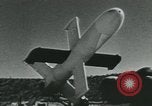
U.S. Army conducts a series of test firings of various battlefield missiles
U.S. Army firing battlefield missiles at test sites in the U.S.A. An Army Dart Missile is seen on launch stand as the film begins. It is fired and speeds low over the ground until it strikes a building target which it destroys in smoke filled explosion. Next, its later replacement, an SS-10 missile is seen on a simple launching pad in a field. It launches and flies swiftly to destroy a target tank. A Corporal missile (nuclear capable) is seen being trucked to a site at a test location. Soldier at a battlefield position remotely manipulates the Corporal missile, raising it upright to a launching position. View from a distance of the missile firing and disappearing in the clouds. View of a launching gantry, with a Sergeant missile standing upright in it. It fires and climbs out of sight.
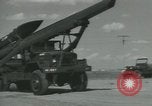
The U.S. Army conducts a number of test firings of tactical missiles for use in the field by Army troops
The U.S. Army test launches missiles in the United States. An Army Honest John missile is moved on its transporter launcher into position near some trees at an Army testing site. An army crew uses controls built into the launcher to raise it into a 45-degree launch angle. Closeup of soldier counting down to launch time and then signalling with his arm. Two hands are seen pushing down the plunger handle of an igniting control, and the missile launches in a burst of black smoke. It explodes in the distance raising a small mushroom cloud from its tactical nuclear warhead. A Little John, replacement is launched and disappears in distance. Next, an MGM-18 Lacrosse missile is seen on launch pad and then fired, leaving a trail of white smoke. View of it crashing onto the ground without any explosion.
CRITICALPAST.COM: About Us | Contact Us | FAQs - How to Order | License Agreement | My Account | My Lightboxes | Shopping Cart | Advanced Search | Featured Collections | Website Terms & Conditions | Privacy Policy ©2026 CriticalPast LLC.
License Agreement |
Terms & Conditions |
Privacy Policy
©2026 CriticalPast LLC.