


 Francais
 Deutsch
 Italiano
Refine Your Search
1941 hong kong stock footage and images
- Showing 109 to 114 of 1627 results more
more Hide
Hide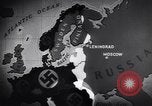
German Operation Barbarossa on the Eastern front in World War II
Animated map shows extent of German controlled areas in Europe following their conquest of the Balkans in World War 2. Norway is under their control and German forces threaten Leningrad and Moscow. A soviet defense line is shown on the map. The German attack is shown to come from 5 directions on June 22, 1941, with the launch of German Operation Barbarossa. A sky filled with German Heinkel He 111 bombers is shown. German Panzer III tanks with 75 mm guns. Army trucks carry German troops into battle. German soldiers on motor cycles and infantry advance under fire. Animated map shows principal German targets as Leningrad, Moscow, and Kiev. It then shows beginning a drive from the North to encircle Leningrad. Arrows show where German Marshal Fedor von Bock's forces drove 480 miles into Soviet territory. Slates identify cities being overrun by German invaders, including: Pskov, Novgorod, Brest-litovsk, Minsk,Mogilev, and Vitebsk. On July 17, 1941, a German tank is seen entering Smolensk, past the Dnieper River threatening Moscow, itself. To the south, German forces, under Marshal Gerd von Rundstedt, cut deep into the Ukraine. Newspapers world-wide consider the Soviet forces close to defeat. Slate shows communique from the German High Command stating: "The issue in the East is already settled. Smolensk is the last halt on the road to Moscow." German infantry marching. Scene shifts to heavy artillery being fired by Soviet forces in a snowy scene clearly later in the year. Animated map shows German forces very close to Moscow on October 15, 1941, forcing the Soviet Government and all foreign missions to move to Kuibyshev, 700 miles to the east. Adolf Hitler, in a speech on October 3, 1941, states that the enemy is broken and will never rise again. Animated map shows 500 thousand square miles of Soviet territory occupied by German forces. Views of fires burning in Russia. Damaged and abandoned Soviet industrial plants. A German guard atop a hill looks down on thousands of Soviet people in the occupied areas of Russia. Damaged and abandoned Soviet T-26 tanks. Glimpse of damaged Soviet aircraft and field artillery. Headline in New York World Telegram newspaper reads: "Berlin Admits Russ War May Last Winter." Another headline reads: "Red Army Holds Push On Moscow." Weary German soldiers traveling in horse-drawn wagons, pulling field artillery. Soviet and German war planners are seen at work. Slate quotes Adolf Hitler saying: "A single blow must destroy the enemy, without regard for losses... A gigantic all-destroying blow." German armor moving along a road. Animated map shows this technique in the German invasions of Poland, France, the Balkans, and Yugoslavia. In contrast, the Soviet planners are seen, as map illustrates how they intend to take advantage of the vast area of their land by holding lines of defense an falling back as necessary to keep engaging the invaders across interior of the Soviet Union. Soviet infantry are seen marching along a road. German troops riding atop their tanks. Soviet troops forcing German invaders into close combat in her cities. Soviet soldiers running in a city and firing heavy machine guns. Bomb damage and rubble inhibit German armor mobility in cities. Cities where this kind of Soviet resistance prevailed were: Rostov, Kharkov, Kiev, Kursk, Smolensk. German troops leaving a city with heavy black smoke rising in the background. More views of cities where Soviet troops are engaged German forces in House-to-house battles, including: Odessa, where the Old Opera Theater building is shown sandbagged and relatively undamaged. The Odessa NI tank, created from an STZ-3 agricultural tractor.
British Commandos raid Lofoten Islands, Spitsbergen Island, and Vaagso Island during World War II.
Pictures taken by military and news cameramen during World War II. Operation Claymore, March 1941: British Commandos raid Lofoten Islands in assault boats. They destroy a fish oil refinery off the coast of Norway. Soldiers and civilians on the docks. Burning refineries and buildings. Clouds of black smoke. 1941: British and Canadian troops on Spitsbergen Island. They destroy Soviet coal mines to prevent the Germans from occupying them. Black smoke clouds due to the explosions. Operation Archery on Vaagso Island, 1941: British Commandos raid the Island. Soldiers walk in the snow. Nazi prisoners surrender and marched by British soldiers. Battle ensues on the Island. Soldiers walk past a fence. Burning buildings in the background.
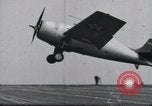
F4F aircraft crash on aircraft carrier, USS Wasp (CV-7) prior to U.S. entry into World War II
Crash of a Grumman F4F-3 aircraft from U.S. Navy Squadron VF-42, on the carrier, USS Wasp, early in 1941. In a slow motion sequence, a U.S. Navy F4F-3, with F-42-17 painted on its side (BuNo 2537) is seen rounded out too high for landing, above all arresting cables, and drifting into the carrier's island, where it impacts, losing its right wing, and flipping over to crash inverted on the flight deck. Sailors stand in the background. After the aircraft settles, a sailor runs across the deck to render aid. (Note: Navy Squadrons VF-42 and VF-71, assigned to the USS Wasp, received their F4F-3 Wildcats in January and February of 1941 under Bureau of Aeronautics contract C-68219, order number 48-020. These aircraft were painted overall aluminum with VF-42 having willow green tails and VF-71 having black tails. Later in 1941 the aircraft were repainted overall light gray.)
Attack on Pearl Harbor by Japanese, and President Roosevelt asks for war declaration on Japan in 'date of infamy' speech.
United States Government film entitled "The World At War" dealing with World War 2. Film opens showing Japanese warplanes in formation above a Japanese military installation. Slate reads: "Pearl Harbor December 7, 1941. An airfield is seen filled with parked U.S. Army Air Forces B-17 bombers. Two Boeing XB-17 (Model 299) bombers are parked next to each other on the ramp. Derricks and ships are shown at the Pearl Harbor naval base. A formation of Japanese Mitsubishi G3M bombers is seen in flight. They are seen overhead as bombs explode on the U.S. Navy Air Station at Ford Island destroying hangars and aircraft. Next, is shown the famous image of the USS Arizona burning, listing, and sinking, after being bombed. Film continues, panning over post-air raid views of destruction. On December 8, 1941, U.S. President Franklin D. Roosevelt, addresses the Congress, delivering his declaration of war message. He calls December 7, 1941 "a date which will live in infamy." Roosevelt recounts that the United States was at peace with japan and in conversation with its government and Emperor, in the interest of maintaining peace.in the Pacific. even at the time of the attack. Japanese ambassador and his colleagues seen visiting State Department offices to meet with U.S. Secretary of State prior and even during the initial attack operations by Japan.Roosevelt recounts that the United States was still in conversation with Japan even at the time of the attack. Japanese ambassador and his colleagues seen visiting State Department offices to meet with U.S. Secretary of State prior and even during the initial attack operations by Japan. Photographers take pictures of the visiting Japanese delegation. President Roosevelt asks Congress to affirm that a state of War exists between the United States and the Japanese Empire.
Film 'Why We Fight' episode "Prelude to War" depicts battle scenes in various countries during World War II.
Series 'Why We Fight' episode "Prelude to War" depicts the battles during World War II. United States soldiers parade on street lead by a band. Japanese bombing attack on Pearl Harbor, Hawaii, on December 7, 1941. The London Blitz with buildings destroyed and burning. The Eiffel Tower in Paris with Nazi flag flying atop it. German troops marching into Paris, through the Arc de Triomphe. Japanese warplanes bombing shanghai, China, in 1937. Chinese residents running for shelter. Glimpse of German "Schwerer Gustav" 80 cmrailway gun firing during German offensive against Soviet Union in 1941. German forces entering Czechoslovakia in 1938. German mounted troops entering France in 1940. Heavy guns firing. German ships en route to Norway 1940. German Ju-52 aircraft flying low over trees. Montage showing rapid succession of war scenes, including heavy guns firing, smoke rising, explosions, an aircraft shot down and crashing straight down, German armor on the move, German Ju-52 aircraft dropping paratroopers into Holland and one flying over Athens, Greece, with Mount Lykabettus in the background. More of the same with Narrator mentioning Belgium, Albania, Yugoslavia, and Russia (where citizens are seen digging anti-tank trenches and fortifications). Cavalry charging across a field. A German tank rolling forward. A German Dornier Do-17 bomber taking off, and bombs falling.
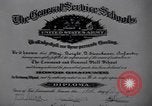
The military career of General Dwight D Eisenhower from 1926 to World War II
Film starts showing Dwight D. Eisenhower's diploma as honor graduate of the Army Command and Staff School, in 1926. Image of Major Eisenhower (in civilian clothes) Narrator says he was assigned to France, to prepare a guide book on American battlefields in Europe. Image of Eisenhower as a member of General Douglas MacArthur's staff in the Philippines, where MacArthur was Commander-in-Chief of the Philippine army. Glimpse of headquarters building there. MacArthur in his office helping the Commonwealth of Philippines work out a plan for its military defense. Image of Lieutenant Colonel Eisenhower in 1939, serving as Executive Officer of the 15th Regiment, at Fort Lewis, Washington, View of the Regiment's Headquarters building. Scene shifts to 1940, showing German forces invading Holland and Belgium. German tanks are seen in action. German Junkers 87 Stuka dive bombers and Heinkel 111 bombers drop bombs. After passing of the Selective Service draft act, President Franklin D. Roosevelt is seen at a public ceremony on October 29, 1940, where Secretary of War Henry L. Stimson drew from a bowl the capsule containing the first draft number of World War 2. Views of Lt. Col. Eisenhower as Chief of Staff of the Army 3rd Division and later as Chief of Staff of the Ninth Corps. Next, he is seen as Chief of Staff to General Walter Kreuger, who in 1941 led the Third Army in the most realistic maneuvers held by American troops (The Louisiana maneuvers). Views of American troops engaged in those maneuvers. Image of Eisenhower as a Brigadier General. Views of the Pearl Harbor bombing during Japanese attack on December 7, 1941.