


 Francais
 Deutsch
 Italiano

Refine Your Search
1941 hong kong stock footage and images
- Showing 115 to 120 of 1637 results more
 Hide
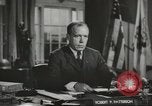
American Undersecretary of War speaks to difficulties facing Allies in confronting Germany and Japan in World War II
Undersecretary of War, Robert Porter Patterson, Sr. speaks about a report from the General staff outlining the needs for combating Germany and Japan in World War 2. He cites Operation Husky, the invasion of Sicily, as an example of what will be needed. He continues to narrate in the background as an animated map appears showing the buildup of supplies and Allied forces in North Africa; Allied air forces flying 60 thousand sorties over Sicily and, the direct amphibious assault using 3,200 vessels. Map also depicts opposing forces of 12 (“unwilling”) Italian Divisions and 3-1/2 German Divisions. View of Allied troops carrying some of their 31 thousand casualties on stretchers from field ambulances. Allied medics attending to the wounded. Some are seen lying on stretchers in a row on the ground near a wall. Interior of a field hospital where surgeons and other medical personnel treat the wounded. Animated map shifts to Europe with Germany at its center, showing , in contrast to Sicily that was only an “outpost,”, the heavily fortified perimeter of Axis controlled areas; the axis industrial might; and the disposition of 300 German Divisions (mostly on the Eastern front) defending the region. Next, the map illustrates Japan’s defended regions in the Pacific Image returns to Undersecretary Patterson i n his office, speaking of the Allied offensives planned for next year (1944), and emphasizing their challenge and difficulty. Scene shifts to General Jonathan Wainwright and his garrison at Corregidor, in the Philippines, surrendering to Japanese forces in 1941. Japanese military camera pans over the Americans being taken prisoner. Other Americans and Filipinos are seen being marched together under guard. Scene shifts to classic views of the Japanese attack on Pearl Harbor, Hawaii, on December 7, 1941. View of Japanese soldiers executing two Chinese civilians in 1937. Dangling bodies of persons hung by Nazis during Operation Barbarossa in Russia, in 1941 A Russian soldier comforts a little girl as he escorts her across a snowy landscape. Time bomb left by German forces retreating from Naples, Italy, in 1943, blows up a Post office building . Views of damage to building and bodies of victims. American Military Police assisting a victim. American soldiers carrying an injured civilian on a litter. Scene shifts to British Foreign Minister, Anthony Eden, Soviet Foreign Minister, Vyacheslav Molotov, and U.S. Secretary of State, Cordell Hull, entering a hall in the Spiridonovka Palace, during the 1943 Moscow Conference in Russia. Close-up of the American, Soviet, and British flags on a table. View of many delegates seated around the table. Close-up of Molotov, Eden, and Hull signing conference document.
British Prime Minister Winston Churchill in many meetings before and after America's entry into World War II
Opening slate reads: "Quebec Conference August 1943." The English battleship, Prince of Wales, is seen in fog off the Coast of Newfoundland, in August 1941. View of sailor on fore-deck of the British ship. View inside engine room of the ship where sailor manipulates her power. Closeup of engine crankshaft stopping as she drops anchor in Placentia Bay. View of Prime Minister Winston Churchill, greeting U.S. President Franklin D. Roosevelt aboard the Prince of Wales. He proffers a letter to the President, from the King of England. View of Roosevelt and Churchill seated on deck with their respective military leaders standing behind them. Admiral Ernest King, U.S. Chief of Naval Operations converses with U.S. Army Chief of Staff, George Marshall, as they stand behind Churchill and Roosevelt. Wider camera view shows the larger military entourage accompanying the Prime Minister and the President. Glimpse of prisoners and enslaved workers taken by Nazi Germans in Europe. Glimpse of bombs falling from an airplane. Classic film views of the Japanese attack on Pearl Harbor in December 7, 1941. Bombs exploding along "Battleship Row." Heavy smoke rising from the bombed ships. The USS Arizona tilted heavily and burning. Camera pans along the path of destruction, as the voice of President Roosevelt is heard in the background, asking the Congress to declare that the Japanese attack created a state of War between the United States and the Japanese Empire. View of President Roosevelt speaking to the U.S. Congress. Seated behind him are Vice-President Henry Wallace and Speaker of the House, Sam Rayburn. Glimpse of Congress members applauding. Change of scene shows President Roosevelt and Winston Churchill meeting in Washington, DC, in December of 1941, during World War 2. Views of war preparations in the United States, including the building of new war production plants and facilities. A large steel ingot being forged into an artillery gun barrel. Machinist at work turning a gun barrel on a lathe in a munitions factory. Views of manufacturing plants in operation and steel being made. A railroad train carrying new Army trucks. Another meeting of Churchill and Roosevelt in Washington, D.C. June, 1942. Standing behind them is President Roosevelt's special assistant, Harry Hopkins, a British naval officer, and an American navy Captain. American soldiers boarding a troop ship, and closeups of them as they enter the ship, looking out of portholes, and waving from the ship's deck. Glimpse of Washington Monument and its image in the reflecting pool in Washington DC. Closeup of a book entitled, "Time Table for Invasion." General George Marshall with several of his generals doing preliminary planning. Series of scenes involving senior military officers engaged in war planning. A convoy of warships is seen at sea during the Operation Torch Allied invasion of French North Africa during 8–16 November, 1942. Views of Allied Navy ship guns firing. Allied troops riding in landing craft, and advancing from beached craft on shore of Algiers. Aerial view of a flight of Douglas Dauntless bombers in formation. "Bombs away" view from Allied airplane dropping bombs. Allied troops firing camouflaged antiaircraft guns from sandy positions near shore. Enemy shells or bombs exploding nearby. Two U.S. Army soldiers holding a document in French entitled, "Message from the President of the United States.
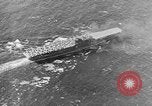
Air Operations aboard the Aircraft carrier USS Enterprise (CV-6) immediately prior to the entry of the United States into World War II
Aerial view looking down at the U.S. Aircraft Carrier USS Enterprise (CV-6) underway below, just before America's entry into World War 2. Her deck is filled with aircraft. Camera view from on the flight deck shows it filled with Grumman F4F Wildcat planes. Pilots are scrambling to some of the planes. Two deck crew sit at the wheels of an 4F4 (as if ready to pull chocks). The engine starts and runs. Several F4Fs have engines running and begin to taxi. One is given clearance to take off and commences its roll with considerable wing flap extension (short takeoff technique). The aircraft takes off and banks right as it clears the carrier deck. Next, two F4Fs are seen in flight above some clouds. Next, a large formation is seen, and individual planes bank and dive from it. Back on the carrier deck, more F4Fs have their engines running. A gunner is seen setting his machine gun into the rear cockpit position of a plane, the narrator calls a versatile scout-bomber. Closeup of the aircraft (a Douglas SBD Dauntless) as engine starts, deck crew pull chocks, and the pilot gets clearance to take off. Next, camera shoots from rear cockpit, with the plane's tail in center of the images. Views cover the complete takeoff and flight away from the carrier. Next an SBD is seen in flight with both front and rear cockpits open. A flight of three SBDs in formation. Closeup of two SBDs in formation. Extreme closeup of SBD with pilot and gunner both clearly visible in open cockpits. The gunner is maneuvering his machine gun. Two SBDs demonstrate rapid descents as in dive bombing. Back on the carrier, an SBD, with wings folded, is maneuvered by sailors, on the hangar deck. Next sailors accompany a Douglas TBD Devastator torpedo bomber on an elevator up to the flight deck. With its wings still folded, they maneuver it into position on the flight deck. An armorer, using a dolly, rolls a bomb to a TBD where two others secure it in a bomb rack under the center of the aircraft. Other armorers distribute machine guns and ammunition to gunners in cockpits of aircraft on the deck. Several TBDs begin taking off. View from hangar deck, of one airborne and departing. A formation of 9 TBDs in flight. (Note: This clip was probably shot in November 1941, based on the aircraft markings in use at the time. Life magazine did a series of stills, and these clips look like they came from that photo session. Enterprise wears Measure 1 camouflage, which she wore from mid-1941 to a month or two into 1942. The flying units aboard are all designated "6" the same as their carrier, CV-6. Thus they are VF-6; VB-6; VT-6, etc.)
Film 'Why We Fight' episode "Prelude to War" depicts battle scenes in various countries during World War II.
Series 'Why We Fight' episode "Prelude to War" depicts the battles during World War II. United States soldiers parade on street lead by a band. Japanese bombing attack on Pearl Harbor, Hawaii, on December 7, 1941. The London Blitz with buildings destroyed and burning. The Eiffel Tower in Paris with Nazi flag flying atop it. German troops marching into Paris, through the Arc de Triomphe. Japanese warplanes bombing shanghai, China, in 1937. Chinese residents running for shelter. Glimpse of German "Schwerer Gustav" 80 cmrailway gun firing during German offensive against Soviet Union in 1941. German forces entering Czechoslovakia in 1938. German mounted troops entering France in 1940. Heavy guns firing. German ships en route to Norway 1940. German Ju-52 aircraft flying low over trees. Montage showing rapid succession of war scenes, including heavy guns firing, smoke rising, explosions, an aircraft shot down and crashing straight down, German armor on the move, German Ju-52 aircraft dropping paratroopers into Holland and one flying over Athens, Greece, with Mount Lykabettus in the background. More of the same with Narrator mentioning Belgium, Albania, Yugoslavia, and Russia (where citizens are seen digging anti-tank trenches and fortifications). Cavalry charging across a field. A German tank rolling forward. A German Dornier Do-17 bomber taking off, and bombs falling.
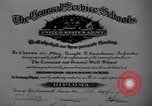
The military career of General Dwight D Eisenhower from 1926 to World War II
Film starts showing Dwight D. Eisenhower's diploma as honor graduate of the Army Command and Staff School, in 1926. Image of Major Eisenhower (in civilian clothes) Narrator says he was assigned to France, to prepare a guide book on American battlefields in Europe. Image of Eisenhower as a member of General Douglas MacArthur's staff in the Philippines, where MacArthur was Commander-in-Chief of the Philippine army. Glimpse of headquarters building there. MacArthur in his office helping the Commonwealth of Philippines work out a plan for its military defense. Image of Lieutenant Colonel Eisenhower in 1939, serving as Executive Officer of the 15th Regiment, at Fort Lewis, Washington, View of the Regiment's Headquarters building. Scene shifts to 1940, showing German forces invading Holland and Belgium. German tanks are seen in action. German Junkers 87 Stuka dive bombers and Heinkel 111 bombers drop bombs. After passing of the Selective Service draft act, President Franklin D. Roosevelt is seen at a public ceremony on October 29, 1940, where Secretary of War Henry L. Stimson drew from a bowl the capsule containing the first draft number of World War 2. Views of Lt. Col. Eisenhower as Chief of Staff of the Army 3rd Division and later as Chief of Staff of the Ninth Corps. Next, he is seen as Chief of Staff to General Walter Kreuger, who in 1941 led the Third Army in the most realistic maneuvers held by American troops (The Louisiana maneuvers). Views of American troops engaged in those maneuvers. Image of Eisenhower as a Brigadier General. Views of the Pearl Harbor bombing during Japanese attack on December 7, 1941.
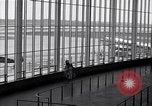
Eastern Airlines DC-3 Aircraft at newly built Washington National Airport
Interior view of people strolling at main terminal building, Washington National Airport, during its first few months of operation in 1941 (built from 1940-1941, during the Great Depression). A man can also be seen on the outdoor observation deck. A plane taxis. Numerous DC-3 passenger airplane parked at airport, some being refueled. View from tarmac shows visitors lined up on outdoor observation deck. Planes go to hangar. Passengers deplane from an Eastern Airlines DC-3 with "The Great Silver Fleet" painted on its fuselage. Cars parked on circular drive in front of the terminal. Officials at Air Traffic Control tower talk on phones. View from inside the terminal showing observation deck and Eastern Airlines DC-3 outside.