


 Francais
 Deutsch
 Italiano
Refine Your Search
1941 hong kong stock footage and images
- Showing 169 to 174 of 1627 results more
more Hide
Hide
Japanese operations to destroy the U.S. Pacific Fleet in Pearl Harbor, Hawaii and mission on Philippines, during World War II.
Dai Toa News of Japan briefs about Nippon's operations in Pearl Harbor, Hawaii and in Philippines, during World War II. Animated map shows Japanese planes on a mission to Pearl Harbor. Japanese carriers and warships in Pacific Ocean. Commander aboard a carrier and addresses pilots. Number of bomber aircraft take off from deck of aircraft carrier one after the other. U.S. Pacific Fleet annihilated by bombers of Nippon during attack on Pearl Harbor on December 7, 1941. View of U.S. Navy ships bombed at Pearl Harbor. American War Losses. Fleet of Japanese warships in ocean.
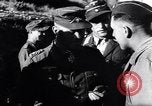
Italian troops occupy Samos Island in Greece during World War 2
German General Friedrich-Wilhelm Müller visits with Italian troops of the 6th Infantry Division CUNEO, after they occupy the Greek Island of Samos, without any resistance, in May 1941. He and his staff members drink local wine with the Italians. Italian soldiers eating bananas at the port, and picking oranges from a local tree. Remainder of film shows 8 thousand surrended defenders taken as prisoners of war, marching in a long line. Next, they are seen crammed on the deck of a Greek ship and then, later debarking. They march in loose formation.
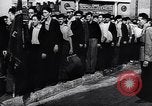
Soviets mobilize for war on the home front during the German invasion of Russia in World War II
A huge number of local men, volunteering to join the Red Army, are seen parading (in civilian clothes) through a Soviet town, in 1941, during time of the World War 2 German invasion of the Soviet Union, known as Operation Barbarossa. Men lined up at an outdoor recruiting station where Army officers and a clerk are seated at a table. View of a man signing his name and date of birth a sheet of paper. Next, he shakes hands with all the recruiters. Next, recruits are seen walking in loose formation. They are still in civilian clothes, but carry sacks with their first government- issued belongings. Change of scene shows workers in a factory and miners working in a coal mine. they use a machine driven conveyor to move chunks of coal from the mine. Scientists at work. The man at extreme right is Soviet Nobel Laureate Physicist, Pyotr Leonidovich Kapitsa (Peter Kapitza). He heads the Department of Oxygen Industry. attached to the USSR Council of Ministers. Oxygen bubbles in a scientific glass device. Several views of fiery molten steel flowing in a steel mill. Older retired man back at work in a machine shop, operating a milling machine, to help the war effort. A man using calipers as he instructs a woman in a machine shop. Closeups of a young women working on various machines in the shop. One at a lathe, stops to inspect a piece of turned steel she is making. A man hot forging a part on a drop forge. A woman monitoring machinery controlling the forge. Women from rural areas in the Ukraine, attend a class to learn about tractors. Instructor using a large illustration to explain parts of a tractor. One of the women manipulates a tractor part. Another adjusts a carburetor. One closes the side hood of a tractor. One woman gets behind the wheel of a tractor, for the first time.Her instructor manipulates its gears as they drive it forward. A line of school children walks in a village with their teachers. Next, the girls are seen cultivating crops on a truck farm, and the boys are seen working in a wheat field. Three boys are assigned "Sentry Duty" and climb wooden towers to maintain lookout for invading German paratroops or other forces. An older man performing similar duties on a rooftop in a village. Another man on the lookout atop a wooden tower. An old man with a rifle on the lookout. Another man holding a rifle in a wheat field.
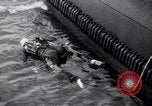
Aftermath of Japanese attack on Pearl Harbor in World War 2; Recovery of Japanese B5N2 torpedo bomber and one Japanese crewman
Aftermath of Japanese attack on Pearl Harbor in Hawaii during World War II. Approximately one week after the December 7, 1941 attack, this is a view of a Japanese crewmember from his torpedo bomber floating face down in the water. He was the radioman (gunner) on the aircraft which was downed in Southeast Loch by antiaircraft fire: Nito Hiko Heiso (Petty Officer Second Class) Yoshiharu Machimoto. Prior to this opening image, a U.S. diver had cut the harness from Machimoto in the still submerged aircraft, and his body had risen to the surface, losing his boots in the process. The mangled wreckage of the recovered Japanese torpedo bomber, a Nakajima B5N2 "Kate" (AII-356 serial 3178) from the Japanese aircraft carrier Kaga, is seen hoisted on a crane, dangling in the air.
Igor Sikorsky piloting VS-300 helicopter sets a new record for suspension flight; scenes of various experimental aircraft.
Shows Vought-Sikorsky VS-300 helicopter taking off vertically and in flight. Clip includes early helicopters, early Ornithopters, and Igor Sikorsky piloting VS-300 on May 6, 1941, setting a new record of one hour and thirty two minutes for suspension flight. Scene after Sikorsky helicopter flight shows some experimental aircraft designs, early in the history of flight, including a helicopter design in the 1920s that would not rise, a windmill type airplane, and an airplane design with concentric circle wings. Next is seen an aircraft ornithopter with flapping wings. Scene returns to more shots of Sikorsky in his record breaking helicopter flight.

Pre World War 2, Major General Jonathan Wainwright and U.S. and Filipino troops in training at Clark Field
U.S. Army mechanics and pilots sleeping in hangar at Clark Field, Pampanga, Philippines in 1941 (before World War 2). P-26 and B-10 aircraft on field taking off and in flight. Local native civilians admire the aircraft. Army officer fixing a notice on notice board outside barracks and Filipino soldiers standing in formation. Major General Jonathan Wainwright talking to other officer nears a river. Men tying military equipment with cloth piece and bamboo. View of them floating equipment across body of water. Water buffalo (carabao) and Philippine troops doing river fording exercises. U.S. aircraft flying overhead and Filipino troops perform live fire practice drills, preparing for future warfare.