


 Francais
 Deutsch
 Italiano
Refine Your Search
1941 hong kong stock footage and images
- Showing 175 to 180 of 1627 results more
more Hide
Hide
P-40 aircraft peeling off, diving, and performing aerobatics in flight over Hawaii.
Views of 18 U.S. Army Curtiss-Wright P-40B aircraft (sometimes termed Tomahawk or Warhawk, though Warhawk properly applies to later variants than these) from Pursuit Squadrons at Wheeler Field, in formation flight over Hawaii. They are filmed from an airborne B-17D Flying Fortress. The P-40s peel off, one at a time. One P-40 performs aerobatics, executing two rapid rolls for the camera. During those rolls it is evident that, in addition to fuselage insignia, the aircraft displays national insignia only on its lower right and its upper left wings, in accordance with a scheme adopted in February, 1941. Footage is from before America's entry into World War 2.

Soviet Union reacts to German attack as Stalin calls for national effort to defend against Nazi aggression in World War II.
Film begins with picture of famous Soviet statue of Worker and Kolkhoz Woman holding hammer and sickle, respectively, over their heads. The title,"View of the World Soviet," is superimposed. A slate gives a title in English: "Stalin Says the Word." Soviet civilians are seen lined up buying newspapers containing Stalin's call for all-out war following the German attack against the Soviet Union in Operation Barbarossa on June 22, 1941, in World War 2. They read newspapers in the streets. Picture of Joseph Stalin can be seen in newspaper held by one man as others look on with him. People reading copies of the newspaper posted at an outdoor display with Pravda (Russian: “Truth”) written above it. Civilians reading outdoors in various places. A slate appears reading: "Wrath of the People." Camera pans across a mass of workers gathered at the Stalingrad Tractor plant. Local leaders address the crowd passionately about the need for a national defense against German aggression.
Farmers in the Soviet Republics harvest crops to aid the USSR in World War II
At start of this film, grains and other crops are shown waving in the breeze in the former Autonomous Volga German Soviet Republic (disestablished in 1941,after German invasion of the USSR). Volga German farmers harvest grasses, using tractors and harvesting wheels. They leave mounds of hay on a field (Narrator says this is for the Red Army cavalry.) Farmers gather the hay and use pitch forks to load it into horse-drawn wagons. Closeups of them loading the hay into a wagons. A line of wagons loaded with hay moves on a path through the field. Scene shifts to Azerbaijan, where ripened wheat is seen in a field. Closeup of a man operating a harvesting combine. He and helpers move about on the moving combine. Closeup of him catching wheat grains in his hand. He wears several medals pinned to his jacket. View from above of wheat grain discharging into a truck moving in parallel with the combine. In another Soviet Republic, women are seen cultivating a huge field of sugar beets. The use metal cultivator tools and some bend down and manually weed plants. A man drives a tractor pulling a wide cultivator behind it. Closeup of the moving cultivator. Wide view of the field with many women workers (all in white skirts) cultivating the crop.

Various views of Soviet soldiers preparing for combat during a lull during battle against German invasion in World War II
Opening of film shows image of famous statue being projected on a screen. The statue depicts a Soviet worker and a collective farm woman, respectively, raising a hammer and sickle high above their heads. The statue is a stainless steel art work created by Vera Mukhinafor the 1937 World's Fair in Paris, France. (It was later moved to Moscow, Russia.) Next a field and forest is shown on the Western front of the Soviet Union (Eastern Front of World War 2, in Europe). Soviet soldiers are preparing for combat during a temporary lull in their defense against German forces in their Operation Barbarossa offensive ,begun in June, 1941. Soviet soldiers place branches and foliage upon a BT tank as camouflage. Others assemble loose ammunition rounds into machine gun belts. Soldiers camouflaging an artillery field piece with foliage. Soviet soldiers refueling a tank. Soldiers moving through wooded area past another camouflaged gun. Several Soviet soldiers at a shelter in the woods, placing ammunition rounds in a clip. A printer producing a daily newspaper for soldiers. A soviet soldier picks one up to read. Closeup of the newspaper. Soviet munitions handlers inserting fuses into noses of artillery shells. A T-34 tank sitting in foliage. Soldiers looking at charts as they sit in the woods. A Soviet soldier running (possibly to deliver a dispatch).

Soviet citizens are called upon to support the war during German invasion in World War II
Soviet propaganda newsreel of July, 1941 shows huge numbers of Soviet citizens being called upon to support the war effort during the German invasion (Operation Barbarossa) in World War 2. Several men in similar clothes stand on stage, as one speaks from a podium. The banner behind them mentions the homeland's need for support. A large portrait of Joseph Stalin forms a backdrop to the stage. A large crowd of mostly men listens intently. (A woman with several children is also seen in the crowd.) A different speaker is now seen at the podium. More views of the crowd filling a large open space (Square). Another view of the speaker. Now a third speaker speaks from the podium and most of those in the crowd respond to him by raising their hands. Next, a gathering of workers is seen at a construction site where a platform has been set up holding several men. A portrait of Joseph Stalin is carried by someone in the crowd. Closeup of some workers listening to a speaker. Closeup of the men on the platform and one speaking to the workers. Closeup of a woman in the audience. Closeup of the speaker on the platform. Camera pans over some of the crowd, that includes women. A train of railroad box cars and an open bulk carrier moving past the camera. Industrial plant in background.
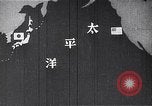
Japanese footage of preparations and attack on Pearl Harbor in Hawaii
Japanese edited film footage chronicling the Japanese approach and attack on Pearl Harbor in December of 1941. Contains Japanese slates and narration. An arrow points from Japan to Hawaii and a dotted line going to United States on a map. Japanese officers on bridge of aircraft carrier. Two Japanese aircraft carrier ships, the Kaga and the Zuikaku underway in heavy seas. Flight quarters being held on carrier. Crew gets ready for attack on Pearl harbor. Japanese pilots being briefed on the mission while standing on the deck of Japanese aircraft carrier (possibly the flagship carrier, Akagi). Japanese pilots on flight deck scatter towards their planes. Single engined planes on flight deck. Japanese planes take off in formation. Map of Hawaiian Islands. Japanese bombers in flight. Bombing on Pearl Harbor. Fire and smoke seen due to explosions. Pictures of Japanese Navy officers who attacked Pearl Harbor in suicide submarines. (World War II period).