


 Francais
 Deutsch
 Italiano
Refine Your Search
1941 hong kong stock footage and images
- Showing 259 to 264 of 1627 results more
more Hide
Hide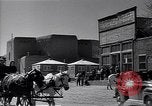
Glimpse of Life in old Spanish settlement of Abiquiu, New Mexico
A couple riding on a horse-drawn wooden wagon on street of the old Spanish settlement of Abiquiu, New Mexico. An old wooden building, housing a country store, seen across from them, and an adobe-stye building down the street. Two small log-style dwellings sit in between. Horses are tied to railings. A 1941 Ford convertible automobile sits in front of the old wooden building, where a number of people, including a woman with a small baby, sit relaxing in the sun. Artist Georgia O'Keeffe steps from the car and enters a store in the building. A Native American Indian woman stands, conversing with an old woman, dressed all in black,like a Spanish widow. Men outside an adobe building decorated with murals and a sign reading: "SL PA BAR." Closeups of the men sitting on benches with legs of cowboy in mural behind. Closeups of mural showing dancing girls. Scene shifts back closeup of the old woman in black. A woman looking out the window of her home. A woman rinsing a batch of some kind of material and placing it into another container. Another woman all in black, steps from her house to feed her two dogs on her doorstep. She poses for a closeup. Views of local flora.
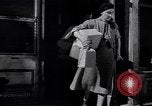
Georgia O'Keeffe, and the environs of the old Spanish settlement, where she lives, in Abiquiu, New Mexico
Artist Georgia O'Keefe carries purchases to her car (a 1941 Ford convertible) as she leaves general store in Abiquiu, New Mexico. The shop keeper carries some of her items. Closeup of O'Keefe in her car as she drives away. Scene shifts to O'Keefe standing at the the Plaza Blanca cliffs, that she calls the "white place." Closeup of Ms.O'Keefe. Camera pans unusual rock formations. View of O'keefe at campfire. Her car parked nearby, and white cliffs in background. An O'keefe painting of flower with white mountains in background. Another of her paintings, and figurines representing Navajo priests. Scene shifts to Navajo dancers in costume as birds. Others in traditional clothing with elaborate headresses, chant and play drums. Scene shifts to Navajo children playing marbles in sand, and back again to dancers and drummers. The adobe St. Thomas Church is seen in background. Navajo Native American Indian family inside their home, where woman attends baby in a swing. Closeup of the baby. Panning views of dramatic landscapes. Herd of sheep grazing. Film concludes with views of mountains, sky, deserts, and canyons.
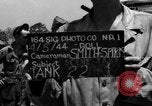
United States crew poses in front of a captured Japanese tank after running it through test exercises at a camp in India
Captured 1941 model Japanese light tank behind a U.S. Army tank crew who had just run the tank through various tests. The crew smiles for the camera. Close-up views of some parts of the tank, showing points of vulnerability and various measurements. Several slits marked in chalk with number "3/16 inches" are seen close-up.

Various U.S. tanks used in World War 2, from film titled 'Tank Mission, World War II'
From a film titled 'Tank Mission World War II'. Eiffel tower in Paris and scenes on quiet streets of Paris during German occupation. German troops in Paris in 1941. United States tanks maneuver during planning phases and drills for invasion of Europe. Tank fires flamethrower. Various U.S. tanks fitted with different attachment for bulldozing practice demolishing beach blockades and erecting landing areas. Infantry troops practice maneuvering behind tanks. German bunkers and fortifications on the French coast. United States infantry and tank units land at Normandy on D-Day and the days following. U.S. troops fire. Smoke rises due to explosion. Many hedges in the way. Tanks fitted with hedgerow cutters (the idea of a Sergeant) for cutting through the hedges. Tank fitted with hedge row cutter cuts through a hedge.
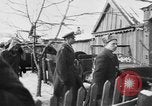
German 6th Army surrenders to Soviet forces at battle of Stalingrad in World War II
German Field Marshal Friedrich Paulus, enters a wooden building near Stalingrad where he surrenders the German 6th Army. He, and Arthur Schmidt, General-lieutenant, Chief of the 6th Army Staff; take seats,surrounded by Soviet Army officers. Scene shifts to the twenty two Divisions (300 thousand men) of the 6th Army trudging through the snow as they surrender. Most of them are seen in open fields near Stalingrad, Russia. Closeups of some make their way along a street in the city. Many wear makeshift shoes and other contrived clothing. They are clearly suffering from their lack of any cold weather equipment. Aerial view of a long line of surrendering German soldiers making their way on snow-covered street in Leningrad. Closeups of some of the German soldiers. One soldier walking slowly, alone, across a stretch of snow. He wears woven homemade coverings over his feet.He heads, alone, toward an open stretch of barren snowy land. Camera focuses on ice strewn Volga River. A dead German soldier lies on its bank. View of Russian countryside, the following Spring. An animated map depicts the extent of the Soviet advance in the previous winter with the occupation of 185 thousand square miles of territory (more than previously occupied by the German forces). Film shows weapons captured during the 6th Army surrender, including German aircraft, tanks, heavy artillery guns, light machine guns, rifles, artillery shells and small arms ammunition. Glimpse of dead German soldiers in the snow. Aerial view of rail cars containing captured German military supplies. Lines of surrendering German soldiers making their way in the snow. Numerous dead German soldiers in body bags, in the snow. Animated film reviews the German operation Barbarossa and subsequent events in the German invasion of Soviet Russian in 1941, 1942, and 1943. Glimpses of Russian troops dressed in white and British troops advancing. Film concludes with artistic representation of United Nations flags and troops marching to victory.
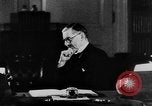
German invasion of Poland triggers British mobilization for World War II
Prime Minister Neville Chamberlain of Britain sits pensively at his desk. Winston Churchill and his wife, Clementine, walking together in London. King George VI stepping from a car and entering 10 Downing Street. Mobilization of British forces for war. British civilians marching casually wearing steel army helmets. A man volunteering for the Army. New recruits being issued uniforms. Others, in civilian clothes, learning to drill with rifles and then marching away from a village. Recruits in bayonet practice. Winston Churchill speaking about the tragedy brought upon Europe by Hitler (this Churchill speech was at St. James's Place, London, June 12, 1941, in an address to Allied delegates). Aerial views of the destruction of Poland by Luftwaffe aircraft of Germany. Civilian Polish victims of German bombardment. A boy and women mourning over the dead. A child being held near a bonfire to warm her. Children rescuing a few possessions from a destroyed home. Parents carrying children. Women and girls crying and in mourning for the loss of loved ones and destruction from war.