


 Francais
 Deutsch
 Italiano

Refine Your Search
1941 hong kong stock footage and images
- Showing 271 to 276 of 1637 results more
 Hide
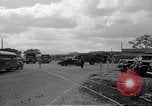
Traffic stops on a road as a commuter passenger train departs Pearl Harbor Naval Shipyard for Honolulu
Oahu Railway and Land Company locomotive No. 76 departs Pearl Harbor Naval Shipyard with commuter train for Honolulu. Passenger cars with freight doors had been previously converted to "can cars" by the OR&L and returned to passenger service after the Dec. 7th 1941 attack. Style of blackout headlight indicates 1942. Cars and trucks on road stop near a railway crossing. Men pass the crossing. Palm leaves near a sea shore. (World War II period).

Glimpse of activities in Pearl Harbor and environs early in World War II.
Pearl Harbor, Hawaii, early in World War 2. U.S. Navy pilots looking serious, being briefed, and then turning to look at Board carrying duty assignment information. Views of palm trees and ocean surf. Navy Chaplain Lieutenant's shoulder board. A navy diver, in rubber diving suit, with grease on his face, reports findings to officers on deck of a vessel damaged by the Japanese attack of December 7th, 1941. He laughs at a remark from one of the officers.

Busy streets of Kiev in Ukraine as women shop for food at a store
A number of people walk through Kreschatik, main city street in Kiev,Ukraine. Wreckage of buildings, ruined in 1941 during German invasion is seen as people pass by the street. Women shop at a food store. Salami being weighed as the meter indicates the weight and is then wrapped in paper. Foodstuffs are seen at the counter Women buy canned food from the store.
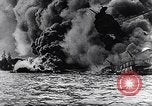
Japanese attack on Pearl Harbor in presaged by a decade of Japanese military aggression in China (WW2)
Opening scene shows the famous image of American battleship USS Arizona as attacked by Japanese forces in Pearl Harbor on December 7, 1941 in World War II. The ship is engulfed in black smoke, and listing. Change of scene to a waterfront in Japan during 1938, where numerous Japanese soldiers board troop ships bound for Manchuria, China. Next, are scenes of Japanese troops marching as they occupy Manchuria. Closeups of some Japanese soldiers. Scene shifts to a train moving on the South Manchurian railway, at a station showing a sign reading,"Chin Hsien." View of steam locomotive pulling a train away from the camera position. (Narrator states that a Japanese train, on the South Manchurian Railway, had been dynamited) This incident triggered a Japanese attack on Mukden, Manchuria. Japanese infantry are seen placing numerous bundles of reeds as a bridge across a wide, shallow, stream and proceeding to cross on their way to invade Mukden. Military supplies are carried on pack animals. In the air, overhead Japanese Mitsubishi G3M Type 96 land-based attack aircraft are seen flying in precision "V" formation. On the ground, Chinese civilians run for cover in the City of Mukden. (The date is September 18, 1931.) Glimpse of Chinese civilians looking at bombing victims on street of Mukden. Brief view of Geneva Switzerland, where League of Nations was housed. A memorial stone monument in that city to Woodrow Wilson, President of the United States and founder of the League of Nations. An entrance to the League of Nations headquarters in the Palais Wilson in Geneva, Switzerland. League delegates in session inside the Palais Wilson. A Japanese Naval Fleet, under command of Admiral Kichisaburō Nomura, is seen steaming toward the Chinese coast and begin a naval bombardment, firing their guns, 15 miles from Shanghai. Japanese Naval biplanes are seen in flight overhead. Japanese troops marching in the streets of Shanghai, as sidewalks of onlookers wave Japanese flags. Next, Japanese troops are seen marching out of Shanghai, at the insistence of the League of Nations. (Narrator states Japan signed a truce with China on May 4th, 1932.) View of Japanese troops entering further, into Mongolia. Japanese soldiers waving flag celebrating formation of the Puppet State of Manchuko in Northeast China and Inner Mongolia, in 1932. Japanese statesmen leaving the League of Nations headquarters, after Japan resigned from the League on February 24, 1933. Japanese infantry moving further into China supported by field artillery fire. Explosions from artillery and damaged buildings, as Japanese troops advance in China. Invaders using tall ladders to scale walls of a damaged fortress in China. Japanese pilots receiving briefing and boarding their Mitsubishi Ki-30 single engine light bomber aircraft at an airfield. View of them taking off and inflight, dropping bombs on Chinese targets. Aerial views of bombs exploding on ground below. Retreating Chinese army marching along the Great Wall of China. Chinese people and military forces moving their military and civilian resources deep into the Chinese interior.
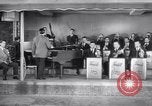
Vincent Lopez and his big band swing orchestra performing in 1943
Vincent Lopez and his orchestra are on stage ready to perform. He stands by his piano, and begins to conduct. The orchestra starts to play. Mr. Lopez calmly seats himself at the piano and plays along with the jazz orchestra, displaying notable flourishes as he plays. Sequence breaks and picks up with male vocalist now also on stage. Lopez stands, conducting vocalist and orchestra. (Note: Vincent Lopez and his orchestra performed at the Grill Room in the Hotel Taft, New York City, from 1941 to 1961.)
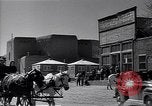
Glimpse of Life in old Spanish settlement of Abiquiu, New Mexico
A couple riding on a horse-drawn wooden wagon on street of the old Spanish settlement of Abiquiu, New Mexico. An old wooden building, housing a country store, seen across from them, and an adobe-stye building down the street. Two small log-style dwellings sit in between. Horses are tied to railings. A 1941 Ford convertible automobile sits in front of the old wooden building, where a number of people, including a woman with a small baby, sit relaxing in the sun. Artist Georgia O'Keeffe steps from the car and enters a store in the building. A Native American Indian woman stands, conversing with an old woman, dressed all in black,like a Spanish widow. Men outside an adobe building decorated with murals and a sign reading: "SL PA BAR." Closeups of the men sitting on benches with legs of cowboy in mural behind. Closeups of mural showing dancing girls. Scene shifts back closeup of the old woman in black. A woman looking out the window of her home. A woman rinsing a batch of some kind of material and placing it into another container. Another woman all in black, steps from her house to feed her two dogs on her doorstep. She poses for a closeup. Views of local flora.