


 Francais
 Deutsch
 Italiano
Refine Your Search
1941 hong kong stock footage and images
- Showing 289 to 294 of 1627 results more
more Hide
Hide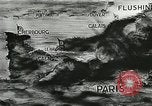
Allies decide that Normandy, France, is the best location for an invasion in World War II. Workers mobilize to build weapons of War in the U.S. and Britain.
Map shows coast of Europe with discussion of various places for a possible Allied invasion of France during World War 2. Normandy was chosen. German coastal defenses on English Channel and Atlantic shore (Atlantic Wall). German officers inspect defenses. Map highlights Cherbourgh, Le Havre, and Caen in Normandy. American workers building war machinery in defense plants and shipyards. Huge numbers of workers are seen in the yard of a U.S. defense plant. View inside a U.S. factory where numerous M3 Lee tanks are being manufactured on production lines during 1941-42. A welder at work. A woman using a saw and many other workers in a busy machine shop. B-17 bombers being built in a Boeing factory. Liberty ships under construction at a shipyard. A lookout watching the skies above a city, for enemy aircraft. A man and woman working together on a plumbing job. British women in Army uniforms working with typewriters. An American woman driving a forklift and loading a piece of ordnance on a railroad freight car. A rail yard filled with stream locomotives and freight trains. A line of trucks carrying war time cargoes. An army truck being loaded into the hold of a cargo ship. Ships underway in a harbor.
General Henry (Hap) Arnold reports to the nation on status of U.S. Army Air Forces in World War II
General Henry H. Arnold, Commander of the U.S. Army Air Forces, seated in front of world map, reports that since start of World War 2, the U.S. Air Force has gone from number 7, to number 1, in the world. Defense plant workers are shown walking near their place of work. A college football game shown in progress. Individual young men who left civilian life to became pilots, bombardiers, radio technicians, and gunners, in the Air Forces. A commercial DC-3 aircraft taxing to park at an airport. Shown are people who make the Air Forces possible, including many men and women workers at factories and manufacturing plants making aircraft and parts for the World War 2 effort: Steel workers, a woman working on a plane fuselage, actor James Stewart (in uniform), a welder at work, a typist, a machinist using a caliper, and an older couple at home, who forgoe driving their private car, shown covered in their garage. The flaming wreckage of U.S. aircraft at Hickam Field, on December 7, 1941. Large formation of German Heinkel He-111 bombers in flight. Formation of Japanese Mitsubishi G3M (Nell) bombers. U.S. P-40 pursuit planes taxiing out from parking places. Assembly line in U.S. aircraft manufacturing plant. U.S. Army Air Forces B-17 Flying Fortress planes on assembly lines. Workmen work on engines and aircraft fuselages. At the Douglas plant U.S. Army Air Forces B-26 Marauder bombers being assembled. Workmen inserting machine guns into a wing.
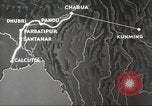
U.S. Army Air Force transport aircraft carry supplies over the Himalayan Mountains to Kunming during World War II.
A film based on getting U.S. supplies to Kunming, China from Chabua, India during World War II. An animated map links Chabua with Kunming. A USAAF (United States Army Air Forces) C-87 Liberator Express in flight over the Hump. An aerial view of the Himalayan Mountains. A USAAF C-54 Skymaster in flight. An animated representation of the content of materials carried by an aircraft over the Hump. USAAF transport planes land at Kunming in China. An animated map depicts the transportation condition over the Burma Road in January 1941 and by air over the Hump in January 1944. Dispersal of cargo and U.S. troops to various fighting fronts from Kunming. A transport aircraft takes off from Kunming. Chinese troops march. U.S. Army General Joseph Stilwell with U.S. Lieutenant General Claire Chennault in Kunming. A formation of transport planes.
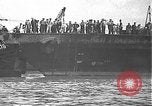
USS California (BB-44) being salvaged at Pearl Harbor
United States Navy ship salvage activities at Pearl Harbor after the Japanese attack on December 7, 1941. Harbor tug USS Geronimo (YTM-119) and another tug moving the USS Califonia (BB-44) to Drydock number 2, a month after she was successfully refloated. Repair crews watch from her decks as tugs move the battleship. (World War II period).
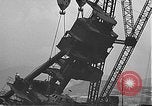
Men dismantle the foremast of USS Arizona at Pearl Harbor, Hawaii, United States.
Activities of the United States Navy at Pearl Harbor, Hawaii, United States during World War 2. The foremast of USS Arizona (BB-39) is dismantled, five months after the ship was sunk at Pearl Harbor during the Japanese attack of December 7, 1941. Men working on the ship. Blow torches being used in the dismantling of the foremast.
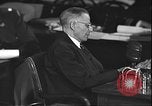
General Short speaks about the Japanese attack on Pearl Harbor occurring without notice, during an investigation.
Joint Congressional Investigation of the Pearl Harbor attack in the United States. Officials gather in the court room. Officials seated at their desk and Retired U.S. Army Major General Walter Short addresses them about the Pearl Harbor attack. He states that no mention was ever made by the Japanese for the attack on Hawaii. The United States had no idea to be prepared for the Japanese air raid on Pearl Harbor. On December 7th 1941. The United States Army was not notified about the attack even at that time. (World War II period).