


 Francais
 Deutsch
 Italiano

Refine Your Search
1941 hong kong stock footage and images
- Showing 319 to 324 of 1637 results more
 Hide
2nd Sino-Japanese war, precursor to World War II in the Pacific. Pearl Harbor attack. Early phase of Pacific conflict between Japan and the U.S.
The film 'Sea power in the Pacific' showing Japanese dominance in China and at start of World War 2. Then it chronicles U.S. efforts to build Navy and fight back on sea and in the air. Opening scene shows Japanese Mitsubishi G3M (Type 96) bombers high overhead, and then closeup in formation. View from bomber of bomb bays open with bombs falling and view from ground of explosions and destruction. Overlay on film says: "China---1931." (This is not correct. The G3M bomber was not yet in service.) This film depicts Japanese attacks during second Sino-Japanese War, commencing 1937, Chinese civilians running to escape Japanese bombing of Singapore. Buildings destroyed and on fire. Next, Japanese troops, carrying the Rising Sun flag, are seen establishing a beachhead in an Amphibious assault. More scenes of Japanese infantry advancing through Singapore, ad it is being destroyed and burned. Soldiers charging along an alleyway, with pagoda in background. Next, Japanese soldiers are seen attacking Nanking, and committing atrocities and killing Chinese during the so-called "Rape of Nanking," in December, 1937. Chinese civilians being summarily shot and dumped into a large open grave after execution. Two Chinese prisoners with hands bound, being executed by rifle fire. Jubilant Japanese troops celebrating their victory. Map shows areas of China occupied during second Sino-Japanese war and the East Indies to the South. View of oil tanks; an open pit tin mine; a native cutting rubber tree bark to collect latex. Flags on map show regions of English, French, and Dutch colonial interest. It also shows Islands to the East, fortified by the Japanese. Cartoon shows Japanese soldier opposed by and American sailor (representing U.S. Sea Power). Next, famous images of the Japanese attack on Pearl Harbor, Hawaii, December 7, 1941, are shown, including the USS Arizona burning and sinking. Hawaii, Midway, Wake, and the Philippines Islands, are highlighted on a map and Japanese control of the Pacific is illustrated. Japanese soldiers are seen displaying a captured American flag. U.S. Lieutenant General Jonathan M. Wainwright is seen surrendering the garrison at Corregidor, on May 6, 1942. View of Japanese General Masahara Homma discussing surrender terms with Wainright. Map shows interlocking web of Japanese fortified bases in Pacific and need for seapower to oppose it. View of American shipyard with hundreds of workers, employed to build ships for the war effort, in World War 2. Views welding, metal fabrication, and other shipbuilding activity. A new ship going down the ways and a woman christening a new ship with splash from bottle of champagne. A new "Liberty Ship," the Richard Bassett, going down the ways at Bethlehem-Fairfield Shipyard Inc. Baltimore, Maryland. Closeup view as the stern of another ship enters the water upon launching. View of it from a distance. Shipyard workers knock supports from under what may be a landing craft, as it is launched. Japanese warships underway in the Pacific and firing their naval guns. Explosions on a shoreline from naval bombardment. Japanese infantry wading ashore during an amphibious assault. Map shows where Japanese forces attempt an amphibious assault on Southern New Guinea, thwarted by the U.S. Navy in the battle of the Coral Sea of May, 1942. In June, 1942, a Japanese attempt against Midway Island, was again checked by the U.S. Navy in the Battle of Midway. View of USS Wasp (CV-7) carrier deck filled with airplanes, including Grumman F4F Wildcats. A Douglas SBD Dauntless dive bomber being cleared for takeoff from the Wasp. Gun camera film showing Japanese airplanes being shot down by pursuing U.S. aircraft.
Franklin Delano Roosevelt retrospective - FDR with Winston Churchill, Chiang Kai-shek and Joseph Stalin at different events in different continents.
Life of the President of the United States Franklin Delano Roosevelt in the United States. U.S. President Franklin D Roosevelt is greeted by British Prime Minister Winston Churchill aboard HMS Prince of Wales during the Atlantic Conference for signing of the Atlantic Charter off Newfoundland in 1941. The ship approaches the harbor. Soldiers present arms aboard a ship. Prime Minister Churchill and President Franklin D Roosevelt talk. President Franklin Roosevelt addresses U.S. Congress with declaration of war after the Pearl Harbor attack by Japan in World War 2. The President signs a document. President Roosevelt reviews troops in Casablanca. The troops march. Franklin Roosevelt salutes troops. Vehicles driven in the foreground. Cairo: Franklin D Roosevelt and Winston Churchill with the Chairman of the Nationalist Government of China Chiang Kai-shek. Tehran : Franklin D Roosevelt, Winston Churchill and General Secretary of the Communist Party of the Soviet Union Joseph Stalin pose. United States: The exteriors of the White House. People enter White House. President Franklin Roosevelt with Vice President Harry S. Truman at the 1945 inaugural ceremony. Yalta : President Franklin D Roosevelt, Winston Churchill and Joseph Stalin pose. Franklin D Roosevelt addresses a conference. (World War II period).
As the United States enters World War II, U.S. military forces are seen, deployed in various places throughout the world.
American troops are seen in arctic gear moving on skis through blustery snowy weather in Iceland, during World War 2. They were sent in 1941 to relieve British troops occupying Iceland since 1940, during World War II. A guard post at the American camp, with Quonset Hut in background. Closeup of U.S. sentry in arctic gear holding rifle with bayonet affixed. View from above, of numerous tents partially covered with snow in the American camp. Change of scene shows U.S. troops disembarking from transport ships at the British Isles. They march with their combat gear onto a square where Army trucks wait to transport them inland. Another scene shows the American troops, viewed from behind, parading in London. Other scenes show them marching in various areas of London. Saint Paul’s cathedral is seen in the background of one scene. A large number of American M3 Stuart Light tanks move on a railroad train in Britain. Scene shifts to the Middle East, where railroad cars and various military supplies for Russia are be offloaded from American ships. A Russian officer is seen signing receipts for war materiel, from a U.S. Army Technical Sergeant. A row of American Army trucks are lined up behind them. The Russian and American exchange salutes, and shake hands. Next, a troop ship carrying American troops is seen arriving at a port in India, where they disembark with their gear. An American Army Sergeant in a pith helmet pays attention to a little Indian girl. Scene shifts to China, in 1942, where Brigadier General Claire Lee Chennault, Commander of the China Air Task Force, of the Tenth Air Force, that replaced the American Volunteer Group (Flying Tigers), is seen with Brigadier General Caleb V. Haynes, Commander of the India Air Task Force. A colonel joins their discussions. A Consolidated B-24 Liberator bomber is parked behind them. View of Curtiss P-40 Warhawk fighter planes, with Flying Tiger markings, parked on a flight line. A B-24 bomber landing on a runway, between hills, deep in China. Closeup of Nationalist China Generalissimo Chiang Kai-Shek, saluting. Huge numbers of Chinese troops assembling in a formation. Next, an expeditionary force of American troops is seen arriving on a troop ship in Australia. They line the ship’s deck and wave. General Douglas MacArthur arriving in Australia to assume the office of Supreme Commander, South West Pacific Area (SWPA). .Glimpses of U.S. Navy activities in Australia: setting up defenses of islands; unpacking a Kingfisher float plane and making it ready for use on a desert island. The final segments of the film show American forces in August ,1942 sailing to Adak in the Aleutian Islands, to strengthen American defenses there. Troops seen descending by rope ladder from the American transport ship USS J Franklin Bell (PA-34), into her landing craft for deployment on Adak Island. Scenes of landing craft reaching the beach and offloading troops, vehicles, and supplies. View of beach filled with supplies. One landing craft is clearly marked with ""P34" showing that it belongs to the USS J Franklin Bell ( later reclassified as APA-16).
Montage of scenes showing the continuous close coordination between the United States and Britain during World War II
Film shows an invasion task force at sea overwritten by a slate reading, "Casablanca." Narrator speaks of January, 1943, in World War 2. View of the city of Casablanca in Morocco. U.S. President Franklin D. Roosevelt seated next to British Prime Minister, Winston Churchill as they meet in Casablanca, at the Anfa Hotel, January 14–24, 1943, during World War 2. Roosevelt wears a black armband on his left sleeve in mourning over the death of his mother, in 1941. Backs of Military officers seen from behind, with Churchill and Roosevelt on chairs in the background. Then a closeup of Roosevelt and Churchill seated with high ranking Allied military officers behind them, including U.S. Admiral Ernest King and U.S. General George Marshall. View from directly overhead of marching American soldiers. Huge number of British soldiers led by a Rolls Royce armored car, are seen walking across the desert, celebrating their victory over German forces at Tunisia. Prime Minister Churchill and President Roosevelt seated on the lawn in front of the White House during the third Washington Conference (code-named Trident) held in Washington DC, from May 12 to May 25, 1943. Closeups of both men. Scene shifts to a U.S. invasion task force in the Pacific. Glimpse of a Benson-Livermore class destroyer near hills in the Pacific. A navy Douglas Dauntless dive bomber flies over ships in an invasion task force. U.S. troops are seen in a Higgins Boat landing craft from the transport ship USS President Jackson (APA-18). Troops storming ashore from landing craft. U.S. troops firing artillery field pieces, and raising the U.S. flag on a captured island in the Pacific. Scene shifts to European theater, where an Allied warship is firing its guns during Allied invasion of Sicily, code named Operation Husky, 9 July – 17 August 1943. Amphibious assault taking place. A jeep is seen pulling an artillery piece through shallow surf. An army truck drives through shallow surf, out of a landing craft. Breech view of artillery gun being fired and shell ejecting. A shell exploding near the camera. Camouflaged antiaircraft guns firing. Series of brief scenes showing Soviet Russian infantry and tanks advancing against German forces in Russia. Next scene shows Benito Mussolini in military dress uniform, giving a speech, and then posing next to a Bronze statue of Roman emperor, Julius Caesar, in Rome, Italy, as troops march past him. A bust of Mussolini being pulled down. Rioting Italians. Axis defenders in Sicily, carrying a white flag as they surrender to Allied powers. Views of Lieutenant General Mark Clark and a Major General pleased at the surrender. American troops being cheered by Sicilians as they ride in jeeps. Italian men receiving food after the surrender, as a British soldier stands nearby. U.S. Army Air Force B-24 Liberator bombers in flight over the Northwest Pacific. Aerial view of Kiska in the Aleutians. B-17 flying Fortress bomber in flight with bomb bays open. Bombardier at his station in the aircraft he presses button to release bombs. Formation of B-24 bombers dropping bombs. View from aircraft of them exploding on the ground. Aerial view of surfaced German submarine being strafed by Allied aircraft. After several attacks it is sunk. B-24 bombers raining bombs over Germany. Huge explosions on the ground raising plumes of white smoke. Bombed out remains of Coventry Cathedral in England. Religious services being held in the ruins. View of the Pentagon building just outside Washington DC, and the British Prime Minister's residence at 10 Downing Street, London, England. View of Quebec Canada. A Canadian sentry on a hill. The Wolfe–Montcalm Monument in Governors' Garden beside the Château Frontenac, Quebec, Canada. Views of the Chateau Frontenac. Canadian troops patrolling around the Hotel. Royal Northwest Mounted Police on the grounds. Canadian soldiers with antiaircraft guns, scanning sky for possible threats. Armed couriers loading bags of official dispatches into a car. The dispatches being delivered to waiting aircraft. Censors examining postal mail. Conference attendees showing their passes to Canadian Mounted police officers at the hotel entrance. Closeup of an actual pass issued to a U.S. Army Major.
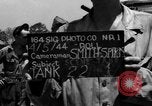
United States crew poses in front of a captured Japanese tank after running it through test exercises at a camp in India
Captured 1941 model Japanese light tank behind a U.S. Army tank crew who had just run the tank through various tests. The crew smiles for the camera. Close-up views of some parts of the tank, showing points of vulnerability and various measurements. Several slits marked in chalk with number "3/16 inches" are seen close-up.
Various U.S. tanks used in World War 2, from film titled 'Tank Mission, World War II'
From a film titled 'Tank Mission World War II'. Eiffel tower in Paris and scenes on quiet streets of Paris during German occupation. German troops in Paris in 1941. United States tanks maneuver during planning phases and drills for invasion of Europe. Tank fires flamethrower. Various U.S. tanks fitted with different attachment for bulldozing practice demolishing beach blockades and erecting landing areas. Infantry troops practice maneuvering behind tanks. German bunkers and fortifications on the French coast. United States infantry and tank units land at Normandy on D-Day and the days following. U.S. troops fire. Smoke rises due to explosion. Many hedges in the way. Tanks fitted with hedgerow cutters (the idea of a Sergeant) for cutting through the hedges. Tank fitted with hedge row cutter cuts through a hedge.