


 Francais
 Deutsch
 Italiano
Refine Your Search
2nd-Rangers-D-Day stock footage and images
- Showing 7483 to 7488 of 13612 results more
more Hide
Hide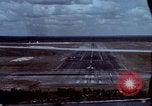
Navy pilot trainees in carrier landing training on USS Lexington and in Advanced Jet Training in Corpus Christi Texas
Aircraft carrier landing training for Navy pilots at Corpus Christi, Texas, United States. View of North American T-2 Buckeye aircraft performing simulated aircraft carrier deck landing on a land runway configured with a mirror optical system to simulate a real aircraft carrier landing. North American T-2 Buckeye in flight over Gulf of Mexico with point of view shot from inside aircraft as it approaches carrier deck of USS Lexington (CV-16) to practice carrier landing. View from USS Lexington flight deck as T-2 Buckeye aircraft perform arrested landings. Pilot exits the aircraft having completed basic training. Next, during advanced jet training at Kingsville, near Corpus Christi, Texas. Grumman F-9 Cougar jet aircraft seen landing on airstrip. Pilots in class learn using working mockups and in a procedures trainer. Instructors and students in classroom training. View of student in cockpit simulator. He demonstrates control panel to them and gives training of jet flight procedure and its handling in odd situations. Pilot and instructor in F-9 Cougar on runway as wings descend into position for flight. Aerial view of F-9 Cougar aircraft in flight.
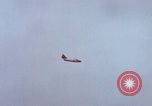
U.S. Navy pilots in advanced training on their specialized aircrafts and getting their wings in the United States.
Naval aviator in training seen flying a F9 Cougar aircraft and practicing air to air gunnery and bombing and low level navigation. Aircraft landing on USS Lexington (CV-16) in Gulf of Mexico near Corpus Christi, Texas. Pilot Point of view (POV) shot from inside cockpit of aircraft as it descends approaching aircraft carrier deck for landing. Pilot performs arrested landing on deck of aircraft carrier. Two Grumman F-11 Tiger jet aircraft taking off from a ground runway, in tandem. Aerial views of formation of F-11 Tiger aircraft as they perform aerial rendezvous operations and fly in formation and in hunter-killer formation. Two F-11 aircraft perform strafing operations and aerial tactics and high altitude radar intercepts. View of pilot in cockpit of US Navy S-2 Tracker anti-submarine aircraft, and then aerial view of S-2 Tracker aircraft in flight over water. Pilots training in helicopters. A pilot flying a Bell H-13 Sioux helicopter at Ellyson Field near Pensacola. Close-up view of pilot and instructor inside Bell H-13 helicopter in flight. View of H-34 Seahorse helicopter in flight and landing. Pilots get their wings pinned on during ceremony. African American naval aviator has his wings pinned on him by his wife. Senior captain representing chief of naval air advance training pins wings on pilot's uniform in a ceremony. View of P-3 Orion aircraft parked on airfield and pilot walking away from aircraft. View of P-3 Orion aircraft taking off directly overhead of viewer at end of runway. SH-2 Seasprite helicopter taking off and in flight out of Key West, Florida. F4B Phantoms. Navy pilots in briefing on an aircraft carrier learn about a training operation.
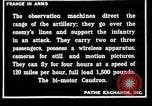
Several aircraft used for observation and other missions during World War I
French airplanes used for observation in World War 1. A twin engine Caudron airplane parked, with engines running, on a grass field. A Sopwith two-place 1-1/2 strutter airplane with Scarff ring-mounting for Lewis gun in rear cockpit. Tail number P I-A2 visible on rudder which is being moved by an aviator in the cockpit. Another person stands next to the aircraft, which is parked in front of a hangar. Next scene show ground crewman turning propeller on a Salmson 2 airplane parked in front of a hangar. Closeup of the airplane with engine running and two aviators on board. Closeup of the aircraft engine.
U.S. Naval bombardment of Iwo Jima, preceding the amphibious assault in World War II.
Naval bombardment of Iwo Jima, preceding the amphibious assault during World War 2. Animation shows a map which locates Iwo Jima. Animation shows the defensive positions of Japanese defenders on Iwo Jima at various dates. U.S. Warships firing naval guns. Other ships in the background. Cruiser USS Salt Lake City (CA-25) seen at time codes 2:18-2:21.
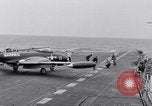
Deck crews aboard a U.S. Aircraft Carrier handle aircraft and prepare them for catapulting.
U.S. Marine Corps McDonnell F2H Banshee jet airplane being guided by a Yellow shirt. Scene shifts to animated diagrams interspersed with actual pictures. They show narrower tires used on jets giving lower braking friction and less lateral stability. One is shown in sketch, being blown over by jet blast. Sketch illustrates jet intake suction and reward blast. Deck crewman removing loose tools from pockets and fastening chin strap and goggles on his helmet, to avoid loose items being sucked up or blown about on deck and protect himself from jet blast. A Marine Corps Captain, pilot, climbs aboard his F2H airplane and deck crewman moves out of line of fire from plane's weapons. Next, a Navy F2H of Attack Squadron 12 (VA-12), Carrier Wing One (Tail code "T") is seen being readied to depart. Deck crew has already pulled the duct covers and pilot is in the cockpit. A 3-wheeled starting "jeep" containing an auxiliary power unit provides power for engine start and then pulls away. Fire fighter standing by in protective gear is seen. Deck crew pull chocks and aircraft taxis guided by yellow shirt who gives signals to spread wings and lower flaps. Yellow shirts guide jets to catapults for takeoff. Yellow shirt Plane Director uses various hand signals to guide pilot. Deck crew scramble underneath the aircraft an set it on the catapult.
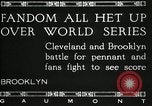
Scenes from 1920 baseball World Series between Cleveland Indians and Brooklyn Robins (Dodgers) in Brooklyn New York.
Several scenes from the 1920 Baseball World Series between the Cleveland Indians and the Brooklyn Robins (also known as the Brooklyn Dodgers). Opening scene shows ballpark and players meeting at home plate, including Wilbert Robinson and Zack Wheat of Brooklyn and probably Tris Speaker of Cleveland seen partially behind an umpire ( and wearing a black armband out of respect for the recent death of Cleveland shortstop, Ray Chapman). Some questions have been raised about the captions appearing in this clip. For example, the first game action scene, is entitled "Jimmie Johnson scores for the Dodgers." Johnson did score for Brooklyn, from third base, on a hit. But in the clip, it appears the scoring runner may be rounding third base, rather than starting from there. Also, the scoring team clearly has dark colored hats--as the Indians wore--and the fielding team has white--the Robins. It is believed the play is actually Joe Wood scoring for Cleveland on a double by Steve O'Neill in the 4th inning of game 1. The second action scene is captioned,"Grimes scores on Griffith's double." But a close look shows the batter running only straight over first base, with no turn towards second. It is believed this may actually show Myers hitting into a 5-2-3-2 double play in the third inning of Game 2 ( with the final throw from the Cleveland first baseman to the catcher edited out.)
CRITICALPAST.COM: About Us | Contact Us | FAQs - How to Order | License Agreement | My Account | My Lightboxes | Shopping Cart | Advanced Search | Featured Collections | Website Terms & Conditions | Privacy Policy ©2026 CriticalPast LLC.
License Agreement |
Terms & Conditions |
Privacy Policy
©2026 CriticalPast LLC.