


 Francais
 Deutsch
 Italiano
Refine Your Search
2nd-Rangers-D-Day stock footage and images
- Showing 7489 to 7494 of 13612 results more
more Hide
Hide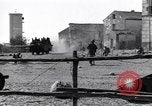
U.S. Army soldiers recover German Panzer III Ausf L Flamethrower tank, in a village near Salerno, Italy, in World War II
U.S. Army troops of 179th Infantry entering village at Ponte Barizzo, Salerno, Italy, during World War 2. Some ride in a DUKW amphibious vehicle, and a few trucks are seen. But most soldiers simply walk through the area. An officer in a parked jeep watches as the troops move past. Soldiers hoist one of two captured German Panzer III Ausf L Flamethrower tanks with a U.S. tank recovery truck, and haul it away. Tank has unusual '2 squared' marking - vehicle number is raised above platoon number. A U.S. Army soldier, standing in the turret, steers the German tank as it is being towed. Elements (not seen) of the 753rd Tank Battalion and 645th Tank Destroyer Battalion were also engaged in this operation. (Note: Location has been identified as the intersection of SP11a and SP 278 east of the Sele River.) (World War II; WW II; World War 2; World War Two)

Tanks in action, aircraft in flight and soldiers in boats during combat drills at Fort Knox military base in Kentucky, United States
U.S. Army first armored Division for cross country maneuvers at the Fort Knox military base in Kentucky, United States, shortly before America's entry into World War 2. Aerial view of tanks on ground. U.S. fighter aircraft in formation flight. Tanks move on ground. Army soldiers on motor bikes or motorcycles. Soldiers of the U.S. first armored division in boats crossing a water way. Water splashes as bombs are being dropped in practice battle drills. Soldiers climb a hill. Tank moves on an uneven ground. Tank smashes a trees. M2 Light Tanks and M2A1 Medium tanks smashing into trees, small houses, and shed buildings.
Various "firsts" in U.S. aviation history from 1918 through 1924; early history of flight and vintage flight scenes
Shows several aviation "firsts" accomplished by U.S. Army Air Service aviators in the period from 1918 through 1924. A close formation of biplanes in flight. President and Mrs. Woodrow Wilson chat with Major Fleet, Officer in charge, on the occasion of the first air mail flight, inaugurated on May 15,1918 between Washington DC and New York.The mail is loaded into the Curtis JN-4 aircraft. Pilot in the cockpit. The aircraft takes off and in flight. Air Service. Mention of aviators helping spot forest fires. Smoke rising from forest fires and mountain ranges. In 1920, U.S. Army Captain St. Clair Streett is seen with some of his Squadron who flew four De Havilland DH-4 aircraft 9,000 miles, from New York City to Nome, Alaska. Two of the men play with pet dogs. Their itinerary is painted on the side of one of the aircraft, along with the names of pilot and mechanic (C.E. Crumline and J.E. Long). In 1923 the first non stop coast-to-coast flight was made in the Fokker T-2 aircraft. . A sign on the aircraft reads 'Army Air Service non stop coast to coast'.First Lieutenants Oakley O.Kelly and John A. Macready board the aircraft, at Roosevelt Field, Long Island, New York, on May 2, 1923. Their Fokker T-2 in flight. Their arrival at Rockwell Field, on Coronado Island (San Diego) California. In 1924, Lt. Russell Maughan is seen boarding his P-1 Hawk airplane at Mitchel Field, on Long Island, New York, and taking off , bound for Crissy Field at the Presidio, San Francisco, California. His goal is the first dawn-to-dusk, coast-to-coast flight. Views of his P-1 Hawk airplane flying over Manhattan, New York City.
Pre-war views of cities and countries in Pacific region; wartime views of Japan attacking nearby nations
Animated map of Pacific region shows sphere of Japanese influence and potential areas for Japan to control in the Southwest Pacific during World War 2. Majority of scenes are from before outbreak of World War 2. Final scenes of clip include invasion scenes. Clip begins with pre-war views of city life and streets of Manila, Philippines and Filipino people. Scene changes to Hong Kong under British, and scenes of port area and buildings near port. Chinese civilians on busy city streets of Hong Kong. Views of jungle areas in Malaysia. Views of buildings and temple landmarks in Bangkok, Thailand. A car and a rickshaw pass by with temples in background. Thai tanks and Thai soldiers marching through the streets of Bangkok as civilians watch soldiers in Thailand on parade. Aircraft in skies over Bangkok during parade. Scene changes to Makassar on Celebes and people on streets in city of Indonesia. Views of port of Singapore, pre-war. Elevated views of city of Singapore and City Council offices. Buildings and traffic along busy streets in Singapore. View of the General Post Office (GPO or Fullerton Building.) Scene changes to Sumatra with port views and three float planes of flying boat aircraft flying overhead in formation. Final scenes of clip focus on Japanese offensive maneuvers during World War 2: Japanese fleet at sea and Japanese aircraft in skies overhead. Japanese soldiers boarding landing craft from transports. View from inside Japanese landing craft of Japanese soldiers preparing to go ashore on a beach landing. Japanese soldiers invading an area in the Pacific under cover of naval bombardment. Japanese soldiers firing machine guns and rifles. Japanese infantry charging. Animated map of Pacific region. Japanese aircraft bombing Port Darwin in Australia.
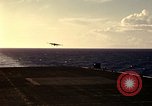
Aircraft operations on the flight deck of USS Midway aircraft Carrier in the Atlantic
Two AJ Savage airplanes land successively on the flight deck of USS Midway (CVB-41) aircraft Carrier in the Atlantic. F2H-3B plane lands and right tire blows out. Following F2H-3B has to execute go-around. It lands after the first F2H is cleared from the deck. An AJ Savage on final approach is waved off and goes around. It makes a somewhat rough landing.
U.S. orientation film for Allied occupation forces, to provide background for understanding Japanese and their society
Background information for United States occupation forces in Japan after end of World War II. At start, the film shows sky filled with U.S. Navy airplanes flying in formations. They include Vought F4U Corsair aircraft, among others, and are seen overhead above the Battleship USS Missouri (BBB-63). Closeup of the USS Missouri with her crew in formation on deck wearing dress whites. Next, General Douglas MacArthur is seen and heard speaking from a podium on the Missouri's deck. He invites the representatives of the Emperor of Japan, and the Japanese Government, and the Japanese Imperial headquarters, to sign the instrument of surrender. The date is September 2, 1945, just after the end of World War 2. Closeups of the Japanese delegation, which includes envoys Foreign Minister Mamora Shigemitsu and General Yoshijiro Umezu, and of MacArthur. Japanese Foreign Minister Mamora Shigemitsu sits at a table. Closeups of him signing the surrender document. Change of scene to Japan, where camera pans over many thousands of Japanese people assembled to learn of their fate. Closeups of Japanese soldiers and family members, as Narrator asks how should the U.S. occupying force treat them. View of soldiers in plain non-military uniforms. Views of Japanese responding en masse to a leader, during World War 2. Views of child victims of the war. Closeup of Japanese soldier firing a short barrel light machine gun. Views of Japanese pedestrians including families, most in western dress. Japanese workers in an office. Film shows artists view of one worker's brain, and then many brains, as Narrator refers to need for reorienting Japanese thinking. View of learned wise Japanese leader at a podium. View of a Japanese soldier posed with his sword above the head of a war prisoner. Japanese mother feeding her baby. Closeups of Japanese babies. Closeups of Japanese school age children, in a group, and some doing things in school, and some at a playground. Group of uniformed Japanese students studying the art of Japanese calligraphy. Students doing artwork, studying nature outdoors, and paying attention to a teacher using a black board to explain how to calculate volumes of different shaped vessels. Students in classes of Geography and of geology. Japanese chemists, architects, and lawyers at work. Telephone switchboard operators at work. Electrified train moving on a track.
CRITICALPAST.COM: About Us | Contact Us | FAQs - How to Order | License Agreement | My Account | My Lightboxes | Shopping Cart | Advanced Search | Featured Collections | Website Terms & Conditions | Privacy Policy ©2026 CriticalPast LLC.
License Agreement |
Terms & Conditions |
Privacy Policy
©2026 CriticalPast LLC.