


 Francais
 Deutsch
 Italiano
Refine Your Search
2nd-Rangers-D-Day stock footage and images
- Showing 7501 to 7506 of 13612 results more
more Hide
Hide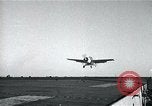
Carrier flight deck operations aboard the USS Guadalcanal during World War II
Slow motion pictures of U.S. Navy aircraft operating on the USS Guadalcanal (CVE-60) in World War 2. Brief view of an FM-2 making normal landing. Closeup glimpse of TBM passing camera, after landing and view of another one in normal landing. Then a TBM bounces on touchdown, misses early restraining cable, but stops safely. Momentary views of several more by TBMs and one FM-2. touchdowns. A Grumman TBM-3U, utility aircraft, touches down at edge of flight deck and instantly veers to the left, as if its left main gear collapsed. It continues turning, noses over, tail high, and falls off the port side of the carrier deck. Sailors rushing to the accident site, and standing at the aft railing as the Guadalcanal begins a sharp turn to port.
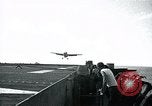
Landing incidents aboard USS Guadalcanal (CVE-60) during World War II
Slow motion pictures of operations aboard the USS Guadalcanal (CVE-60) at sea, in the Atlantic ocean, during World War 2. Marines watch landing of U.S. Navy FM-2 Wildcat on the aircraft carrier as its tail wheel breaks off. The aircraft drags its tail as it passes close to the camera position, beside the flight deck. View of clouds in the sky (possibly unintended). U.S. Navy SB2C Helldiver approaches for landing and catches wire, bounces and hits the barrier. An F4U Corsair hits the barrier while landing and stands upright on its nose. Deck crews rush to the scene and lower the aircraft to a normal position.
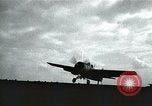
Landing incidents aboard the aircraft carrier, USS Guadalcanal, at sea, during World War II
Slow motion pictures of flight operations aboard the USS Guadalcanal(CVE-60)during World War 2. U.S. Navy FM-2 Wildcat lands on the Gaudalcanal but veers to left and narrowly misses the camera, as it falls partially off the flight deck and hangs over the lower walkway beside the flight deck. The aircraft sustains considerable damage, but no fire. Deck crewmen respond quickly. But fate of pilot is not evident. In another instance, a U.S. Navy SB2C Helldiver comes in high, snags a restraining cable, but lands in a crab, causing its left main gear to collapse. It ends up facing the Island, with both main gear broken, and being inched forward by tension of the arresting cable. There is no fire. Finally, several F4U Corsair fighters are seen landing satisfactorily on the flight deck. In one scene, an F4U, following behind one landing, is forced to go around.
Science fiction filming and actual rocket-related activities and events in Germany
A 1940 movie entitled "Weltraum Schiff I Startet Eine Technische Fantasie" (Space Ship I launches a technical fantasy). Imaginary view of moon shining over Lake Constance in Friedrichshafen in the future. Views of a huge hangar and industrial complex with a rocket on a launch pad. A large crowd is gathered and listens to a technician speak about a moon rocket.project. Supposedly, the director of the Friedrichshafen airship shipyard speaks to some reporters about aircraft, flying, rocketry, and space travel, while speaking about manned rocket flight to the moon. He answers questions from members of the press corps. Animated pictures show critical distance for escaping earth's gravity and other aspects of a moon flight. Posters of various German Dornier airplanes line the briefing room, including: a circa 1937 Dornier Do 17; Dornier Do 24 3-engined flying boat; Do-X 6-engined flying boat; Dornier Do J II Wal; Dornier Do-19 aircraft; Dornier Do-18 push-pull twin engine flying boat, and the mammoth Do-X twelve-engine flying boat with its date, 1929, stenciled on the bottom of its left wing. From this point on, the narrator continues speaking but the images are of actual applications of rocketry to land vehicles and aircraft. View of a small rocket fired from a tilted trough type launcher. A sign warns about fire explosives ("Vorsicht Mit Feuer SprengstoffI"). Igniter being wired to rockets on the Opel RAK-2 rocket propelled car. Max Valier sitting in his rocket propelled car Valier RAK-6. Fritz Von Opel sitting in his rocket propelled car, Opel RAK-2. Fritz Von Opel driving his rocket propelled car, Opel RAK-2 at Avus track in Berlin on May 23, 1928. A sign above the seating area reads: "Zeitnahme" (Timekeeping). Driven by 24 solid-fuel rockets, the car raises smoke and dust in its wake as it reaches a speed of 230 km/h (143 mph). Brief view of the Opel-Sander Opel RAK-.3 Zopeltra rocket rail rider racing along a track in 1928. The Opel-Sander RAK-1 rocket propelled airplane on a launching rail. With Opel at the controls, It fires up and takes off in a cloud of smoke, at Frankfurt-am-Main airport, on 30 September 1929. A rocket test resulting in failure, as the rocket tumbles to the ground after rising only a short distance after launch. Men gather around a liquid oxygen tank as it fuels a rocket car driven by Max Valier. His white car is seen speeding along the ramp of an airport, past a twin engine high-wing monoplane. Next, Valier is seen in April 1930, smiling as he sits in his liquid rocket propelled car, surrounded by spectators. Glimpse of a rocket vehicle on a railway, as it fires up sending a cloud of smoke that obscures the scene completely. A poster showing starry sky and reading:"Die Erreichbarkeit Der Himmelskorper" (The accessibility of the celestial body). Fingers working rapidly on an arithmetic calculator. Fumes rising from a beaker of liquid oxygen. A technician (hands only, seen) pours liquid into one of a number of beakers in a laboratory. It produces a chemical reaction causing dark smoke to rise from the beaker. (World War II period).

German view of the beginning of the the Battle of the Bulge in World War II
Beginning of the German counterattack into Belgium, during winter of 1944-45 of World War 2. Opening scenes show German artillery barrages by Grille (Cricket) self-propelled artillery firing 15 cm sIG 33 infantry guns. This is the beginning of German Field Marshal Gerd von Rundstedt's Ardennes Counteroffensive (aka the Battle of the Bulge) in December, 1944. German soldiers riding on Jagdpanzer IV tank destroyer moving forward in Ligneuville, South of Malmedy, Belgium. German infantry walk past a knocked out tank on their way toward the front, where smoke rises ahead. They pass burning American armor and vehicles destroyed by the German Luftwaffe (Air Force). Sounds of artillery fire are heard. Closeup of one soldier carrying an MP44 7.92 x 33 mm (7.92 Kurz) caliber assault rifle. The German infantry move along a ditch parallel to a burning column of U.S. armor and vehicles on the road, where it was wiped out by German aircraft. A United States 3" anti-tank gun abandoned at the roadside. German soldiers retrieve American cigarettes from a knocked out U.S. tank, and share them. At TC:02:00 the German gunner with a belt of ammunition around his neck, is Hans Tragarsky aka Walter Armbrusch, a soldier in the Kampfgruppe Hansen battle group formed during the Battle of the Bulge from SS-Panzergrenadierdivision Regiment 2, an infantry regiment of SS Pz Rgt 2 "Das Reich". (His image is well known but his identity is subject to debate.) German troops relax as they smoke cigarettes. A group of German soldiers sharing cigarettes, atop a Stug III tank destroyer. A German army Type 82 Volkswagen Kübelwagen drives past detritus of combat, near a village church. Glimpse of damage in City of Antwerp from a German rocket.
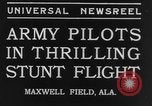
U..S. Army Air Corps flight demonstration team known as "Men on the Flying Trapeze," put on air show at Maxwell field in Alabama, United States
Army pilots in thrilling stunt flight, Maxwell field in Alabama, United States. Four pilots known as "Men on the Flying Trapeze," an Army flight demonstration team, pose in front of a U.S. Army Air Corps P-l2. From the left they are Sgt. William C. McDonald; an unidentified pilot; Captain Claire Chennault and Sgt. John H. Williamson. (Claire Chennault went on to lead the famous "Flying Tigers," The First American Volunteer Group (AVG) of the Chinese Air Force in 1941–1942.) Next, three P-12's are seen taking off together. When airborne, they start an inside loop, then execute other aerobatics in formation Three P-l2's executing a 360 degree roll. Three P-l2's in formation flight.
CRITICALPAST.COM: About Us | Contact Us | FAQs - How to Order | License Agreement | My Account | My Lightboxes | Shopping Cart | Advanced Search | Featured Collections | Website Terms & Conditions | Privacy Policy ©2026 CriticalPast LLC.
License Agreement |
Terms & Conditions |
Privacy Policy
©2026 CriticalPast LLC.