


 Francais
 Deutsch
 Italiano
Refine Your Search
2nd-Rangers-D-Day stock footage and images
- Showing 751 to 756 of 13613 results more
more Hide
Hide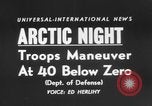
U.S. Paratroopers jump from aircraft and build ice shelters in Greenland during "Exercise Arctic Night."
U.S. paratroops of the 82nd Airborne Division participate in joint Army-Air Force "Operation Arctic Night."conducted from 2-13-1956 to 3-14-1956, in Greenland. With ambient temperatures of minus 40 degrees Fahrenheit, Paratroopers in Arctic parkas, with their parachutes underneath, are so burdened that they waddle like penguins as they board waiting C-124 aircraft, at Thule Air Force Base, Greenland. Sign erected in snow reads: 'North Pole, 802 Miles, Fort Bragg, N.C. Home of 82nd Airborne 3500 Miles'. Troops seated inside C-124 aircraft. A flight of three large Douglas C-124C Globemaster aircraft, in formation, carries the entire group of 700 paratroopers, who make a mass jump from the aircraft to land on the Greenland icecap. Parachutes billowing as troopers land on the ice. They assist one another as they land. The paratroopers dig snow shelters and build shelters with ice blocks on the icecap.
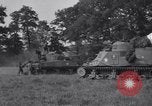
Free French tank crew removing casualties from one of their Sherman tanks during World War II
French tank crew of the Free French Forces, leave their M4A2 Sherman tank to inspect another that has been knocked out. Both tanks display the logo of French 2nd Armored Division (2e Division Blindée, 2e DB), commanded by General Philippe Leclerc. The destroyed one belongs to the 501ème Régiment de Chars de Combat (501st RCC 3eC) and was knocked out, probably by an 88mm anti-tank shell, on August 13, 1944 in Ecouves forest. Closeups of huge holes penetrating the turret of the tank. The other tank's crew members begin recovering bodies of dead from the stricken tank, which has the name "l'Ourcq" stenciled on its side. They remove the body of one dead soldier and place it on a blanket. They also remove the headless body of another from the tank. (Note: Reportedly, the destroyed tank was number 420583.)
French General, Philippe Leclerc consulting with staff in the Montparnasse, Paris, train station,during World War II
Two civilians and two soldiers, are standing on the sidewalk in front of the train station at Montparnasse, Paris (Gare de Montparnasse) during World War 2 liberation of Paris. A remnant of former German occupation is a sign (in German) indicating it is for the German Army and contains the office of the train station guard officer. The French tricolor is displayed on the front of the building. Through the large glass window of the station, several men are seen huddled around a table inside. Camera moves inside, showing General Philippe Leclerc commander of the Free French 2nd Armored Division (2e Division Blindée,2e DB, aka La Division Leclerc). He is reviewing tactical maps with officers of his staff. After a glimpse of a train on a track behind them, the camera returns to Leclerc and his officers, and then pans upward to the train station clock reading 12:47.
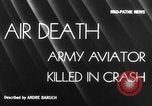
Army Air Forces airplane crashes in front of spectators during air show at Langley Field, Virginia, 11 December 1938.
Crowd gathered to watch air show celebrating 20th anniversary of Langley Field, Virginia. Seven Y1B-17s from the 2nd Bombardment Group, at Langley Field, fly very low in an echelon-right formation. The crowd gazes at the sky. Several Consolidated PB-2As, from the 8th Pursuit Group, in flight. R3-2As dive and fly by in front of the crowd. A lone Y1B-17 flies low over the ground. One of several low-flying PB-2As, 35–50, of Headquarters Squadron, 8th Pursuit Group, suddenly dives into the ground and crashes, bursting into flames. People watch the burning wreckage. A crash truck responds and is seen besides the wreckage. Spectators rush towards the crashed plane. (Army Air Corps Major Alfred J. Waller was killed in the crash and Observer, Sergeant John Johnston was injured.)
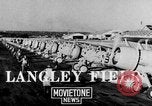
Fatal airplane crash mars 20th anniversary air show at Langley Field, Virginia.
People gather to watch air show commemorating 20th anniversary of Langley field, Virginia. Long line of P-12s parked with engines running on the air base ready for flight. Crew members rush towards the planes. Y1B-17 bombers, from 2nd Bombardment Group, move slowly along taxi strip toward the runway. One of the B-17B takes off. Nine B-17Bs in flight in echelon formation. PT-6 lays a smoke screen. P3-2As and PB-2As, of the 8th Pursuit Group, fly low over the field. Suddenly, one PB-2A dives and crashes into the ground, and burns. Smoke arises from the crashed plane. (Major Alfred J. Waller is killed in the crash and his observer, Sergeant John Johnston is injured.)
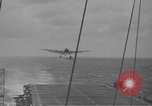
U.S. Navy TBF Avenger gunner from USS Essex is buried at sea with his aircraft during World War II
A Grumman TBF avenger torpedo bomber of VT-15 Torpedo Air Group, approaches and lands on the deck of the USS Essex (CV-9) during the Battle of Manila Bay, in World War 2. Upon landing, Lt. Robert Cosgrove (Pilot) and Sailor Digby Denzek (Radioman) can be seen in their respective forward and middle crew positions. But the rear gunner position, occupied by Aviation Machinist Mate 2nd Class, Loyce Edward Deen (Gunner), has been completely destroyed by Japanese enemy 40mm shell fire, and AMM2C Loyce Deen is dead. As the aircraft is parked among others, with wings folded up, U.S. Navy sailors of the USS Essex take fingerprints and cut dog tags from the body of AMM2C Deen in the gunner position. Captain Carlos W. Wieber, Commanding Officer of the Essex, and her crew, participate in funeral services on the deck. A chaplain conducts the services from beside the aircraft, where Loyce Deen's remains in the gunner's position have been shrouded. Closeup of Rear Admiral Frederick C. Sherman during the service of burial at sea. A bugler plays taps. Beside the bugler is David L. McDonald, who was XO of the USS Essex (and later Chief of Naval Operations in the 1960s). Deen's remains are then buried at sea in the TBF avenger in which he died. The aircraft floats off the fantail for a short time before sinking from view. Two TBF Avengers are seen flying overhead, in tribute. Crew members then disband and return to their duties.
CRITICALPAST.COM: About Us | Contact Us | FAQs - How to Order | License Agreement | My Account | My Lightboxes | Shopping Cart | Advanced Search | Featured Collections | Website Terms & Conditions | Privacy Policy ©2026 CriticalPast LLC.
License Agreement |
Terms & Conditions |
Privacy Policy
©2026 CriticalPast LLC.