


 Francais
 Deutsch
 Italiano
Refine Your Search
2nd-Rangers-D-Day stock footage and images
- Showing 7669 to 7674 of 13612 results more
more Hide
Hide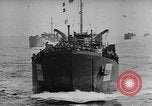
Allied troop transport ships en route to a beachhead in France during World War II.
A convoy of Allied troop transport ships en route to a beachhead in France, during World War 2. The leading ship displays the number 321 on its bow. Allied troops play with a pet monkey on the deck of a ship. Colonel Kirke B Lawton smokes a cigar as he sits on the bridge of a British transport ship with British Naval officers. The waterfront is crowded with Allied vessels. Many barrage balloons fly overhead. Landing ships at the beachhead. Two U.S. landing craft are seen, numbered 512 and 72. Large Landing ships discharge their cargoes of trucks, tanks, and military vehicles of all sorts. An L-4 airplane being carried on a 2 and a half ton truck. U.S. and British tanks and troops moving inland.
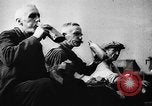
Germans laborers rest beside dragon's teeth at the Siegfried Line and Adolf Hitler with other officials tour Westwall bunkers
Germans at the Siegfried Line World War 2 defenses in Germany. German laborers take rest next to dragon's teeth (tank traps). Adolf Hitler in his car gives a Nazi salute. He rides on a road arriving at a Westwall standardized bunker. He speaks with other officials including Commander in Chief of Army Group 2, General Erwin von Witzleben, and enters a bunker. Views of German soldiers at Westwall bunker -- appears to be Regelbau 35 -- loading large artillery gun. Hitler and officials look at a map. Newspaper headlines announcing von Witzleben's declaration to Hitler about readiness of the Westwall fortifications.
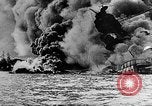
Japan extends its empire into Manchuria, Mongolia, and China in 1931 and 1932
Brief opening scenes show ships being engulfed in flames and smoke from Japanese attack on Pearl Harbor, December 7, 1941 in World War 2. Focus is primarily on the USS Arizona. Scene shifts to Japanese troops assembling on a pier and boarding troop transport ships bound for Manchuria and China, following the Mukden Incident of September, 1931. Japanese troops are then seen marching into Manchuria on September 18, 1931. A formation of Japanese soldiers presents arms. In another formation, they shoulder swords. Closeup of a Japanese soldier in a steel helmet with chin strap in place. A steam locomotive pulls a train into the Chin Hsien station on the South Manchurian Railway. A Japanese train on that line had been dynamited, triggering a Japanese push into Mukden. View from behind a train leaving Chin Hsien on the South Manchurian Railway. Japanese battalions place bundles of straw across a stream to facilitate troop crossing. A column of Japanese troops is seen crossing the water on the makeshift straw crossing. Japanese troops advancing along with supplies carried by pack animals. Troops traverse a sandy berm past an abandoned two-wheel cart. A formation of 12 Japanese G3M bombers flies overhead in a "V" formation en route to bomb Mukden. View of Chinese population running for shelter from the bombing. Chinese walk past some civilian casualties lying in a street. The League of Nations headquarters in Palais Wilson, Geneva, Switzerland. A memorial to Woodrow Wilson at the Palais Wilson reads: "A La Memoire De Woodrow Wilson President des Etats-Vnis,Fondatevr DL La Societe Des Nations, La Ville de Geneve." A car driving away from the entrance of the League Headquarters. Closeup of doorway with sign identifying it as the entrance for delegates and members of the Press. League delegates are seen inside its meeting hall. Japanese warships are seen next, attacking 15 miles from Shanghai with naval gunfire.Three Mitsubishi 2MR4 (Type 10)Reconnaissance biplanes are seen in flight above the barrel of a large naval gun. Japanese troops marching into Shanghai, as people on the roadside wave Japanese flags. Next, they are seen marching out of Shanghai at the insistence of the League of Nations. After signing a truce with China, on May 4, 1932, Japanese troops are seen entering Mongolia, in September, 1932, which they reconstituted as the Puppet State of Manchuko. A Japanese soldier standing atop a building waving a Japanese flag. Japanese statesmen resigning and leaving the League of Nations in protest after it labeled Japan an aggressor. Japanese forces fire a long barrel Type 89 cannon (150mm) as they push into China proper. Group of Japanese artillerymen use range finders, Periscopic viewers and binoculars to guide the gunners. Shell explodes raising large amount of earth. More views of artillery firing and infantry advancing. Infantry crossing a bridge and raising siege ladders to scale a fortress. Engines running on Japanese Ki 30 Type 97 airplanes, as pilots get final briefing and orders. They salute, board their aircraft, and are seen in formation aloft, dropping bombs. View from the air of bombs striking below. View from a bomber of its bombs dropping from the aircraft (bombs away view) and exploding on the ground. A column of Chinese soldiers moves along a section of the Great Wall of China heading into the interior of China. Civilians moving all manner of equipment and machinery into the interior.

A mammoth Studebaker "Giant Car" roadster is seen in South Bend, Indiana.
In South Bend, Indiana, views of a "Giant Car" Studebaker roadster built by a group of 60 craftsmen working under Studebaker's Paul Auman. This giant scale version 1931 model 80 Studebaker Four Season Roadster was used in the film "Wild Flowers." The Giant Car is 41 feet long with a wheel base of 325 inches. It is 13 1/2 feet high, 15 feet wide, and weighed 5 1/2 tons. Men drive up beside the giant President roadster in a normal vehicle. Some use a rope ladder to climb up into the giant car and others climb up the wheel fender and then onto the hood. A boy is shown trying unsuccessfully to climb up a giant wheel of the car (each wire wheel was 6 feet 8 inches in diameter and weighed 600 pounds). The boy's small pedal car is seen beside the Giant Car tire. A police officer in a motorcycle rides up beside the giant car. He places a board-style 'Police Ticket' on the running board and then climbs up onto the running board to present the ticket to a woman who is behind the wheel of the giant roadster.

U.S. and German forces clash at Stavelot, Belgium, during World War II
Opening slate identifies site of World War 2 combat as Stavelot, Belgium, 20 miles from the German frontier. American soldiers of the 30th Infantry Division are seen digging protective field positions. M1917 Browning 30mm machine guns are at their positions. U.S. troops set up 90mm guns along the roads, as fog begins to obscure the area. On 21 December, 1944, Two U.S. soldiers walk across a square in the town of Stavelot where American and German forces clashed on December 20th. Views of destroyed buildings, abandoned Tiger II tank of s.SS.Pz.Abt.101 and Stummel half-track and wreckage. Civilians run for cover into a substantial building as German forces renew an attack on the town. (World War II; WW II; World War 2; World War Two)
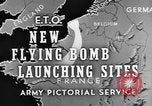
Canadian troops occupy a German flying bomb launching site and describe launching apparatus in Flanders, France.
Canadian troops occupy a German flying bomb launching site in Flanders, France. Map of France. Long rocket launching ramp. View of pistons that propel buzz bomb during take off. Allied pilot takes photographs. Canadian troops inspect the ramp mounted with a 400 pound piston. Canadian troops carry V-2 bombs and load them on to piston. The operation of the V-2 and launching apparatus: Man operates remote control boxes for launching. Soldier handles jet nozzle assembly. Jet propulsion engine is used for fire piston set off explosives. Compressed air bottle supply power for gyro pilots. Servo motors moves radar and elevator. Unexploded head contains explosives for bomb. Diagram shows flying bomb and its parts. View of a bomb site. (World War II period).
CRITICALPAST.COM: About Us | Contact Us | FAQs - How to Order | License Agreement | My Account | My Lightboxes | Shopping Cart | Advanced Search | Featured Collections | Website Terms & Conditions | Privacy Policy ©2026 CriticalPast LLC.
License Agreement |
Terms & Conditions |
Privacy Policy
©2026 CriticalPast LLC.