


 Francais
 Deutsch
 Italiano
Refine Your Search
2nd-Rangers-D-Day stock footage and images
- Showing 7717 to 7722 of 13612 results more
more Hide
Hide
Chaplains conduct Easter Services aboard USS Cone (DD-866) underway at Yankee Station.
U.S. Navy aircraft carrier USS Kitty Hawk (CV-63) underway near Yankee Station in Vietnam. A man wears flight gear and helmet and leaves a hatch way. He moves up on a ladder. Man arrives on the flight deck. Chaplain arrives in flight gear. Two Chaplains walk over the flight deck. Aircraft parked on flight deck. U.S. Navy helicopter UH-2C Seasprite parked in the background. Chaplains donning Mae Wests. Both Chaplains have a gold cross on their helmets. Chaplains board the UH-2C helicopter. Pilot seated in the helicopter. Chaplains are lowered on the deck of USS Cone (DD-866) to conduct Easter Services. A Chaplain puts sling around the waist. Gear lowered on the deck. Junior Grade Lieutenant and Chief Petty officer setting up the altar for services. Small congregation seated in the hangar for the services. Chaplain conducts the services. Men look through their song books. Protestant Chaplain shakes hand with several officers. Small altar set for the service.
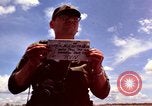
A 50 caliber machine gun aboard a Patrol Craft underway in the Dong Tran River during Operation Jackstay in Vietnam.
Operation Jackstay in Vietnam. A PCF-26 (Patrol Craft Fast or Swift Boat) underway in the Dong Tran River. A man at the controls of the craft. EN2 (Engineman Second Class) Gunter is wounded during a patrol. The chief C.P. Gernigan bandages his wounded arm aboard the craft. EN2 Gunter on a 50 caliber machine gun on the stern. BMC (Chief Boatswain's Mate) on the 50 caliber machine gun. Second crewman stands in the background. He wears a helmet and an armored vest. A machine gun on another craft. A crewman with an M-16 rifle. He stands by the 50 caliber machine gun manned by Chief Boatswain's Mate. (Vietnam War period).
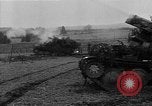
Kaiserbaracke Crossroads, Tiger 222. Battle of the Bulge in World War II
Sdkfz 138-1 “Grille” self-propelled guns (Panzerkampfwagen) of 1 SS Pz Div support, attack towards Poteau road junction near St Vith on December 16th 1944, during World War 2. Fall of shot is adjusted by artillery radio crew. Cuts to road junction at Kaiserbaracke, Sdkfz 250 half tracks pass road sign, VW166 stops at sign before moving off. German PK photographer adjusts sign, removing 202 Ord Depot sign. Stoewer 1500a passes camera towing 12cm mortar, VW166 slows in front of camera. Tiger 222, carrying Fallschirmjager of FJR9 passes camera, followed by motorcyclist. Two officers stop to talk on road as other Sdkfz 251 half track passes. Cuts to two officers walking right to left past camera in front of stationary Sdkfz 250. A crew member stands in rear looking on. Cut to close of of VW166 Schwimwagen, driver smoking cigar, officer looks at map. Cut to Tiger 222 stopped outside Ligneuville. Paratroopers on rear deck share cigarettes with motorcyclist. They are armed with K98, MP44, British Sten gun, MG42. Cut to Gustav Knittel looking at map, they look around as U.S. aircraft fly overhead. Cut to Sdkfz 7 with 2cm gun on road, Kubelwagen passes destroyed U.S. 76mm AT gun.
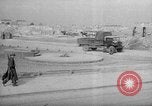
Ruined buildings outside Warsaw, and the first memorial to the Warsaw Ghetto uprising in Poland
Scenes shortly after the end of World War 2. View of the mostly cleared rubble and ruins in Warsaw, Poland, near the intersection of Anielewicza Street, Karmelicka Street, Lewartowskiego Street and Zamenhofa Street in the devastated Warsaw Ghetto district of Muranów, near where the first armed clash of the uprising occurred. Two soldiers walk by on a sidewalk beside the round memorial on the street corner. A truck is parked on an intersecting street. There are mostly open sight lines into the distance with all buildings having been destroyed. A horse cart moves along the road. A jeep with soldiers pass along the road. Closer views of the first memorial to the Warsaw Ghetto Uprising (also later called the Monument to the Ghetto Heroes), designed by Leon Suzin. Views of the inscription on the stone memorial, dated April 19,1946, and commemorating Polish Jews who fought against German military forces in World War 2. Translated, it reads, "To those who fell in an unprecedented and heroic struggle for the dignity and freedom of the Jewish people, for a free Poland, and for the liberation of mankind. Polish Jews." Some flowers laying at the memorial site. (The round 1946 memorial tablet, with its shape symbolizing the underground manholes used during the uprising, was later incorporated into the larger Monument to the Ghetto Heroes, sculpted by Nathan Rapoport and unveiled in 1948.)
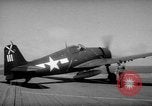
Flight deck operations on the USS Wasp (CV-18) at the end of World War II
Fleet Carrier Air Group 86 (CVG-86) embarked on the USS Wasp (CV-18) at end of World War 2. A pilot of Squadron VF-86, sits in an F6F with engine running, on flight deck of the Wasp. He runs the engine a while, then shuts it down, and climbs down from the aircraft. Another pilot greets him and they both walk across the deck together. An F4U, Corsair (Number 154) of Fighting Bombing Squadron 86 (VBF-86) takes off, followed by another (number 155). Next, a TBM-3E Avenger (number 301) of VT-86, takes off, followed by numbers 303, and 314. An SB2C-4 Helldiver (number 210) is the next to take off. View aft, shows sailors working around an F6F; a tug driving along the flight deck; and a destroyer (looks like Fletcher-class) underway in far background.

The Moritzburg Castle, the Opera House and the Zwinger Museum in Dresden, Germany.
Famous tourist destinations and architecture in Saxony, Germany, before World War 2. Views of the Moritzburg Castle (Schloss Moritzburg, Schloßallee, 01468 Moritzburg, Germany) and the Semperoper Opera House building (Semperoper Dresden Schinkelwache Theaterplatz 2 01067 Dresden) in Dresden, Germany. View of the world-famous Zwinger Museum (Zwinger Theaterplatz 1 01067 Dresden). Trains passes by on a track. Buildings in the background.
CRITICALPAST.COM: About Us | Contact Us | FAQs - How to Order | License Agreement | My Account | My Lightboxes | Shopping Cart | Advanced Search | Featured Collections | Website Terms & Conditions | Privacy Policy ©2026 CriticalPast LLC.
License Agreement |
Terms & Conditions |
Privacy Policy
©2026 CriticalPast LLC.