


 Francais
 Deutsch
 Italiano
Refine Your Search
2nd-Rangers-D-Day stock footage and images
- Showing 769 to 774 of 13613 results more
more Hide
Hide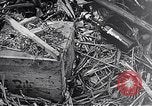
U.S. Marines in mopping up operations on Iwo Jima during World War II
D-Day + 7 on Iwo Jima during World War 2. View of Japanese wooden crate in debris and sea grass. A bottle of Saki sits next to it. A U.S. marine examines it closely and finds a wire connected to the crate (a booby trap). He cuts the wire, removes the bottle, and ties a red warning flag by the crate. Camera focuses on a wrecked Japanese 75mm wooden-wheeled mountain gun with several shells on the ground nearby, and then on the breech of, what appears to be a wrecked 10cm wooden-wheeled cannon with a shell in the sand next to it.
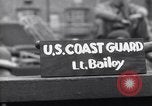
Elements of Allied invasion fleet, including USS Samuel Chase, en route to Normandy during World War II
View from stern of Landing Craft Infantry, of Several Allied vessels underway near coast of England, as they begin voyage across the English Channel for the D-Day invasion of Normandy during World War 2. The Attack Transport ship, USS Samuel Chase, is seen from abeam her port side. A destroyer is steaming at her starboard. A U.S. Coast Guard 83-foot patrol boat of Rescue Flotilla One,is seen. She displays the number 6 on her bow and supercarriage and a skull and cross bones, as well.
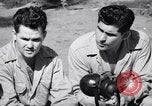
An escaped and then rescued American prisoner of war describes the Japanese death march to San Fernando
A representative of Prisoners War Branch (a MIS-X officer) interviews American soldiers who had escaped from the Japanese 10-A prison camp in Palawan, Philippines, and had then been rescued. Private first class Albert D Pacheco and Edwin A Petry share their experiences before they reached the World War 2 Japanese prison camp at Puerta Princessa, Palawan and the conditions there. Petry describes the famous five days long death march to San Fernando, where war prisoners were not given any food.
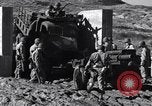
American troops practice loading and handling of vehicles aboard concrete landing craft in France during World War II.
American troops practice in the military training area at Braunton Burrows North Devon, England, in preparation for the D-Day landings in Normandy, during World War 2. They practice handling and loading of 105mm Howitzers, trucks and vehicles aboard concrete landing craft mock ups Vehicles being unloaded from one of the mock ups.

World War II Allied invasion of Normandy as seen from the German perspective
German civilians read newspaper headlines about Allied invasion in Normandy, France, during World War 2. The German newspapers also contain stories about German military operations in Russia. German radio operators wearing headphones in communication centers, being warned of Allied bombers during D-Day operations and relaying information by radio and morse code. German soldiers rush from underground bunkers, grabbing helmets and rifles, to man battle positions in Atlantic Wall defenses. German soldiers running in underground tunnels. Anti aircraft guns being fired at Allied aircraft. Guns aboard German ships being fired at Allied vessels and aircraft at night. Explosions occur causing fiery flashes.
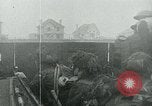
Canadian troops wade ashore from landing craft on Juno Beach in Normandy, France, June 6, 1944.
View of Canadian troops on D-Day huddled in a landing craft approaching Juno beach in Normandy, France, during Operation Overlord, June 6, 1944, in World War 2. The landing craft reaches the beach and all the Canadian infantry leave the boat, two or three at a time, and wade ashore during the invasion of Europe by Allied forces. Steel obstacles placed by the German forces can be seen on the beach. Several houses, stand along the beach. Two other landing craft with Canadian soldiers arrive near beach and soldiers wade ashore. The troops advance on the beach.
CRITICALPAST.COM: About Us | Contact Us | FAQs - How to Order | License Agreement | My Account | My Lightboxes | Shopping Cart | Advanced Search | Featured Collections | Website Terms & Conditions | Privacy Policy ©2026 CriticalPast LLC.
License Agreement |
Terms & Conditions |
Privacy Policy
©2026 CriticalPast LLC.