


 Francais
 Deutsch
 Italiano
Refine Your Search
2nd-Rangers-D-Day stock footage and images
- Showing 7819 to 7824 of 13612 results more
more Hide
Hide
Men work with pontoons for salvaging U.S. Navy submarine Squalus off the coast of Isles of Shoals near Portsmouth,New Hampshire.
Salvaging activities for the U.S. Navy submarine Squalus (SS-192) off the coast of Isles of Shoals near Portsmouth,New Hampshire. Pontoon afloat on surface with cable slings attached. Men work with pontoon alongside U.S. Navy Ship Falcon (ASR-2). Men on top of pontoon. "Flowerpot"cable clamp is lifted from pontoon by crane hook. Men work with "flowerpot" on deck of U.S. Navy Ship Falcon (ASR-2). Officer sits on bitts in the foreground. Men work with cable on top of pontoon. Air hoses stretched over surface seen in the background. Pontoon alongside USS Falcon. Air bubbles come up along lower portion. Air hoses in mass lying on surface. View of the motor launch and crew work. Man stands on the top of mass of hoses on surface. Men work with hoses stretched over surface. View of the rescue site. Air hoses seen on surface.
U.S. Army 75th Division, 289th Infantry Regiment soldier paints signs in Ickern, Germany during World War II.
Scenes in Ickern, Germany following the town's defeat and occupation by U.S. Army forces in World War 2. Opening shot shows an American soldier in World War 2, with a paint box, kneeling down and touching up a letter on sign painted across a bridge that reads: "Visit Ickern -- A Good Place to Live --Now! 289 Inf. 75 Div. Chamber of Commerce--Every Home a Knockout!" The soldier walks across the bridge and stops to touchup more letters in the sign. Next, the soldier is seen touching up painting on a concrete pillar reading: "The 289 Inf." Closeup of the GI artist using his paint brush, as Sherman tanks pass on street behind him. Change of scene shows the artist working on another sign, reading: "The 289 Inf. 75 Div. took this town!" A tank pulling a caisson passes behind him. The soldier painter touches up another sign on a concrete wall reading: "Roses is Red, Violets is Blue, the 289th took Ickern for you, 75th Division." The artist paints "Kaput" on a German 8.8 cm Flak 41 anti aircraft gun set up on a street. An American soldier rotates the gun, showing more painted comments on its front that read, "Love and Kisses from the 289 Inf 75 Div." Standing in front of a building with a huge hole in it, the artist paints, "This home is a knockout! 289 Inf. Chamber of Commerce." German woman and young boy stand at corner as GI artist paints message on house behind them. German civilian passes on a bicycle as the artist paints on a destroyed German truck. The Message reads, "GI Cooks Tour on Hitler's Autobahn, Courtesy of 289 Inf. 75 Div."
Nazi leaders speak. Faces of Allied soldiers. Nazi massacres. Victims mourned. German troops surrender. American life.
Nazi leaders in Germany giving speeches during World War 2. Soldiers from various countries like England, Poland, Greece, America and Norway. View of young boy soldiers in Germany at end of World War 2. Earlier scene of Nazi Waffen SS soldiers as they march with goosestep on parade. Victims executed in Nazi massacre in Italy shown with hands tied behind their backs. Nazi victims mourned in France. Bodies of women and children slain by the Nazi SS in Belgium. A large crowd of civilians gathered to pay homage to the dead in Lublin, Poland. Allied military vehicles and personnel trample and walk on Nazi flags and posters in Germany. A pile of Nazi flags burning in the street, as men, women and children walk past. German prisoners of war assembled in a large outdoor enclosure, and moving out in a line. German soldiers surrendering, with white flags displayed. American soldiers look at open mass graves of persons shot dead by Nazis. Emaciated boy children inmates of Buchenwald concentration camp stand behind barbed wire fence around the time of its liberation. The prior scenes are contrasted with ordinary life in the United States. A boy retrieves a ball from a pond, and throws it. Children play on see saws at a playground. A baby take first few faltering steps. A girl hangs from monkey bar. A man and two women share a newspaper article.
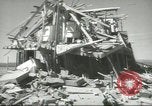
Soldiers assess damage from atomic explosive test shot,"Apple Two," during U.S. Army exercise Desert Rock 6.
Views of various structures and objects after being exposed to atomic explosive test shot "Apple 2" during U.S. Army Exercise Desert Rock VI. A wooden frame house splintered by the blast. A low concrete structure, relatively intact. An overturned Army vehicle. An unsheltered low-wing monoplane, number NG 489851, with skin stripped from its horizontal stabilizer and wing tips. A P-47 aircraft appearing relatively intact. A badly damaged two-wheel trailer. A relatively unscathed auxiliary power unit on a stabilized trailer. Vehicles reduced to rubble. Radar unit and accompanying truck and power unit, seemingly OK, but dish antenna may be damaged. Three soldiers stand around an M2HB heavy machine gun knocked from its stand. A B-29 bomber sits on a ramp with a sign in front of it warning of radiation. A ground crewman sprays the bomber down with a pressure hose to decontaminate it by washing off radioactive particles. A soldier rides a jeep out to check radiation readings on a vehicle that had been exposed. Troops walk back from ground zero and undergo personal cleaning with brooms and checks by geiger counters. A soldier being checked, including his boots. Soldiers sweeping dust from M48 tanks used in the exercise. A soldier being "interviewed" by another, about means of coping with atomic weapons on the battlefield. A formation of soldiers marching, led by one carrying a Corps of Engineers Guidon with the number 14 on it. [Note: According to the U.S. Department of State, Office of the Historian, from February 18 to May 15, 1955, the United States conducted Operation Teapot, a nuclear test series at Yucca Flat and Frenchman Flat on the Nevada Test Site in the continental United States. During the test period 14 nuclear shots and 1 non-nuclear shot were detonated. Several thousand scientific, military (army, air force, navy, marines), and civilian contract personnel participated in the organization, planning, and execution of the test series. Military exercises undertaken during and following the shots took place under the name Desert Rock 6.]
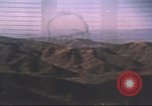
Montage of scenes from the Korean War
Montage of Korean War scenes. View of mountainous terrain in Korea, 1950. African American soldier yells, holding phone left hand, as gun crew fires a 240mm howitzer. American soldiers, in heavily sand-bagged position, firing 4.2 inch mortar. Gunners firing a quad .50 machine gun and others firing a 155mm howitzer and an M2 .50-caliber machine gun. American soldiers in sandbagged and camouflaged bunkers. An army patrol heading out from their defensive position. Barrels of artillery pieces silhouetted against the sky. Numerous bursts of artillery fire flashing in the black of night. Weary soldiers returning from a patrol.
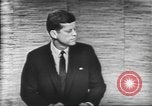
During a presidential election debate in Washington DC, Kennedy comments that its proper to express regrets to nations.
The second Kennedy-Nixon Presidential Debate in Washington DC, United States . Edward P. Morgan of ABC News asks Democratic candidate Senator John F Kennedy about sending apologies or regrets to General Secretary of the Communist Party of the Soviet Union Nikita S Khrushchev over the U-2 reconnaissance aircraft incident. Kennedy answers that if it could save the summit conference it would have been proper to express regrets. He speaks that the U-2 flights were proper from the point of view of protecting their security. But they were not in accordance with the international law. He speaks about the regrets expressed to Castro, to Southern Russia and to Eastern Germany under the Eisenhower Administration during the past years. He mentions the regrets expressed by the Soviet Union and the Chinese Communists to the U.S. over incidents. He states about they should have a stronger military force and should increase their strength all over the world. Republican candidate U.S. Vice President Richard M. Nixon presents his views and states that Senator Kennedy is wrong in thinking that Khrushchev might have continued with the summit conference if the U.S. had expressed regrets. He disagrees with Kennedy's analogies that the U.S. is a strong country and can express regrets for any wrong doings. He also disagrees in expressing regrets to anybody for doing things which has the support of the Congress and which is right from point of view to protect the security of the U.S. (This 4 part debate is sometimes called the Great Debate)
CRITICALPAST.COM: About Us | Contact Us | FAQs - How to Order | License Agreement | My Account | My Lightboxes | Shopping Cart | Advanced Search | Featured Collections | Website Terms & Conditions | Privacy Policy ©2026 CriticalPast LLC.
License Agreement |
Terms & Conditions |
Privacy Policy
©2026 CriticalPast LLC.