


 Francais
 Deutsch
 Italiano
Refine Your Search
2nd-Rangers-D-Day stock footage and images
- Showing 9001 to 9006 of 13613 results more
more Hide
Hide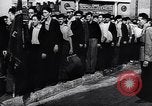
Soviets mobilize for war on the home front during the German invasion of Russia in World War II
A huge number of local men, volunteering to join the Red Army, are seen parading (in civilian clothes) through a Soviet town, in 1941, during time of the World War 2 German invasion of the Soviet Union, known as Operation Barbarossa. Men lined up at an outdoor recruiting station where Army officers and a clerk are seated at a table. View of a man signing his name and date of birth a sheet of paper. Next, he shakes hands with all the recruiters. Next, recruits are seen walking in loose formation. They are still in civilian clothes, but carry sacks with their first government- issued belongings. Change of scene shows workers in a factory and miners working in a coal mine. they use a machine driven conveyor to move chunks of coal from the mine. Scientists at work. The man at extreme right is Soviet Nobel Laureate Physicist, Pyotr Leonidovich Kapitsa (Peter Kapitza). He heads the Department of Oxygen Industry. attached to the USSR Council of Ministers. Oxygen bubbles in a scientific glass device. Several views of fiery molten steel flowing in a steel mill. Older retired man back at work in a machine shop, operating a milling machine, to help the war effort. A man using calipers as he instructs a woman in a machine shop. Closeups of a young women working on various machines in the shop. One at a lathe, stops to inspect a piece of turned steel she is making. A man hot forging a part on a drop forge. A woman monitoring machinery controlling the forge. Women from rural areas in the Ukraine, attend a class to learn about tractors. Instructor using a large illustration to explain parts of a tractor. One of the women manipulates a tractor part. Another adjusts a carburetor. One closes the side hood of a tractor. One woman gets behind the wheel of a tractor, for the first time.Her instructor manipulates its gears as they drive it forward. A line of school children walks in a village with their teachers. Next, the girls are seen cultivating crops on a truck farm, and the boys are seen working in a wheat field. Three boys are assigned "Sentry Duty" and climb wooden towers to maintain lookout for invading German paratroops or other forces. An older man performing similar duties on a rooftop in a village. Another man on the lookout atop a wooden tower. An old man with a rifle on the lookout. Another man holding a rifle in a wheat field.
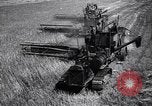
Farmers in Ukraine save crops from invading German forces in World War II Civilians prepare fortifications and defenses
Three Soviet harvesting machines in formation cut wheat in Ukraine before arrival of invading German forces during Operation Barbarossa, in World War 2. Several varying closeups of the harvesting operations and the farmers as they work. Tractor pulls a harvesting machine. Closeup of farmer teaching his wife how to operate the machinery. View of her at the wheel. People (mostly women and children) gleaning grain from the fields after the machinery has finished. Soviet soldiers carrying long handled scythes walk past the wing of an aircraft parked in a field, to join those in the harvesting. A windmill is seen in the far background. Civilians and soldiers work together with hand held tools to cut wheat. Closeup of woman twisting stalks to form a rope to bind the wheat sheaves. Views of soldiers carrying sheaves of wheat. People gathered around and atop a threshing machine. Workers,using pitch forks, toss wheat sheaves up to the threshers, who push them into the threshing machine. A tractor pulls a many wagons filled with flour, from a mill. Complete change of scene shows civilians hard at work building fortifications. Several ensuing scenes show civilians sandbagging and strengthening fortifications in other Allied countries, such as France, Czechoslovakia, Poland, Norway, Holland, Belgium, Spain, and China. Soviet men with shovels digging deep antitank defenses. Many hundreds of Soviet women at work with shovels building defenses along a hillside. A cadre of Soviet women, in uniform, march under command of a military officer, at a square in Moscow. Some appear to be carrying rolled up stretchers or litters over their shoulders, reflecting their role as nurses or medics. Red Cross nurses train for an emergency. One practices bandaging the arm of another. Several Red Cross nurses line up in a formation to march
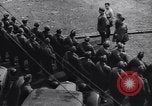
Women serving in the Soviet army and women with children, preparing gifts for soldiers during World War II
A battalion of Soviet women soldiers stands at attention in formation as officers address them, during World War 2. . Change of scene shows one bandaging the arm of a wounded soldier. A shell bursts nearby. Several Soviet soldiers advancing in a field. Closeup of a Soviet woman soldier. Another shell explosion. View reverts to the battalion of women soldiers in formation. Closeups of several of them. The battalion members break formation and board open army trucks that will take them to the battle front. Views of civilian women and children behind the lines at home, filling parcels with cakes, socks, handkerchiefs, and the like, for soldiers at the front. Closeups of women knitting and sewing items for the troops. One little girl has painted a design on a box for the soldiers. Camera zooms in on the painting. Closeup of a package ready for shipment. In bold letters the main heading on the parcel reads: "подаркн боицам" (Gifts for Fighters). View of a package being opened by soldiers at the front, reveals newspapers and other small items. Soldiers reading an enclosing message from the senders. View of a letter, with many signatures on it. Smiling soldiers share contents of the box, which includes cigarettes
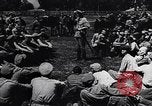
Home guard cavalry unit training during World War II in Soviet Union
An old bearded Russian Cossack stands in the midst of a contingent of Soviet cavalry, seated on the ground, during World War 2. Closeups of some in his audience. Next, the old man is seen riding at the head of a troop of cavalry. They pass close to the camera, and then are seen from above, as they proceed along a dirt path. Marshal of the Soviet Union, Semyon Audyonny, is seen consulting with other officers. (Narrator states he is involved in training home guard cavalry.) Cavalry mounting up and heading out, past a fence where several rural people wave to them. A troop of Cossacks in Papaha (black Cossack hats) is put through their paces by their commander. He directs one of his troop to charge on horseback, brandishing his sword. The Cossack charges through a series of wooden stakes, swinging his sword at each as he passes. Closeup of one cut clean through. Final scene shows the entire troop charging in formation
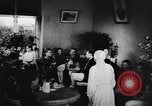
Soviet women donate blood for use at the battle front during World War II.
Waiting room of a city hospital in the Soviet Union, during World War 2. it is filled with women waiting to donate blood. A nurse in white, calls one of the women, who follows her. Several women are seen in the donor station of the hospital. The women show some identification and are accepted as blood donors. One woman writes a letter that will be sent with her blood donation. A laboratory technician takes her letter. She follows him, dons on a white gown and mask and goes to a table where she lies down. View of her blood entering a collection flask. Technicians preparing the vials of blood by wrapping them and placing them in refrigerator containers for shipment to the battle front. The woman blood donor sits upright, removes her mask, and smiles.

Soviet Union builds railroads and mines natural resources for war effort west of Urals in World War II
Views of Moscow, and the Kremlin, in the Soviet Union, during World War 2. View of snow covered mountains in the Urals. Map of Russia and environs focusing on areas east of the Ural mountains including Siberia. A pointer highlights areas where raw materials such as coal, bauxite copper, oil, and nickel are found. View from above of numerous Soviet workers in the Steppes, where blasting occurs during road building. Giant trees are seen being felled to clear the way for roads. Young Russian men and teenage boys are seen at a camp, marching with shovels and other tools over their shoulders. Next some are seen driving spikes as others in teams swing iron rails into place for a railroad. A group of boys are seen shoveling sand into the road bed as a steam locomotive passes pulling a train of box cars on an adjacent completed track. Siberian engineers, examine a construction site and converse. Workers digging a deep ditch for a pipe line to cross the plains. A field of oil derricks and oil drilling operations are seen, with Soviet roughnecks tending the drills and pipes of the oil wells. A pump operating and crude oil flowing. A camel is seen behind a roughneck tending an oil drill.
CRITICALPAST.COM: About Us | Contact Us | FAQs - How to Order | License Agreement | My Account | My Lightboxes | Shopping Cart | Advanced Search | Featured Collections | Website Terms & Conditions | Privacy Policy ©2026 CriticalPast LLC.
License Agreement |
Terms & Conditions |
Privacy Policy
©2026 CriticalPast LLC.