


 Francais
 Deutsch
 Italiano
Refine Your Search
2nd-Rangers-D-Day stock footage and images
- Showing 9433 to 9438 of 13612 results more
more Hide
Hide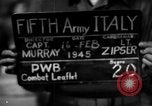
Italian women wrap propaganda leaflets into bundles for insertion into artillery shells and airdrop, Italy.
Italian women working in a factory in Italy under U.S. Army auspices. They wrap the propaganda leaflets into bundles for insertion into artillery shells and airdrop to citizens (psychological warfare in World War 2).
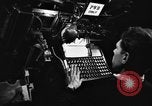
Men work on lino type machine and stereo type plate in Italy creating propaganda leaflets for air drop.
Men work on printing machines in Italy. A man operates lino type machine. 'PWD only' written on the machine. Another man positions stereo type plate and makes one multiple plate for creation of propaganda leaflets to be air dropped in World War 2.
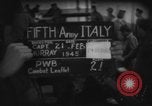
U.S. Army soldiers load and pack leaflet bomb shells with leaflets (Monroe Bombs) in Italy.
American soldiers work in a factory preparing Monroe Bombs filled with propaganda leaflets in World War 2. They load and pack shells with cardboard cylinders containing leaflets, as well as explosive charges to detonate the bombs at altitude which would release the leaflets as part of psychological warfare tactics. The Monroe Bomb shell assembly line is shown in operation.

Exchange German Prisoners of war return home to Stettin Germany, from Oran, Algeria during World War II
The Italian hospital ship, "Gradisca," arrives in Stettin harbour, in Germany, (Stettin on the Oder River, now Poland, Szczecin), during World War 2. She carries recuperating exchange German prisoners of war, back home from Oran, Algeria. They are greeted by medical staff and many well-wishers. Children run to the ship as it berths and throw flowers to the soldiers on deck. Wounded on stretchers are removed first. Then the ambulatory soldiers disembark amid warm welcome. Another steamship is seen approaching on the river. It is the Freigeleit. (Actually, this is the French ship,“Djenne,” in German possession, and it too is bringing exchange German POWs back from Oran.) German soldiers fill her upper decks. They play music on deck and celebrate their homecoming. (All the troops, congregating on their port sides, caused both the Gradisca, and the Freigeleit to list to port, somewhat, as they approach the pier.) A bouquet of flowers is raised to the deck of the Freigeleit, on a line, as she ties up. Red Cross nurses line up holding flowers, as sick or wounded soldiers are taken off the ship on stretchers. Then the remaining troops disembark and are greeted with flowers. Some troops write notes to be transmitted to loved ones. A military band plays on the pier. The soldiers board waiting railroad trains to continue their journey.
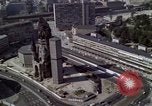
View of the remains of Kaiser Wilhelm Memorial Church and factory area in Berlin, Germany.
Points of interest in Berlin, Germany. High altitude view of the city. The remains of Kaiser Wilhelm Memorial Church still damaged from World War 2, factory area, marshaling yard, coal stockpiles and apartment buildings.

B-17s of 91st Bomb Group, including the "Memphis Belle," return from mission over Wilhelmshaven, Germany.
One by one, 29 B-17 aircraft of the 91st Bomb Group (out of 36 launched) return from their bombing mission over Wilhelmshaven, Germany during World War 2. Many suffered battle damage and have wounded crew aboard. The B-17, "Dame Satan," is seen with large holes in it. The B-17, "Old Bill," is shot to pieces, with its nose missing. Lieutenant Colonel Stanley T. Wray waits in control tower as three more aircraft arrive, including the "Memphis Belle." Her crew members relax and smile as she lets down to land. Her pilot, Captain Morgan buzzes the airfield before landing to complete their 25th bombing mission. They are congratulated by well wishers on the ground. Their crew chief paints the 25th bomb on the "Memphis Belle" fuselage. Change of scene: Brigadier General Haywood S. Hansell, Jr. awards a Distinguished Flying Cross to each crew member. Change of scene: King George VI and Queen Elizabeth, of England, visit the flight crew and ground crew of "Memphis Belle" and converse with them. Change of scene: Lieutenant General Jacob L. Devers, Commander of U.S. Army Forces in Europe, and Major General Ira Eaker, Commander of the 8th Air Force, visit and greet the crew. General Devers reads their orders to return to the United States and encourage Americans on the home front.
CRITICALPAST.COM: About Us | Contact Us | FAQs - How to Order | License Agreement | My Account | My Lightboxes | Shopping Cart | Advanced Search | Featured Collections | Website Terms & Conditions | Privacy Policy ©2026 CriticalPast LLC.
License Agreement |
Terms & Conditions |
Privacy Policy
©2026 CriticalPast LLC.