


 Francais
 Deutsch
 Italiano
Refine Your Search
2nd-Rangers-D-Day stock footage and images
- Showing 9439 to 9444 of 13612 results more
more Hide
Hide
German Air Force Junkers 88 bombers on a nighttime bombing mission over London, England
A German airfield where bombers are getting ready to take off on mission to blitz bomb London, England during the Battle of Britain in World War 2. View from one of the German aircraft in a large formation of Junkers 88 bombers in flight. Aerial view as the aircraft pass over the coast of England, United Kingdom. The shoreline visible below. Point of view from inside cockpit of German aircraft mission during bombing raid. British defenders employ lights and antiaircraft fire. Bombs can be seen as exploding lights in the darkness on the ground.
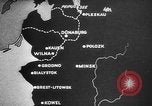
German military operations on the Eastern Front in World War II
German military action on the Eastern front in World War 2. Map shows places. German forces invading Belorussian Soviet Socialist Republic. Soldier near a German Tiger tank. Military vehicles move on street. Soldiers fire from tanks. Soldiers near rail road station. They lay demolition charges on railway tracks. The charges destroy the tracks. Bombardment in the area. Houses and trees. Local refugees leave the area along with their belongings in wagons and their cattle. Tiger tanks move on the field. Destroyed Soviet Sherman tanks (Lendlease). Wreckage in the city.
Early allied victories in Europe during World War II are challenged by German counter attacks in late 1944
Elements of U.S. Army arriving in a town in France, in August, 1944, during World War 2. Local people line the sides of the roads to welcome them. Young French women reach up to American soldiers in the back of an open stake truck and later mingle with them on the ground. Some of them kiss the soldiers. Some American flags are displayed by people in the crowd of well-wishers. One American soldier holds up a souvenir Nazi flag.Large crowds of French people gathered in a square to welcome the Americans. Many display the "V for Victory" sign with their hands. Film fades to a brief glimpse of a fallen soldier, and new slate reads: "Counterattack." Next, U.S. Medical Corpsmen are seen carrying American wounded to ambulances in the field in December, 1944.Several views of medics attending to American wounded soldiers. American infantrymen advancing across a field beside a Pershing T26E3 tank. (Note: It has 6 bogey wheels. Not designated M26 until 1945.) American infantry advancing into area of burning buildings and then into built up part of town, where they take up defensive positions inside a building. A U.S. soldier firing out a building window. Other U.S. soldiers firing from positions behind a wall. One is next to a mortar. Buildings burning and destroyed all around them. Close-up of American soldiers firing M1 Garand rifles from behind the wall. Infantrymen hunkered down behind a stone wall with light snow atop it. An explosion from a hand grenade raises smoke. A medical Corpsman checks a fallen American soldier for sign of life. Next, a Chaplain is seen reading from a small bible or prayer book, as he stoops over the fallen soldier. Fallen and wounded soldiers are carried to a truck, from the battlefield, on stretchers. Scene shifts abruptly to captured German film depicting two junior officers conversing in the field and then to German Field Marshal Erwin Rommel conversing with an artillery assault gun officer. Rommel holds a pair of eyeglasses in his right hand. The gun officer wears binoculars around his neck. A war torn city. German Volkssturm (People's Militia) parading. Some carry panzerfaust anti-tank weapons over their shoulders. A field full of German King Tiger II Ausf. B Heavy Tanks. One being driven out of the field. A German SdKfz 251 halftrack maneuvering in woods. it is covered with foliage for camouflage. German soldier in an open single seat courier car. It and he are spattered with mud. Close-ups of the mud-spattered driver smoking an cigar. German infantry moving across a field and moving along a road, in the mist. German infantry moving along a muddy road near a forest. A German V-1 Buzz bomb seen overhead with engine running. It flames out. Next an explosion and rising smoke is seen inside a town.
Public demonstration of "fire bomb" and its use supporting U.S. Marines in the Battle of Peleliu in World War II
A U.S. Navy F6F Hellcat airplane is seen parked on a ramp, with a bomb slung under its fuselage. The narrator identifies it as a "fire bomb," containing gel gasoline. Scene shifts to an F6F dropping one from several thousand feet, in a demonstration. The incendiary bomb creates a swath of fire along the ground, in the direction of flight. A flight of two F6Fs repeat the demonstration, dropping their bombs simultaneously, from a formation. Another drops a bomb on a pier at a waterfront. View to the rear from an airplane that just dropped a bomb in a wooded area. Views of actual U.S. 1st Marine Division operations on Peleliu, Palau Islands, during World War 2, showing F4U Corsair aircraft, flying low and slow, with gear down, dropping napalm incendiary bombs on Japanese troops dug in on a ridge. View of smoke rising from bomb strikes at targets near a river.

Seeds, crops, farm, and victory gardens worked to support war effort in World War II in the United States.
Agricultural progress motivated by the demands of World War 2, in the United States. Efforts made to develop substitute crops for foreign products now unavailable. Farmer on a tractor in the farm. Crop planted and harvested with the help of tractor. Man takes seeds in hands from a bag. A 100 pound bag of 0-14-14 fertilizer reads: 'AAA for use only in carrying out soil building practices. Agriculture Conservation Program of the Agricultural Adjustment Agency." Farmer Harry Vetch in Mississippi shown in his field of nitrogen rich legumes that he is growing in order to obtain nitrogen fertilizer since nitrogen is needed in the war effort and unavailable to farmers. View of a field of crimson clover also for use in obtaining nitrogen. View of soybean and clover also used for nitrogen in corn fields. Man on tractor spreads manure fertilizer. A sign board reads: "Emergency Rubber Project. Quail Creek Nursery. Forest Service U.S. Department of Agriculture" outside a building. A man examines a test planting of a Mexican hule rubber plant needed to meet war demand for rubber. Man beside a 'Department of Agriculture' truck bounces a chunk of rubber. Also shown is a test planted row of Kok-saghyz Russian dandelion used to produce rubber. Milkweed and goldenrod plants are shown. Narrator talks about Victory Gardens as images of farmers plowing small fields are shown. Samples of Victory Garden vegetables shown on a table with signs noting the nutrients in each such as calcium, iron and vitamin B. A woman in a home victory garden holds up produce. View of a shelf of canned vegetables from a victory garden. Houses and trees on a farm, as a combine harvester works the fields. Mountains in the background. A row of grain silos. Man plows a field with yoked oxen. A woman works on a farm and drives a tractor. Farmers drive tractors and harvest potatoes or onions in a field.
Allied strafing of German aircraft on ground, European Theater.
U.S. Army Air Force 8th Fighter Command Operations, European Theater, in World War 2. Lieutenant E H Miller of 83th squadron 78th fighter group flies the aircraft. Gun camera footage of strafing of German fighter type aircraft on ground. Hits on aircraft and explosion. Strafing of an ME-410 on ground. Hits and explosion. Strafing of a stationery DO-217 on ground. Black smoke arises.
CRITICALPAST.COM: About Us | Contact Us | FAQs - How to Order | License Agreement | My Account | My Lightboxes | Shopping Cart | Advanced Search | Featured Collections | Website Terms & Conditions | Privacy Policy ©2026 CriticalPast LLC.
License Agreement |
Terms & Conditions |
Privacy Policy
©2026 CriticalPast LLC.