


 Francais
 Deutsch
 Italiano
Refine Your Search
2nd-Rangers-D-Day stock footage and images
- Showing 10021 to 10026 of 13612 results more
more Hide
Hide
Canadian Mosquito Bomber and United States Army observation plane are demonstrated early in World War II
Canadian De Havilland DH.98 Mosquito aircraft is shown to the public for the first time, in Canada, early in World War 2. Air Force officers stand near the aircraft. British test pilot Geoffrey Raoul de Havilland Jr., son of the famed British aviation pioneer and aircraft designer, pilots the airplane in a demonstration flight. The plane taxis for takeoff. De Havilland circles and buzzes the field several times to demonstrate its speed and maneuverability. At one point, he feathers the right engine and demonstrates its excellent single-engine flight characteristics. Complete change of scene, to Wayne, Michigan, in the United States and a snow-covered air field where a Stinson Model 76 observation aircraft (registered NX27772) demonstrates its extreme short takeoff and steep climb capability.. Aerial view of the airplane maneuvering aloft and then landing in the snow, whereupon, it spins about in a 180 degree turn and immediately takes off, again, in very short distance and a steep climb. (Note: NX27772 was the final prototype for the L-5 Sentinel airplane, as it was named, when delivered to the U.S. Army.)

View of Memorial Bridge, Lincoln Memorial and Washington Monument in Washington DC, United States.
Public buildings in Washington DC, United States. Memorial Bridge and Lincoln Memorial in view. Vehicular traffic on the street in the foreground. Cars pass by. Civilians walk into Lincoln Memorial (2 Lincoln Memorial Cir NW, Washington, DC 20002, United States). National Mall with the Washington Monument. Lincoln Memorial and snow on ground in the foreground. Corner of the Lincoln Memorial with the Washington Monument in the background.
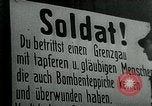
German troops preparing to head toward the war front in World War II
As film opens, a sign in German is displayed reading "Soldier You enter an area with brave and believing people who also know and have overcome carpet bombing." Camera focuses on a large seemingly undamaged cathedral. German troops are seen gathering up their gear and preparing to move during World War 2. Glimpse of a German sailor standing nearby. People boarding a tram with the cathedral in the background. A truck driver stopped and presenting identification to a German soldier on the sidewalk. German troops with their gear, including bedrolls, walking en masse toward and past the camera. Several older civilian men in the background. Signs on building walls (in German) reading "With the Leader to Victory" and "Now fight even more to Victory."
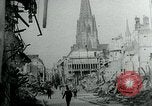
German people evacuate a city subject to Allied bombing during World War II
A large cathedral dominates the opening scene. It seems relatively undamaged although their are destroyed buildings all around it from bombing during World War 2. People are seen carrying their belongings as they flee the area. They pass through narrow corridors between destroyed buildings. View of an orphanage named St. Catharina. View of infants in cribs inside the orphanage. Staff and nurses leading the children out of the building and then loading them aboard a bus. One attendant giving treats to very small infants. Staff waving goodbye to the children and caregivers on the bus, as it departs. Refugees using wagons pulled by cattle to transport them and their belongings. Livestock on the hoof being herded along a road.
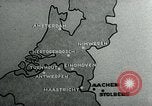
City of Aachen is defended by German Volksgrenadier Divisions during offensive by American 30th Infantry Division supported by armor and aircraft of the 9th Air Force in World War II
An animated map of Aachen and surrounding cities during World War 2, is shown at start of film. Entrenched German heavy artillery is seen firing from wooded areas. Closeups of German soldiers rushing from a bunker and uncovering a camouflaged mortar that they being firing from a trench. Glimpse of shell exploding near a building in the background that narrator says contains Americans. Closeup of German soldier looking upward at the sound of aircraft overhead. German soldiers running for cover. Volksgrenadiers running through backyards of damaged houses. Some seen looking out and firing from inside houses. One points at something outside. German soldier aiming and firing a sniper rifle equipped with large telescopic sight. Camera pans over landscape containing industrial facilities. Closeups of German soldiers in defensive positions. (Note: American forces are not actually seen in this film.)

Adolf Hitler and Nazi officials meet in Munich, early in World War II, on the anniversary of the Beer Hall Putsch of November 9, 1923.
Narrator announces the "9th of November in Munich." (It is 1941, early in World War 2.) A gathering of Nazi officials in a church. They are celebrating the anniversary of the Nazi Beer Hall Putsch of November 9, 1923. Next, a large group of Nazi officials are seen conversing in a large hall. Adolf Hitler arrives to the cheers and Nazi salutes of the attendees, as he walks through their midst and spends time greeting and shaking hands with his old comrades from the 1920s. He steps to a podium. Closeup of him at the podium responding to the adulation of the assembly by rendering a bent elbow Nazi salute. The audience is applauding. According to the narrator, Hitler speaks disparagingly about U.S. President Roosevelt and Soviet leader Stalin.
CRITICALPAST.COM: About Us | Contact Us | FAQs - How to Order | License Agreement | My Account | My Lightboxes | Shopping Cart | Advanced Search | Featured Collections | Website Terms & Conditions | Privacy Policy ©2026 CriticalPast LLC.
License Agreement |
Terms & Conditions |
Privacy Policy
©2026 CriticalPast LLC.