


 Francais
 Deutsch
 Italiano
Refine Your Search
2nd-Rangers-D-Day stock footage and images
- Showing 13195 to 13200 of 13613 results more
more Hide
Hide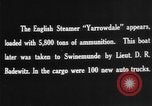
British steamers "Yarrowdale" and "St.Theodore" halted at sea and ordered to follow German cruiser SMS Möwe during World War I
British ships seized by Germany on high seas. View of the English Steamer "Yarrowdale," with cargo of ammunition (5,800 tons) and 100 new trucks. (Note: This ship was later taken to Swinemünde by Lieutenant D.R. Badewitz.) Yarrowdale's occupants are seen crowding her deck. The English Steamer, "St.Theodore," carrying 7366 tons of coal for the Italians, is halted and is commanded to follow the SMS Möwe. (Note: The Germans later refitted this ship as the auxiliary Steamer, "Geier.") View from the Cruiser Moewe, as the St. Theodore follows in fairly rough seas. To ease congestion on the SMS Möwe, British "prisoners" are transferred to the Yarrowdale for the journey. View of them on deck, including three African American crewmen. View of three British ships' captains on board. Group of British "prisoners" rowing to the Yarrowdale, to be take aboard.
The Czechoslovakian Foreign Minister Jan Masaryk in Czechoslovakia.
Jan Masaryk at his office in Czechoslovakia. Masaryk stands on bridge. Masaryk greeted by President Franklin D Roosevelt and signs a document. Masaryk shakes hands with Trygve Lie. Masaryk at desk makes a brief speech and ends with the words "Truth Shall Conquer".
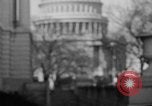
Spokesperson delivers speech opposed to President Roosevelt's Court-Packing initiative in 1937
Unidentified spokesperson (possibly a senator or congressman),is seen standing outdoors, before background of the Capitol, in Washington, DC. He delivers a recorded speech in opposition to the proposal by President Franklin D. Roosevelt to add more Justices to the Supreme Court (so-called "Court-packing"). In his speech, he extols the sanctity of the U.S. Constitution and explains the legal process for amending it. He notes that the proposal (to increase the number of Justices in the Supreme Court) comes directly from the Executive Branch (the President). He deplores the action as designed to "place on the Supreme Court six young wreckers." He stops this line of criticism and resumes again, saying that, "the purpose of the Supreme Court Bill is to change the Constitution." He characterizes the bill as unconstitutional, and continues praising the Constitution, itself, explaining, again, the proper procedures for amending it. He acknowledges that the bill's advocates are likely sincere and conscientious.But, he says, "they are raiders off the reservation, raiding the reserve domain of the people." He concludes by saying "they are not playing the American game of Constitutional Democracy."
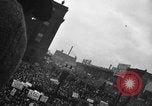
U.S. President Franklin Roosevelt addresses large crowd during 1940 Presidential campaign
Thousands of people gathered in streets of a town to hear President Franklin D. Roosevelt speak during the 1940 Presidential campaign in the United States. Numerous signs carried in the crowd display CIO and AFL letters representing unions.One reads: "Labor wants Roosevelt." One refers to New York truck drivers who support Roosevelt. The President addresses the crowd from a balcony overlooking the street corner. He is surrounded by photograpers and newsmen, and others.
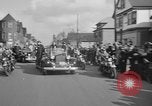
President Franklin Roosevelt's motorcade in Buffalo, New York, during 1940 Presidential Campaign
During the 1940 Presidential election campaign, President Franklin D. Roosevelt rides the streets of Buffalo, New York, in his limousine, a 1939 Lincoln V12 model 1708, special parade car, built for the President's use. Escorted by several motorcycle policemen, and followed by a car of Secret Service agents, it stops in front of the City Hall, at 65 Niagara Square, where a large welcoming crowd is gathered. The McKinley Monument is seen behind them in the square. Police and uniformed guards control the flag-waving crowd. The President, bundled against the wind in a cloak, makes some remarks recorded on a microphone of radio station WBNY. Several enthusiastic women supporters wave American flags at the front of the crowd. The next scenes show the Presidential limousine and escorts traveling along streets of the commercial district of Buffalo. Spectators line the sidewalks and cheer the President. A final sequence is taken from a car moving in the motorcade. It shows members of the Presidents party, and a police official waving spectators away from the motorcade.
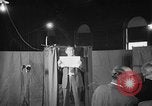
President Roosevelt accompanied by his mother and his wife at polling place
Interior of polling place in Hyde Park, New York. A volunteer voter assistant stands in front of a bank of voting booths perusing a document. Scene shifts to woman being identified on the voter rolls, by volunteers, as line of people wait in background. New sequence in same place shows President Franklin D. Roosevelt signing a voter's ledger. The woman volunteer gives him a voter pass, as Eleanor Roosevelt, and her mother-in-law, Sara Roosevelt, approach the registration table. The President uses a cane and is assisted by a man whose arm he holds. Photographers ask them all to pose for a picture, which they do. Sara Roosevelt exchanges banter with the volunteers. Photographers pester the President to look up for a photo, at which he responds, good naturedly, "Yes sir." As the banter continues, the three Roosevelts begin to laugh. At one point, in response to a request, he answers: "I couldn't, I've got a crick in my neck." Finally, the President says, "Let's go and vote." The President is helped into a booth and votes, without bothering to close the curtains. As he turns to exit, his assistant moves quickly to his side and he is joined by his wife and mother. The President smiles broadly.
CRITICALPAST.COM: About Us | Contact Us | FAQs - How to Order | License Agreement | My Account | My Lightboxes | Shopping Cart | Advanced Search | Featured Collections | Website Terms & Conditions | Privacy Policy ©2026 CriticalPast LLC.
License Agreement |
Terms & Conditions |
Privacy Policy
©2026 CriticalPast LLC.