


 Francais
 Deutsch
 Italiano
Refine Your Search
2nd-Rangers-D-Day stock footage and images
- Showing 13369 to 13374 of 13614 results more
more Hide
Hide
Eurico Gaspar Dutra being sworn in as the new President of Brazil in Rio de Janeiro, Brazil.
The swearing-in ceremony of Brazil's new President Eurico Gaspar Dutra in Rio de Janeiro, Brazil. Eurico Gaspar Dutra acclaimed as the new President of Brazil. Aircraft carrier USS Franklin D Roosevelt (CV-42) arrives for the ceremony, at the mouth of Guanabara Bay with Sugarloaf Mountain in the background. Aircraft in flight overhead. The Mayor of New York, Fiorello Henry La Guardia also arrives for the ceremony. Mayor LaGuardia along with other officials coming out of an aircraft. People gather in a large number to greet him. Officials gather at the congress for the ceremony. Eurico Dutra along with officials arrive in a car at the Palace (Palacio Tiradentes). Eurico Gaspar Dutra being sworn in as the President of Brazil in the Hall of Congress after being handed over the reins by provisional President Jose Linhares. The new President, the first in Brazil elected by direct popular vote, shakes hands with other officials and dignitaries.
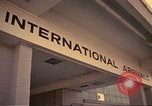
MPs and Salvation Army crewmen talking amongst themselves in at the Harrisburg International Airport in Pennsylvania.
Scenes during Vietnamese refugee arrival event of Operation New Life and Operation New Arrival at the Harrisburg International Airport (1 Terminal Dr, Middletown, PA 17057, United States) in Pennsylvania, United States. A sign above a terminal building entrance at Harrisburg International Airport reads: 'International arrivals'. View of military photographers. A U.S. Army UH-1D Iroquois helicopter parked in the airport. Soldiers in the foreground. A military policeman talking to a man from the Salvation Army. The ground crewmen of the airport talking. A sign reads: 'Harrisburg International Airport'. People walking at the airport. Northern Lebanon High School Color Guard band line up in formation.
Commander Richard Byrd and Warrant Officer Floyd Bennett, receive medals following their flight over the North Pole
Commander Richard E. Byrd, receives the National Geographic Society Hubbard Gold Medal, from President Calvin Coolidge. The event takes place on June 23, 1926, in the auditorium of the National Geographic Headquarters, at 1146 Sixteenth Street, in Washington DC. The audience includes Mrs. Coolidge (on the stage) as well as cabinet officers; members of the diplomatic corps; and National Geographic Society members. Scene shifts to grounds of the White House, on February 27, 1927, as President Calvin Coolidge places the Tiffany Cross Medal of Honor around the neck of Commander Richard E. Byrd. Those seen in the ceremony are, from left to right: Assistant Secretary of the Navy Theodore D. Robinson; Secretary of the Navy Curtis Wilbur; Commander Richard E. Byrd, USN; President Calvin Coolidge; Warrant Officer Floyd Bennett, USN; and Admiral Edward W. Eberle, USN, Chief of Naval Operations. Closeup of Richard Byrd and Floyd Bennett, wearing their medals.
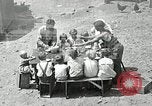
Enactment and effects of Social Security and Labor legislation during the Great Depression in the U.S.
Part of a documentary on the history of the Labor Department in the United States. Opening scene shows numerous children gathered around a large wooden picnic table outdoors, as a woman and two men serve them lunch, during the Great Depression of the 1930s, in the United States. The setting is a barnyard, with chickens walking about in the background. Scene shifts to many women working in an Emergency Employment Office of the U.S. Department of Labor. They are all engaged in various kinds of clerical activities. Next, men are seen receiving hot food at an outdoor "Soup Kitchen." People on a "bread line." A woman getting the last bit of food from an empty food kitchen pail. President Franklin D. Roosevelt, is seated at his desk, surrounded by interested persons, as he signs the Social Security Act on August 14, 1935, and appoints the Secretary of Labor as head of a committee to develop a Social Security Program which shall embrace and cover the hazards of old age, unemployment, the handicapped, and children. A rural family seen on their porch. Many unemployed men gathered on a building porch in a rural setting. Railroad cars and an industrial site can be seen in the background. Children gathered on an open porch. The U.S. Capitol building. Coal miners headed into a mine shaft, wearing helmets with lights and carrying their lunch pails. Workers on an automobile assembly line. Rural poor families near their makeshift houses. A woman airing out bedding outdoors. Men stoking a furnace. A large group of child laborers. A factory with multiple smoke stacks. Striking union members carrying signs on a picket line. Others carry signs identifying them as members of the International Seamen's Union. One of them carries a sign reading: "Radio is the only Hope. Insist on reliable radio protection." Other union members in an outdoor protest. A group of businessmen, ostensibly in peaceful negotiations, facilitated by the Department of Labor.
Dancers entertain the members of the Russian War Veterans Association at a gala dinner in Paris, France.
Members of the Russian War Veterans Association at a gala dinner in Paris, France. Exterior sign for restaurant Chez Korniloff located on rue d' Armaille in Paris. Russians converse with each other. Dancers entertain the guests. Women clap in the background. Russian emigre (exile) couples do the waltz dance. Russian officials drink and speak with each other.
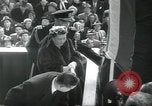
Launch of the first nuclear-powered submarine, USS Nautilus (SSN 571), christened by U.S. First Lady, Mamie Eisenhower
Launch of the world's first nuclear powered submarine, the USS Nautilus, at shipyard of the Electric Boat Division of General Dynamics Corporation, Groton, Connecticut. Mrs. Dwight D. Eisenhower breaks a bottle of champagne on the bow of USS Nautilus as a part of tradition. The submarine slides down the ways into the waters of the Thames River. A Navy CH-46 Sea Knight helicopter flies above USS Nautilus underway in Long Island Sound..
CRITICALPAST.COM: About Us | Contact Us | FAQs - How to Order | License Agreement | My Account | My Lightboxes | Shopping Cart | Advanced Search | Featured Collections | Website Terms & Conditions | Privacy Policy ©2026 CriticalPast LLC.
License Agreement |
Terms & Conditions |
Privacy Policy
©2026 CriticalPast LLC.