


 Francais
 Deutsch
 Italiano
Refine Your Search
2nd-Rangers-D-Day stock footage and images
- Showing 13525 to 13530 of 13614 results more
more Hide
Hide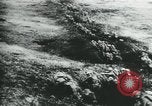
Numerous scenes showing evolution of mechanized warfare emphasizing World War I. but including footage as late as 1934
Montage of scenes illustrating development of mechanized warfare beginning with American Expeditionary Forces (AEF) engaged in World War I. U.S. Army infantry soldiers moving out of trenches going "over the top" into "no man's land" and advancing on battlefield. U.S. troops firing Browning M1917 machine gun,1903 Springfield rifles, and Stokes mortar from trench positions. Soldiers firing mortar are wearing gas masks. AEF trucks and other vehicles ostensibly an improvement over horses, but seen having difficulty in mud. A truck pulling a large artillery gun. A German 80cm K (E) rail gun (developed in 1934) shown at the Rugenwalde Test Range in Germany. It moves along curving rails and is elevated to its maximum elevation (65 degrees). Two World War 1 rail guns firing. An American World War I Naval 14-inch rail gun firing. Allied heavy howitzers firing in World War 1 (one with gun crew in gas masks). American gunners with a French 75 field piece and caisson. French soldier advancing in no-mans-land. The Wright brothers brought warfare into the air with their Wright Flyer airplane, seen being maneuvered on the ground by U.S. Army personnel at Fort Myer, Virginia in July 1909. A De Havilland DH-4 airplane taking off in World War I. A German Fokker D.VIII aircraft in flight. Three U.S. Army Air Service Curtiss P-1B Hawk pursuit aircraft in flight, circa 1926. Aerial dogfight scene including view from behind a pilot in open cockpit biplane (from feature film, circa 1927). Brief view of Renault FT tank maneuvering in World War I. Narrative and clips shift to historical perspective of warfare, showing use of horse and chariot, starting in ancient Assyria and use of elephants in later years by Hannibal. Pictures of mounted soldiers, in the middle ages, waging war in armor, and being transported in a wagon. Shift to World War I showing British Mark IV tanks maneuvering in a field.
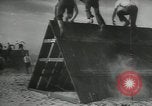
Training of American draftees before World War II; also Japanese attack on Pearl Harbor and Roosevelt's request for declaration of war.
United States soldiers and new recruits at a camp in the U.S. before outbreak of World War II. New recruits and U.S. Army soldiers in training run obstacle course. Soldiers in their uniforms march through the camp area. Tents in the background. Newly drafted U.S Army soldiers learn to fire weapons on firing range using artificial wooden rifles. U.S. soldiers seen training with wooden replica machine guns and using empty Adelphi beer cans as substitute artillery ammunition for training purposes. Teams of soldiers compete in moving a giant ball. They compete in blindfolded boxing on their knees. Lacking adequate war materiel for training, they make do by pretending that trucks are tanks and labeling them with such signs. They pretend with wooden guns and throw flour sacks instead of grenades. Scenes of the Pearl Harbor raid by the Empire of Japan on December 7, 1941. Views of the USS Arizona being hit and various ships on fire soon after the attack. United States President Franklin D. Roosevelt is seen addressing Congress, where he asks for a declaration of war against Japan.
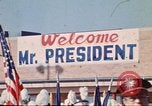
A crowd holding placards awaits the arrival of U.S. President Richard Nixon at Tri-City Airport in Saginaw, Michigan.
A crowd at Tri-City Airport in Saginaw, Michigan awaiting the arrival of U.S. President Richard Nixon. A sign on a building at Tri-City Airport reads 'Welcome President'. The U.S. flag flies in the foreground. Placards held by the crowd. Signs held by the crowd read 'IMPEACH NIXON HE'S EARNED IT', 'GOD LOVES NIXON', 'IMPEACH THE CROOK', 'WE'D STREAK FOR YOU' and 'GAYS FOR NIXON'. A band plays. A sign reads 'Welcome TRI-CITY AIRPORT'.
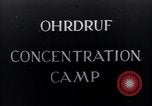
U.S. Generals tour newly liberated Ohrdruf concentration camp near Weimar, Germany towards the end of World War II.
Nazi atrocities at Ohrdruf concentration camp near Weimar, Germany towards the end of World War II. U.S. Army Generals Dwight D. Eisenhower, Omar N. Bradley, George S. Patton and Walton H. Walker inspect the camp. The Generals inspect the scaffold and talk to prisoners. A woodshed is filled with dead bodies stacked in piles. The Generals view lime-covered corpses. Inmates demonstrate how they were tortured. Dead bodies are strewn on the ground. U.S. Congressmen also view the camp. A crude cemetery with charred remains.
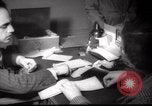
Relief being given to Austrian refugees by a relief committee in France after the annexation of Austria by Germany.
Comite Francais d'Assistance aux refugees in France after annexation of Austria by Germany prior to World War II. Relief being given to Austrian refugees in the form of cash. The refugees sign receipts. They wait in a lobby and show papers to officials of the committee. A meeting of the committee's council shows former commanding officer of the Republican Guards Colonel Duriex, President of the Committee Albert Levy, Managing Director of the Committee Gaston Kahn and the Secretary General Raymond Raoul Lambert. The committee discusses the problem of Jewish settlement in the world over a map.
British Prime Minister Neville Chamberlain makes a speech at Heston Airport in London, England before leaving for Germany.
Scene of boats docked on the Thames River with Houses of Parliament in the background, in England. Scenes related to British Prime Minister Neville Chamberlain's trip, September 15-16, 1938. to meet Adolf Hitler, at Berchtesgarden,Germany. Chamberlain steps from an airplane. Neville Chamberlain, on September 16, 1938, after returning from Bertchtesgarden. He is seen making his way through a crowd at Heston Airport in London, England, where he speaks into a microphone. Scenes from September 15, 1938, before leaving to meet German Chancellor Adolf Hitler,in Berchtesgarden. Crowds gather on top of the airport building. Cameramen record the event. Police officers and officials stand about waiting for Chamberiain to depart. A British Airways aircraft lands and taxis in at Heston Airport. German Charge d'Affaires, Herr Kordt, Lord Halifax and Prime Minister Chamberlain talk with each other. Chamberlain cuts open a letter, from the King, and reads it, privately. Chamberlain makes a speech , surrounded by microphones, as photographers take pictures. Chamberlain poses beside the airplane. Lord Halifax joins him. Chamberlain doffs his hat and looks about to enter the aircraft.
CRITICALPAST.COM: About Us | Contact Us | FAQs - How to Order | License Agreement | My Account | My Lightboxes | Shopping Cart | Advanced Search | Featured Collections | Website Terms & Conditions | Privacy Policy ©2026 CriticalPast LLC.
License Agreement |
Terms & Conditions |
Privacy Policy
©2026 CriticalPast LLC.