


 Francais
 Deutsch
 Italiano
Refine Your Search
2nd-Rangers-D-Day stock footage and images
- Showing 1369 to 1374 of 13612 results more
more Hide
Hide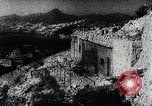
Japanese troops occupy Hong Kong after British forces surrender on Christmas day 1941 (WWII)
The Japanese occupation of Hong Kong following British surrender on Christmas day, 1941 (World War II). Japanese propaganda newsreel, narrated in accented English: Japan occupies the entirety of Hong Kong and British surrender on December 25, 1941. Destroyed British island defenses including bunkers and pill boxes. Wrecked buildings and oil storage tanks in Hong Kong. Japanese troops pose as a group and shout “Banzai” for the camera. Destroyed British tanks and artillery. British military prisoners gathered in a courtyard. Japanese officer inspects captured artillery. Japanese troops pile up shells from surrendered British forces. Captured British soldiers and sailors crowd British officers exit the "New Oriental Building" (Formerly 2 Connaught Road, Central, Hong Kong) after surrender discussions with Japanese forces. White flag hoisted on top of the New Oriental Building. Aerial view of Hong Kong area. Japanese aircraft in formation over the city making their formal occupation entry. Japanese troops parade through the streets with commanding officers on horseback.
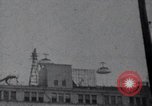
Western tourists visit Asakusa, Matsuya Department Store, and Dai-Nippon Beer Company in Japan.
Aerial view of buildings and tourist attractions in Asakusa District, Tokyo, Japan. Exterior of Matsuya Department Store Building (1-4-1 Hanakawado, Taito-ku, Tokyo 111-0033). Views over Asakusa and Honjo-Ward from the top of Matsuya Department Store, Sumida River and the vehicles on the Kototoi-Bridge over Sumida River of Asakusa Ave., the facilities of Dai-Nippon Beer Company along Sumida River in the background. to Sensō-ji temple (2 Chome-3-1 Asakusa, Taito City, Tokyo 111-0032, Japan) with the five-story pagoda are also seen. The Kototoi-Bridge over Sumida River, the tugboat going down Sumida River and the rope way on the top of Matsuya Department Store. Tourists taking a walk in the Sumida Park at the riverside and boating under the truss bridge of Tobu Railway in Sumida River.

Destruction in Saarlautern (Saarlouis) Germany, the day after Christmas, 1944, during World War II
Slate indicates the area shown is occupied by the U.S. 3rd Army, 95th Infantry Division. Bombed out buildings are seen with rubble piled at side of road, in Saarlautern (Saarlouis) Germany, the day after Christmas, 1944, during World War 2. View of apartment buildings and shops across from a park. Another street of shops. No people or vehicles are seen. An American soldier carrying a large camera, walks past an antique French 155mm gun, circa 1877, on display in a public Square. A view of the seemingly undamaged Catholic Church of St. Ludwig (Katholische Kirche St. Ludwig) on Kavalleriestrasse. A jeep drives past it. A U.S. soldier rides a bicycle past destroyed buildings
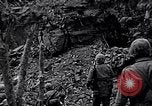
U.S. Marines seek out remaining Japanese defenders in final days of battle for Iwo Jima in World War II
Several U.S. marines approach possible Japanese defensive position at a cave during final days of the battle for Iwo Jima in World War 2. Debris on the ground, including a tin can and Japanese rocket (or mortar shell) with fins. Japanese war supplies outside a destroyed fortification. A marine cautiously approaches the entrance of a Japanese cave fortification, and then walks away. Several marines below a ridgeline. One throws wire, from a spool, upward to the top of the ridge, to connect a demolition charge. Later the charge ignites with a huge explosion, destroying part of the ridge.
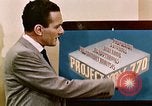
Rocket motor and day and night view of rocket firing at Santa Susanna in California ,United States
Schematic diagram of rocket motor power plant of RTV-A-5 and Navaho 2 missiles is given. Various parts of the motor are shown and their position is specified. Animation shows pathway of fuel to combustion chamber. Vertical and horizontal view of rocket in test stand is given. Day and night view of rocket fired from Santa Susanna field are shown.
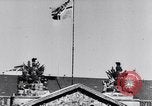
Adolf Hitler and top military leaders pay homage on Heldengedenktag (Day of Commemoration of Heroes) in World War II
German war ensign flying over the Zeughaus (military museum) on Unter den Linden, in Berlin, Germany on Heldengedenktag (Day of Commemoration of Heroes) in World War 2. A military band outside plays the National Anthem, as Adolf Hitler walks out of the building, accompanied by General Paul von Hase, Commandant of Berlin. An honor guard of soldiers presents arms in salute. Hitler and Marshal Hermann Goering (Göring) lead members of the German High Command, including Marshal Wilhelm Keitel; Grand Admiral Karl Doenitz; SS leader Heinrich Himmler; Marshal Fedor von Bock; and Marshal Erhard Milch, as they walk along the street, reviewing troops in formation. Flag bearers dip 30 colors of the old German Kriegsmarine and 30 of the new German army, in salute, as the reviewers pass. Soldiers stand holding a large memorial wreath. Hitler and his entourage turn and walk towards the Neue Wache (New Guard) National War Memorial building. Scene shift to inside the memorial, as the wreath bearers enter, followed by Hitler and the Marshals. The strains of "ich hatt einen kameraden" war song are heard played as a dirge. Soldiers place the wreath, and all present salute. Many more flowers are seen on the memorial floor. View of the memorial black granite block topped by an oak wreath (designed by the sculptor Ludwig Gies) situated under an oculus. It is flanked by two guards. Flowers cover the entire floor in front of it. Meanwhile, outside, on Unter den Linden, all persons simultaneously salute, including military and civilians. As Hitler leaves the memorial building, accompanied by the Marshals, he stops to shake hands and converse with wounded German officers and soldiers in wheel chairs. He greets older veterans of earlier wars. A crowd including many young people hold up placards on poles.
CRITICALPAST.COM: About Us | Contact Us | FAQs - How to Order | License Agreement | My Account | My Lightboxes | Shopping Cart | Advanced Search | Featured Collections | Website Terms & Conditions | Privacy Policy ©2026 CriticalPast LLC.
License Agreement |
Terms & Conditions |
Privacy Policy
©2026 CriticalPast LLC.