


 Francais
 Deutsch
 Italiano
Refine Your Search
2nd-Rangers-D-Day stock footage and images
- Showing 1405 to 1410 of 13612 results more
more Hide
Hide
Newly naturalized Americans recite the Pledge of Allegiance during the 1944 “I Am An American Day” (WWII)
More than a million people attend the “I Am An American Day” citizenship ceremony in Central Park in New York City, during World War 2. Over 150,000 people attended the ceremony as newly naturalized American citizens. Native American Indians in traditional dress and women and men in military uniform attend the ceremony. Flags of various nations are flown. Wounded Army soldiers and wounded Navy sailors arrive as guests of honor. New York City Mayor Fiorello LaGuardia shakes hands with servicemen, giving tribute to their heroism during World War II. Immigrants stand up to recite the Pledge of Allegiance to the United States of America as part of the naturalization ceremony. Speaker recites the Pledge of Allegiance, which predates the inclusion of "under God" which was added later in the 1950s.
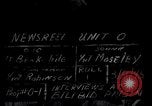
Interview with liberated internee Stanley Kingsbury of the Los Banos camp outside Manila
World War 2 interview in Manila with a released male internee, Stanley Kingsbury, of the Los Baños camp following its liberation from the Japanese by U.S. and Filipino forces the month before (13 days before the interview). A microphone is set on a tripod stand for the interview. An interviewer is present. He introduces Stanley Kingsbury. Mr. Kingsbury (possibly Mr Kingsley?) describes twice daily roll-call operations in the camp and that it was announced there would be no role-call that day, and that the internees knew something was different. He talks about hearing a drone sound later in the day and trying to interpret what it meant (on his 1144th day in camp). He recounts seeing planes flying very low, and a white sheet dropping out of a plane and realizing suddenly that there are many paratroopers jumping out. He says they lay down on the barracks floor during the firefight that ensued between the Allied forces and the Japanese. U.S. GI's came in and told the internees to evacuate and that they could only take a few things and had to leave immediately. They rolled down to the shores of Laguna de Bay nearby where they came under fire from a Japanese machine gun nest that was subsequently taken out. He relates all the internees crossing the lake to safety under well armed escort. He expresses how delighted he is to be free again. (World War II period).

President Harry S. Truman announces the surrender of Germany, ending World War II hostilities in Europe.
President Harry S. Truman broadcasts to the nation from a desk in the White House, Washington, DC. on V-E (Victory in Europe) Day, announcing that Germany has surrendered to end World War 2, in Europe. He expresses his regret that the late President Franklin Roosevelt had not lived to see the day. Truman calls it a "solemn but glorious hour" and offers thanks to the "providence that has guided and sustained us through the dark days of adversity and into light."
Combat fatigued U.S. soldiers are interviewed and sent for treatment in the Training and Rehabilitation Center, Italy.
Psychiatric procedures for United States soldiers in combat areas during World War 2 suffering stress following trauma of battle. Battle scenes: Strong and courageous soldiers sent for fight. They attack enemy and fire rifles from hidden places. Smoke rises. They face danger in battle day after day. View of wounded, burned and dead soldiers in battle. Strongest soldiers of the army maneuver over field. Soldiers seated facing the stress of combat and become psychiatric casualties. Chart depicts fighting front and its three levels: division, army and base. Soldiers are sent to battalion aid station and back to clearing stations for treatment. Medical van brings the wounded soldiers and psychiatric casualties to battalion aid station. One officer checks the ID card of soldiers. ID card reads: '1st battalion, 168 infantry regiment, yes incurred in Italy'. Chart shows training and rehabilitation center (T& R center) near clearing station. Soldiers reach to training and rehabilitation center. A Sign of 'Training and Rehabilitation Center'. Combat fatigue cases are reconditioned by battle training. A psychiatrist interviews a soldier suffering from reactive depression and asks about troubles and feelings faced by him when he got wounded. After interview soldiers are send to clearing center. Soldier enters into tent at camp. They take rest, make social contacts with other soldiers, write letter, get shaved and eat food. Two days later, soldier is re-interviewed about improvement after relaxation in training center. He shows improvement and is encouraged. Recovered soldiers fill the artillery outside the tent near training center. (Modern equivalent - PTSD or post traumatic stress disorder treatment)
American B-24 Liberator aircraft during bombing run in World War 2; also P-38 aircraft production scenes
A propaganda film titled "Angel in Overalls" by the U.S. Army aimed at praising and encouraging war materiel production workers in the U.S. who are building aircraft and other weaponry for U.S. soldiers in World War 2. Aerial scenes of clouds and formations of B-24 Liberator aircraft on their way to a day light bombing run over Germany. Interior views of B-24 cockpit area and other parts of B-24 aircraft as crew perform their duties. Bombardier using sighting equipment to evaluate path toward target. Mix of staged and actual battle scenes. Mock dialog between crew members is heard. Simulation of view through bombardier scope is seen. Bomb bay doors seen opening. Flak bursts and phosphorous bombs seen exploding nearby. Smoke streaming out from one of the B-24 aircraft in formation after it is hit by enemy fire. Machine gunner opens fire at an incoming enemy aircraft. Several views of machine guns being fired. Views of ammunition casings falling the floor as the guns are fired. Hit enemy aircraft are seen exploding and breaking up in air. Close-up view of a P-38 Lightning aircraft joining the group in combat. Scene of a P-38 aircraft production factory assembling P-38 planes in the United States. Narration encourages the work of P-38 production plant workers. P-38 aircraft during building and assembly operations. Formation of four P-38 aircraft in flight. Aerial views of a P-38 in flight. Gun camera footage showing strafing of a German target at the edge of a forest of trees.
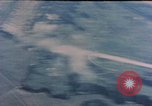
Fires and smoke seen from U.S. Army aircraft strafing Japanese targets in Kagoshima prefecture near end of World War 2
Gun camera views from U.S. Army Air Forces aircraft strafing Japanese targets in Kagoshima Prefecture, Japan, during last days of World War 2. Pilot dives toward a settlement in a rural area, with guns firing. He then attacks a coastal town, from the sea. Fires seen burning in the town. He proceeds a short distance inland, where dense smoke billows from numerous fires already burning. He climbs up steeply to avoid the smoke. Next, he attacks a coastal town, from the land side. Fire is burning as passes over it. Final seconds show strafing rounds striking a tall structure in a built-up town.
CRITICALPAST.COM: About Us | Contact Us | FAQs - How to Order | License Agreement | My Account | My Lightboxes | Shopping Cart | Advanced Search | Featured Collections | Website Terms & Conditions | Privacy Policy ©2026 CriticalPast LLC.
License Agreement |
Terms & Conditions |
Privacy Policy
©2026 CriticalPast LLC.