


 Francais
 Deutsch
 Italiano
Refine Your Search
2nd-Rangers-D-Day stock footage and images
- Showing 1501 to 1506 of 13612 results more
more Hide
Hide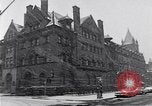
Churches of Harlem and East Harlem in New York City.
A big building in Harlem, New York City. Rain and snow are falling. Bethel Gospel Pentecostal Assembly (2 E 120th St, New York, NY 10035) at Harlem, New York City. The New York Ephesus Seventh-day Adventist Church (101 W 123rd St, New York, NY 10027, United States). The Ebenezer Gospel Tabernacle Baptist Church (227 Malcolm X Blvd, New York, NY 10027, United States). The Religious Training Institute of America's board informs about the courses and timings at institute and information to contact Reverend P.G. Neil. A Schaefer beer billboard advertisement shows woman named Marva Revis, the Miss Beaux Arts winner of 1963, holding two 6-packs of beer and reads "... When you're having more than one". Views of Mount Olivet Church (201 Malcolm X Blvd, New York, NY 10027). Moore's Temple. Saint Mary's Catholic Church. A Jewish synagogue entrance is also seen, with Hebrew words at the entrance door.
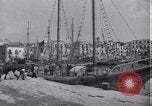
Allied Military Government working to provide medical care and food to Italians in liberated parts of Italy during World War II
Relief activities of the Allies in Italy during World War 2. Opening scene shows a sailing Schooner under Allied Navy control, docked at a port in Italy following the Allied invasion of Italy in 1943. This schooner is being loaded with Allied Military Government (AMG) medical supplies. Closeup of wooden crates containing the supplies. American medical corpsmen checking a stream of water for mosquitoes, and then spraying the area from a DUKW. A hospital building and interior with Italian women holding their infants as they await checkups and vaccinations against disease. Italian citizens in a street anxiously seeking food from the AMG. Local Italian police work to control the crowd in which some persons become unruly and have to be removed. American troops of the U.S. 5th Army marching along Italian roads. Troops riding on a Sherman tank and on a truck pulling an artillery field piece. Supply yard stacked high with food supplies for U.S. troops. (Narrator states it required 750 tons a day to feed the 5th Army.) Views of Naples harbor cluttered with 30 large ships and 300 smaller ones blown up or scuttled by retreating German forces. Firemen manning hoses to fight fires at the waterfront. Smoldering ruins in the port. Three months later, U.S. forces are seen operating supply missions through the port. View from a hill of the port with barrage balloon overhead. Closeup of flour being offloaded from holds of ships by derricks. Italian soldiers unloading the flour bags and placing them aboard trucks for transport to Italian commercial food companies. A U.S. Army Captain at a table with Italian businessmen who purchase the flour from AMG at a fair market price. Italian purchasers examining the flour. Flour being transported to bakers who bake it into bread. Young men busy making and baking loaves of bread. Loaves stacked up at the bakery. A big tray of fresh loaves being sampled by Italian officials and distributed to local Italian civilians who enjoy it.
Christian altars and religious objects at liberated Dachau concentration camp in Germany, at end of World War II
Dachau concentration camp in Germany, after liberation in final days of World War 2. Sign on railroad station building 'Dachau'. Free standing corner post decorated with figures on top, showing three German soldiers in one direction and a German soldier pointing two German musicians in the other direction. One musician has a bass fiddle on his back and carries a folded umbrella. The other carries an accordion. Sign on the entrance to the Concentration Camp: 'Quarantine, Typhus. This concentration camp is off limits to all civil and military personnel. By order of General Patch, CG, Seventh Army'. Christian altars with Mother Mary, a monstrance, and an altar card at the concentration camp. Pile of dead bodies of victims of Nazi atrocities carried in horse carts by German civilians wearing gas masks.
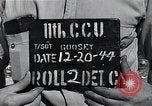
B-29 , tail number 42-224802 on Guam, Mariana Islands during World War II.
Camera pans across North airfield on Guam, Mariana Islands, in World War 2. Next a large group of Airmen are seen standing around a shiny B-29 bomber parked on the ramp. It has "K333" stenciled on left side of its forward fuselage. Its tail number is 42-224802. (This B-29 is named "Purple Shaft," but that is not stenciled on its left side.) The airmen walk around and examine it. Next, The aircraft commander, Lieutenant Warren Richard Aylsworth is seen speaking with a Captain, as they stand next to the plane. Others join in the conversation. (Note: The plane is scheduled to fly to Tinian this night, the 20th, but will land at Saipan, instead, because runway lights were not yet operational on Tinian. The "Purple Shaft" will be the first B-29 to arrive at Tinian, the following day, December 21, 1944.)
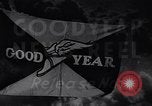
Good Year tire manufacturing facilities in Akron Ohio, and updates to employees in corporate newsreel
View of Goodyear Hall in Akron Ohio, and downtown streets of Akron Ohio from an elevated view. Goodyear Hall and clock tower with flags of different nations hanging from its walls. Scene change to a village across the Pacific and native workers extracting and collecting rubber from rubber trees with hand tools. Workers picking cotton at an Arizona cotton plantation and finished bales of cotton. Scene change again back to Akron Ohio, where spectators enjoy a Goodyear Company baseball game at Seiberling Athletic Field. Well dressed men, women, and children seated in the stands at the baseball game for the Goodyear Wingfoots. Women War production workers manufacture gas masks with rubber pipes at a Goodyear factory early in World War 2, before America's entry into the war. They are seen exiting the factory after the work day is over. Aircraft parts for Britain and America being manufactured at a Goodyear factory that houses the company airship dock, 3 blocks long and 30 stories high. Exterior views of clearing and construction work beginning for two more aircraft construction facilities near the Airship dock. Two men test low pressure aircraft tires and brakes of a Good Year plane. View of many cars parked as employment and facilites expand at Goodyear facilities.

Allied aircraft bomb the City of Dresden in Germany on February 13, 1945 (British) and again on February 15 (American)
British Royal Air Force Lancaster bomber aircraft drop bombs over German targets in Dresden during night of February 13-14, 1945, during World War 2. Bombs impact and view of explosions and smoke. Two views of German scarecrow bombs exploding, designed to look like the explosion of an Allied bomber aircraft in order to intimidate the enemy. United States Army Air Force B-17 bombers attack the City of Dresden two days later on February 15-16, 1945, focusing on railroad marshaling yards. Relentless bombing by both the American and British forces destroy the city completely.
CRITICALPAST.COM: About Us | Contact Us | FAQs - How to Order | License Agreement | My Account | My Lightboxes | Shopping Cart | Advanced Search | Featured Collections | Website Terms & Conditions | Privacy Policy ©2026 CriticalPast LLC.
License Agreement |
Terms & Conditions |
Privacy Policy
©2026 CriticalPast LLC.