


 Francais
 Deutsch
 Italiano
Refine Your Search
2nd-Rangers-D-Day stock footage and images
- Showing 1873 to 1878 of 13612 results more
more Hide
Hide
United States Coast Guard preparing for the Allied invasion of Normandy (WW2)
June 9, 1944. Sand flats seen at low tide in Normandy, France. Allied forces fighting their way inland during the Normandy invasion (Three days after D-Day) in World War II. Landing craft and destroyed buildings on the beaches of Normandy. German steel beach obstacles have been stacked out of the way. A United States Sherman DD tank sunk in sand. Badly damaged LCT-25 on the beach at Normandy, with her cargo of half-tracks still aboard and remains of the first one off, sitting at her ramp where it was hit by a German shell. Higgins Boat riddled with bullet holes. Scene shifts to January 1944 when United States Army troops descend from a troop transport ship into LCT-504 for practice maneuvers in the Chesapeake Bay. A soldier operates a Higgins Boat. Another soldier directs a Higgins Boat to the shore. Troops hit the beach in Higgins Boats driven by U.S. Coast Guardsmen from the Attack Transport ship, USS Samuel Chase (APA-26). United States troops carry equipment or belongings as they board ships to England in February 1944. Views of live aboard transport ships in convoys crossing the Atlantic Ocean. Coast Guardsmen near weapons at duty stations. Some troops are seen wearing life vests on board. Troops sleep or lie in hammocks in their quarters. Soldiers pass the time by playing cards, sleeping, reading and writing letters, and mending clothes on deck. Troops line the deck of the transport ship, USS Bayfield (APA-33), as the ship approaches port in England. Landing craft from the Bayfield, carrying troops, are seen in assault training exercises in England. Troops wading ashore during training. Coast Guard officers and sailors are seen aboard larger landing ships in exercises. Coast Guard officer smoking a cigar, as landing craft from the USS Samuel Chase speeds away after landing troops ashore. Trucks drive ashore from landing craft. Scene shifts to May 1944 and a formation of Consolidated B-24 Liberator bomber aircraft dropping bombs on enemy targets in Normandy. Aerial view shows bombs falling.
Fragmentation and incendiary bombs are dropped over an airfield outside Caen, France (WW2)
Allied bombers drop bombs near Caen, France during World War II. Consolidated B-24 Liberator bombers of the United States Eighth Air Force in flight, passing over surface vessels bound for France six days after D-day. Aerial view of a French city, bombed by another group. Pillar of smoke rises up from the bombed city. Moving engine propeller of a bomber. small fragmentation and incendiary bombs are released over French airfield and railroad bridges outside Caen. Aerial view of Norman countryside. Craters from bombs are seen in aerial view.
Earth Day demonstrators outside Department of the Interior building in Washington DC protest against oil drilling in the Gulf.
Earth Day in Washington D.C. (part of a series of clips in a row). Environmental activists and demonstrators protest against oil drilling in the Gulf and elsewhere. A large crowd of environmentalists and concerned citizens gathered on the street. They march holding banners. One demonstrator flashes the Peace sign and a clenched fist 'fight the power' sign at the same time. Banners seen include 'God is not dead he is polluted on earth' , 'R.I.P. 1990 A.D.', 'Standard Oil is Spouting Off', and 'No Oil Drilling in the Gulf' The people gather outside the United States Department of the Interior building. They protest against the oil drilling and attendant pollution. Senator Gaylord Nelson, organizer of Earthday, is seen in the crowd. A flag, similar to the United States flag, but with green stripes, flutters in the wind atop a flagpole. Oil that has been spilled on the sidewalk is seen.
President of France addresses a Joint Session of the 82nd Congress about the perils of postwar isolationism.
Vincent Jules Auriol, President of France, is ceremonially escorted into a joint meeting of the U.S. Congress, where he is about to speak. He is followed by Vice President Alben W. Barkley and House Speaker, Sam Rayburn (who later take their places as presiding officers). The audience gives Auriol a standing ovation, with applause. continuing, as he ascends the podium. Barkley and Rayburn are seated behind him. President Auriol's remarks, as reported in the press (not heard in this clip, which has no sound) focus on the need to reject isolationism in the postwar world. Among other things, he reportedly tells the joint session of Congress the French people have learned from bitter experience that "isolation is death" and that "right without might is powerless." The Congress applauds him after his address.
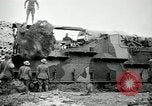
American 52nd and 53rd Coast Artillery Regiments camouflage and fire a railroad gun at Belleville in France.
Soldiers, of U.S. Army Coast Artillery Regiment, place camouflage coverings atop a 14-inch railroad gun, in France, during World War 1. View of the camouflaged gun as its barrel slowly rises and it fires. (World War I; World War 1; WWI; WW1)
U.S. Army 42nd Division soldiers relaxing near foxholes during World War I in St. Mihiel, France.
Soldiers of the United States Army relaxing near foxholes during World War 1 in St. Mihiel, France. Some soldiers write letters, play cards, shave and read books. Shells bursting in the background. Soldiers in figure. Soldiers stand outside field hospital building. U.S. Cavalry troops advancing past wrecked homes.
CRITICALPAST.COM: About Us | Contact Us | FAQs - How to Order | License Agreement | My Account | My Lightboxes | Shopping Cart | Advanced Search | Featured Collections | Website Terms & Conditions | Privacy Policy ©2026 CriticalPast LLC.
License Agreement |
Terms & Conditions |
Privacy Policy
©2026 CriticalPast LLC.