


 Francais
 Deutsch
 Italiano
Refine Your Search
2nd-Rangers-D-Day stock footage and images
- Showing 3013 to 3018 of 13612 results more
more Hide
Hide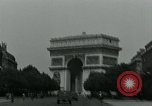
General Dwight Eisenhower and Allied Commanders during liberation of Paris in World War II.
At beginning camera gives shaky view of the Arc de Triomphe in Paris during World War 2. Then it shifts to an American army staff car driving along the Champs Elysee toward the Arch of Triumph. Next, General Dwight D. Eisenhower steps from the staff car, shakes hands with a U.S. army photographer, and walks among French people toward the base of the Arch of Triumph. Camera pans up to top of the arch. Back on the ground, Eisenhower is met by American and French military commanders and surrounded by a crowd of French civilians. He poses for a picture (viewing from left to right) unidentified U.S. Major General; Lieutenant General Omar Bradley, Dwight D. Eisenhower, French General Marie-Pierre Kœnig and British Air Marshal Arthur Tedder. The French Tricolor flies behind them. Camera pans upward to the top of the Arch of Triumph. The Allied commanders and General Eisenhower are surrounded by American soldiers and French civilians as Eisenhower gets into his staff car. View from trailing vehicle of his staff car passing the Place de la Bastille and proceeding through streets of Paris. Eisenhower is seen next, standing on the sidewalk, by his parked car, conversing with General Bradley, General Marie-Pierre Kœnig, and another French General. He shakes hands with a military photographer as he steps into his staff car, and shares a final hand shake with General Marie-Pierre Kœnig. As his car drives away, civilians in the background wave goodbye. Glimpse of American M4 Sherman tanks moving on the street. Eisenhower' car drives away.
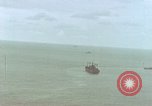
U.S. Navy warships of Task force 51 bombarding Japanese positions on Iwo Jima prior to invasion during World War II
U.S. Navy warships of Task Force 51, Joint Expeditionary Force, commanded by Vice Admiral Richmond Kelly Turner, bombard Japanese positions at the start of the campaign against Japanese-held Iwo Jima, during World War 2. Mount Suribachi visible at end of the island. The Eldorado (AGC-11), Vice Admiral Turner's flagship is seen. At time 00:20 to 1:04, the heavy cruiser USS Chester ( CA-27 ) is seen in camouflage Measure 32, design 9d, following another unidentified heavy cruiser, shelling the island of Iwo Jima. Time codes 1:05 to 1:12 show the battleship USS Tennessee (BB-43). In time codes 1:14 through 1:31 the heavy cruiser USS Salt Lake City ( CA-25) and the USS Vicksburg, CL-86, a Cleveland Class light cruiser, in camouflage (measure 33, design 6D), are seen shelling Japanese anti-aircraft gun emplacements around the east side of Motoyama airfield. The battleship, USS Idaho (BB-42) is seen in time codes 1:32 to 1:53. Other, unidentified U.S. warships are also seen bombarding the Island.
Crash of U.S. Air Force B-52 bomber after takeoff from March Air Base in California. Five of six crew killed.
Film opens showing closeup of a smashed aircraft landing gear at a crash site. A large group of men stand near the burned remains of U.S. Air Force B-52D Stratofortress, 56-0594, of the 22d Bomb Wing, that crashed at 0730 hours, shortly after takeoff from March Air Base in California. An armed airman stands in the foreground. A fire truck is parked near the wreckage. Scene shifts to recovery workers combing through smoldering debris. Medics carry covered remains from the area, on a stretcher, past an Air Force cinematographer filming the scene. Closeup of a medic in white red cross helmet wearing a breathing mask, standing near workers placing charred remains in a plastic bag and tagging it. An Air Force Lieutenant Colonel and a Captain, standing with civilians at the site. View of the plane tail and part of fuselage silhouetted against gray sky. Remains of a farm animal. Airman shoveling ashes over smoldering debris. An aircraft circling over the crash site. A fire truck parked next to wreckage. Camera pans over remains of aircraft tail section. Closeup of landing gear wheels with tires and fire fighters moving hose through through smoldering debris in background. Firefighters at their truck. (Note: the crash site is a plowed farm field at Sunnymead, approximately 2.5 miles SE of March AFB.)
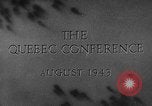
British Prime Minister Winston Churchill in many meetings before and after America's entry into World War II
Opening slate reads: "Quebec Conference August 1943." The English battleship, Prince of Wales, is seen in fog off the Coast of Newfoundland, in August 1941. View of sailor on fore-deck of the British ship. View inside engine room of the ship where sailor manipulates her power. Closeup of engine crankshaft stopping as she drops anchor in Placentia Bay. View of Prime Minister Winston Churchill, greeting U.S. President Franklin D. Roosevelt aboard the Prince of Wales. He proffers a letter to the President, from the King of England. View of Roosevelt and Churchill seated on deck with their respective military leaders standing behind them. Admiral Ernest King, U.S. Chief of Naval Operations converses with U.S. Army Chief of Staff, George Marshall, as they stand behind Churchill and Roosevelt. Wider camera view shows the larger military entourage accompanying the Prime Minister and the President. Glimpse of prisoners and enslaved workers taken by Nazi Germans in Europe. Glimpse of bombs falling from an airplane. Classic film views of the Japanese attack on Pearl Harbor in December 7, 1941. Bombs exploding along "Battleship Row." Heavy smoke rising from the bombed ships. The USS Arizona tilted heavily and burning. Camera pans along the path of destruction, as the voice of President Roosevelt is heard in the background, asking the Congress to declare that the Japanese attack created a state of War between the United States and the Japanese Empire. View of President Roosevelt speaking to the U.S. Congress. Seated behind him are Vice-President Henry Wallace and Speaker of the House, Sam Rayburn. Glimpse of Congress members applauding. Change of scene shows President Roosevelt and Winston Churchill meeting in Washington, DC, in December of 1941, during World War 2. Views of war preparations in the United States, including the building of new war production plants and facilities. A large steel ingot being forged into an artillery gun barrel. Machinist at work turning a gun barrel on a lathe in a munitions factory. Views of manufacturing plants in operation and steel being made. A railroad train carrying new Army trucks. Another meeting of Churchill and Roosevelt in Washington, D.C. June, 1942. Standing behind them is President Roosevelt's special assistant, Harry Hopkins, a British naval officer, and an American navy Captain. American soldiers boarding a troop ship, and closeups of them as they enter the ship, looking out of portholes, and waving from the ship's deck. Glimpse of Washington Monument and its image in the reflecting pool in Washington DC. Closeup of a book entitled, "Time Table for Invasion." General George Marshall with several of his generals doing preliminary planning. Series of scenes involving senior military officers engaged in war planning. A convoy of warships is seen at sea during the Operation Torch Allied invasion of French North Africa during 8–16 November, 1942. Views of Allied Navy ship guns firing. Allied troops riding in landing craft, and advancing from beached craft on shore of Algiers. Aerial view of a flight of Douglas Dauntless bombers in formation. "Bombs away" view from Allied airplane dropping bombs. Allied troops firing camouflaged antiaircraft guns from sandy positions near shore. Enemy shells or bombs exploding nearby. Two U.S. Army soldiers holding a document in French entitled, "Message from the President of the United States.
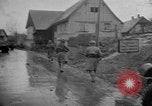
French 1st Army entering towns in Alsace during World War II
French 1st Army, C.C.1, under Colonel Gruss, moving west along highway D16 through the village of Schwoben. Infantry and armor entering Schwoben, past a sign reading "Tagsdorf" ( a village towards the west) in Alsace, during World War 2. A French soldier pauses by the body of a fallen German soldier. Local French people reentering the town of Sierentz,, some carrying belongings on horse-drawn wagon. The church of St. Martin in the background. Large number of French civilian men march loosely into the town, headed by one carrying the French flag.They wave and smile as they pass the camera. They march past an M10 tank destroyer and several French troops. View from jeep passing roadsign reading "Mulhausen,3.62." (This was located on highway D56 between Zimmersheim and Eschentzwiller.) View from parked jeep as jeeps and armored vehicles enter town. Local people fill the sidewalks to watch as French troops and tanks enter the town. French tricolor flags fly from windows of buildings.
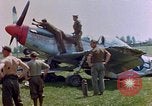
Men disassemble parts of the P-51 Mustang and P-47 Thunderbolt fighter aircraft at an American airfield in Germany.
Activities at American-occupied Ober-Olm airfield (Y-64), county of Mainz-Bingen, Rhineland-Palatine, Germany, immediately after the end of World War 2 in Europe. Men look over a damaged United States Army Air Forces P-51 Mustang fighter aircraft on the airfield. Mechanics disassemble parts of P-51D fighter aircraft. Wrecked United States Army Air Forces (USAAF) P-47 Thunderbolt fighter aircraft of the 393rd Fighter Squadron (8L on fuselage), 367th FG and P-51 aircraft of the 356th Fighter Squadron (AJ on fuselage), 354th FG on the airfield. Damaged wing and tail assembly of P-51. Wreckage under props. Nose of P-51D aircraft reads 'Sweet Janie.'
CRITICALPAST.COM: About Us | Contact Us | FAQs - How to Order | License Agreement | My Account | My Lightboxes | Shopping Cart | Advanced Search | Featured Collections | Website Terms & Conditions | Privacy Policy ©2026 CriticalPast LLC.
License Agreement |
Terms & Conditions |
Privacy Policy
©2026 CriticalPast LLC.