


 Francais
 Deutsch
 Italiano
Refine Your Search
2nd-Rangers-D-Day stock footage and images
- Showing 3025 to 3030 of 13612 results more
more Hide
Hide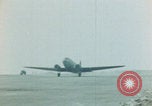
Jane “Candy” Kendeigh caring for injured Marines during medical air evacuation from Iwo Jima during World War II
A Douglas R4D transport aircraft (number 245 seen on fuselage) takes off during World War 2. Jane Kendeigh, the first Navy flight nurse to land in an active Pacific combat zone, and a few U.S. Marines are inside a Douglas R4D airplane in flight, speaking to one another and taking care of injured soldiers that are lying on stretchers and beds throughout the aircraft. Kendeigh is seen next to a few loaves of bread and a plate of meat, making sandwiches. The cockpit of the airplane is shown, with its pilots speaking to one another. An injured Marine on a bed is offered something out of a bowl, and another is seen with his hand on his forehead, presumably sleeping. Finally, a few shots of soldiers sitting and standing throughout the plane, talking amongst themselves.
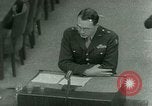
General Telford Taylor presents his summation during the Einsatzgruppen Case in Nuremberg, Germany.
The Nazi Einsatzgruppen Case of the Nuremberg Trials in Nuremberg, Germany, after the end of World War 2. General Telford Taylor gives his summation of the prosecution's case against the Einsatzgruppe. The defendants in the dock. Some of the defendants state that General Taylor believed that they had committed no crime in murdering their victims because they were Jews. Judge Michael Musmanno says that the defendant may now answer, extemporaneously or otherwise, to any new evidence which may have been presented during the prosecutor's summation. The Judges of the tribunal are Michael A Musmanno, John J Speight and Richard D Dixon.
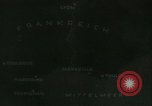
German tanks, trucks, and motorized infantry roll into Narbonne and Marseille during World War II.
German troops in France during World War 2. A map depicts Frankreich (France). A sign at a line of demarcation reads 'Demarkationslinie'. A soldier checks the time in his watch. German tanks, trucks, and motorized infantry enter the former "Zone libre," effectively ending its free status and militarily occupying it. They roll through French villages toward the South Coast of France. The convoy crosses a check post. The convoy on a long winding road through hills. German forces enter the city of Narbonne. Soldiers and tanks on the city streets. Shops on a sidewalk. Civilians including children watch the Germans. Soldiers sit, read and rest. Military vehicles on a tree flanked path. Children look around. Soldiers seated in a line on a railing. Military equipment in rail carriages. A sign for Marseille. The convoy enters the city. Civilians watch the convoy. Tanks on the streets. Soldiers on tanks as they cross the triumphal arch Porte d'Aix (Porte Royale) in the city.
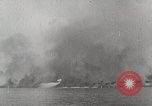
U.S. amphibious assault on Peleliu, Palau Islands, during World War II
U.S. 1st Marine Division amphibious assault agaist Peleliu, Palau Islands, on September 15, 1944, in World War 2. Coordinated assault involving many landing craft, troop ships,supporting warships firing at Japanese positions and F4U Corsair fighter bombers attacking from overhead.The entire island is shrouded in smoke. A U.S. carrier-based TBF Avenger aircraft is seen clearly banking overhead. An F4U in flight overhead. Explosions and smoke from bombardment. Two Landing Craft infantry (large) race toward the beach. The Cruiser, USS Louisville (CA-28) in camouflage (Measure 32, pattern 6d). U.S. aircraft bombing near the beachhead. Numerous landing craft assembling offshore. U.S. warships and LCIs (Landing Craft Infantry) offshore. Sun breaking through clouds and smoke.
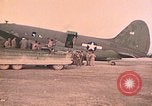
Curtiss R5C Commando aircraft evacuates wounded soldiers of 1st Marine Division at Peleliu Island in World War II
Curtiss R5C Commando evacuates wounded soldiers of 1st Marine Division during World War 2. Curtiss R5C Commando aircraft taxis and takes off from airstrip at Peleliu Island Palau, with Douglas R4D transports in background. Lockheed PV-1 Ventura takes off. Vought F4U Corsair takes off.
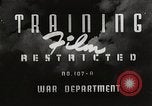
U.S. Army Air forces pilots learn about the Republic P-47 Thunderbolt airplane
From a U.S. Army Air Force Training film, "How to Fly the P-47. Pilot Familiarization." United States pilot seated on table writes a postcard to his mother, "Mrs D.Q. Hopkins. 1024 Clay Avenue, Pelham, New York" Board in the background with 'Daily Assignment of today' written on it. Scene shifts to forward view from cockpit of a Republic P-47 aircraft flying low over the flight line at an Air Base. Momentary glimpse of the pilot and his post card in the office. Back again, to forward view from cockpit of a P-47, but this time it is on final approach to the runway. Scene shifts to ground view of a P-47 landing. It taxis to the ramp and parks. The crew chief stands on the wing as the pilot completes and signs the aircraft's Form 1 (record of any problems). Five pilots walk past the flight line. The pilot, wearing a seat pack parachute, climbs down from the cockpit. The five pilots, seen earlier, approach, and one introduces them to the P-47 pilot (Captain Hopkins). They are Lieutenants assigned to his training flight. He greets them and shakes hands with all. The group ask questions about the P-47. Then they all go to the pilots room. As Captain Hopkins takes off his flight gear he tells them the P-47 is designed to operate at high altitude. He describes the P-47, referencing a large illustration of it on the wall. (World War II; WW II; World War 2; World War Two)
CRITICALPAST.COM: About Us | Contact Us | FAQs - How to Order | License Agreement | My Account | My Lightboxes | Shopping Cart | Advanced Search | Featured Collections | Website Terms & Conditions | Privacy Policy ©2026 CriticalPast LLC.
License Agreement |
Terms & Conditions |
Privacy Policy
©2026 CriticalPast LLC.