


 Francais
 Deutsch
 Italiano
Refine Your Search
2nd-Rangers-D-Day stock footage and images
- Showing 3037 to 3042 of 13612 results more
more Hide
Hide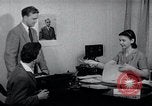
Activities of United States Information Service in various foreign countries
Opening scene shows a U.S. Information Agency (USIA) secretary provides a couple in Germany with information about American schools. Views of students in Saigon, South Vietnam, attending USIA English language classes. View of London, England, showing the Art Deco BBC Broadcasting House at Portland Place (Portland Pl, London W1A 1AA, UK) and All Souls Church, Langham Place (All Souls C of E Church, 2 All Souls' Pl, London W1B 3DA, UK). A man is seen delivering a can, containing the USIA monthly film documentary, to the BBC. View of Broadcasting House of BBC in Marylebone, England. In Iran, a Douglas DC-4 passenger plane takes off, carrying newspaper reporters and Iranian officials to look over an American technical assistance project which is seen from the air. In Tokyo, Japan, a man working in a private publishing company begins translating an American book. The book is open on his desk and contains an illustration of President Dwight D. Eisenhower. A page of the book, written in Japanese, is shown being reproduced on a type of mimeograph machine.
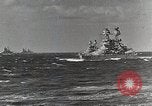
Montage of scenes related to the China-India-Burma theater during World War II
Two U.S. Pennsylvania class battleships underway at sea, with other warships in background, during World War 2. One fires to starboard with her 14-inch guns from the forward triple turrets. U.S. Army Air Forces B-24 Liberator bombers flying in formation over mountains. Glimpse of General Douglas MacArthur with General Joseph (Vinegar Joe) Stilwell in gunner's station of a bomber. Montage of brief glimpses showing U.S. forces engaging Japanese forces in: amphibious assaults; firing weapons in New Guinea and other Pacific islands. U.S. warship firing naval guns. U.S. ship firing at attacking Japanese aircraft, with sky full of black flak clouds. Admiral William (Bull) Halsey. Mitsubishi A6M Zero kamikaze aircraft blown up close to flight deck of U.S. aircraft carrier. It misses the ship and crashes in flames, exploding in the water, astern. U.S. General Joseph Stilwell, Madame Chiang Kai-Shek, British Allied commander Lord Louis Mountbatten, and Chinese Generalissimo Chiang Kai-Shek, photographed together in India. Chinese Generalissimo Chiang Kai-Shek seated for a picture with U.S. President Franklin D. Roosevelt. Camera moves back revealing British Prime Minister Winston Churchill, and Madame Chiang Kai-Shek, also seated. Behind them stand key allied military leaders, including (from the right) Field Marshal Archibald Percival Wavell, Commander-in-chief in India; Admiral Louis Mountbatten, Supreme Allied Commander of South-East Asia forces; George Giffard — commander of Eleventh Army Group; U.S. General Daniel Isom Sultan, deputy to General Stilwell; General Joseph Stilwell, Commander China-Burma-India (CBI) Command; and General Albert Coady Wedemeyer, Chiang Kai-Shek's Chief of Staff. General Joseph Stillwell is seen stepping from a military cargo plane, and being greeted by another officer. Stilwell is wearing a campaign hat. He has the CBI patch on his jacket shouder. A B-24 Liberator bomber takes off from a Chinese base at Liuchow, or possibly, Luiliang, China. (ostensibly carrying Chinese soldiers to India for training). U.S. marked P-40 aircraft are parked beside the runway. They display the shark teeth nose art of the Flying Tiger All volunteer Group of Claire Chennault. But this is 1944 and the aircraft are from the U.S. 23rd Fighter Group. Chinese soldiers are seen being armed and trained in India, with modern small arms. They are also seen fording a river with military supplies and moving in jeeps through jungle-like settings. Various views of Ledo Road construction in Burma. bulldozers, trucks, caterpillar tractors, explosives and men are shown in construction work. A jeep rides along a muddy section of the new road while U.S. and Chinese soldiers patrol on either side to protect it. Allied soldiers firing a small field piece. A C-47 aircraft airdrops supplies to the road builders. General Stilwell, standing with a Chinese officer, looks skyward at the aircraft. A C-46 Commando plane taking off from a field in India carrying supplies. Men loading a jeep aboard a C-46, plus ammunition and other supplies. Rare sight of supplies being loaded into nose cargo compartment of the one-of-a-kind XC-108A transport plane (modified B-17 bomber, tail number 41-2593). A formation of USAAF C-45 transport aircraft flying "over the Hump." Chinese P-36 Hawk aircraft in formation demonstrate firepower. Newly trained Chinese pilots marching and walking on flightline where solid-nose B-25s and P-40s are parked. Chinese and American pilots wave to each other from their P-40 aircraft. A B-25 takes off flanked by two P-40s. Bombs being dropped by Chinese B-25s. Japanese ship being strafed by Chinese fighter plane. Chinese laborers at work building an airfield without machinery. A large group pull a paving roller by hand. Chinese troops in combat with Japanese forces. One firing a Czech ZB vz. 26 light machine gun. Madame Chiang Kai-Shek addressing the U.S. Congress, 18 February, 1943.
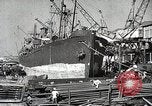
Construction of India-Burma-China Pipeline during World War II
Opening scene shows a large transport ship at a dock in Calcutta, India, during World War 2. It is surrounded by cranes unloading it. In the foreground, numerous sections of pipe are piled up on the dock. Closeup of group of pipe sections being lifted by crane from the ship's hold. Some individual pipes are seen moved by groups of Indian workers carrying them over their heads. Other Indian workers roll pipe sections onto barges that are seen clustered together near a steel bridge. A convoy of trucks is seen carrying the pipe sections along the Ledo road. Some bundles of pipe sections are carried on jeeps. View of an Army Air Forces C-47 transport plane taking off. Sections of pipe being offloaded from a C-47 plane. Numerous pipe sections in organized stacks near the airfield. Sections of pipe being fastened together. Engineers re-condition the road bed using construction equipment. Long connected pipe lines being pulled through water. Caterpillar tractors working on a muddy section of the road. Workers installing pipe near graves of workers who died from disease and other causes. Workers sending a bundle of pipe segments across a river by means of a Zip line. A worker's camp of tents in the background. Workers dressed in rain gear and boots carrying a pipe section through water during the Monsoon. Workers using machetes to chop their way through jungles. An open utility train moving Chinese troops along a single-track rail line, passes pipeline workers standing aside. Engineers and other pipeline workers distributing pipe sections along the rail line from railroad flatcars. Trucks driving the road, in Burma. Various views of the pipeline in including one showing lines of pipe forming a suspension bridge across a river. Other scenes show the pipeline crossing ravines, submerged under rivers, climbing vertical cliffs. Aerial views of the pipeline from low flying aircraft. A vehicle marshaling yard filled with army vehicles. M3A3 Stuart light tank moving past a yard filled with them. Army trucks moving out of their parking yard. Aerial view of large airfield with many parked Air Transport Command C-47 airplanes. B-29 bombers being refueled at an airfield. One is seen taking off. Lieutenant General Daniel Isom Sultan, Commander India-Burma theater, comments that the pipeline is a lifeline to our beleaguered ally and that the Chinese are in on this. Views of Chinese soldiers engaged against Japanese forces. They fire artillery pieces and heavy machine guns. British soldiers carrying Bren guns and struggling to move artillery pieces in the mud. They are seen firing artillery from under camouflage canopies and firing Vickers machine guns. Aerial view of the British controlled port in Calcutta, India, where war materiel is seen being unloaded. Tanks being transported on an Indian railroad. War supplies moving on a barge line and on roads. View of a British airfield in India. North Burma Chinese troops with their weapons and army vehicles. U.S. troops advancing on roads in the jungles. Chinese Marshal Chiang Kai-shek with U.S. President Franklin D. Roosevelt and British Prime Minister Winston Churchill, at the Cairo Conference of November 22–26, 1943. General Sultan concludes the film by reassuring American soldiers that they are in the China-Burma-India theater in the common allied effort to fight against Japan.

Camera Shop and Japanese cameras in Washington. Pictures of Washington landmarks.
A Japanese man walks into a camera shop alongside Tall Fashions clothes shop. Stacks of photography films and cameras are on display for sale. Cameras and Nikkor Camera lenses made by Japanese company Nikon are on display for sale. A Nikon S2 flash BC-5 for sale. American man buys a camera from proprietor. American man takes pictures of the Japanese Pagoda sculpture (ca. 1600) beside the Tidal Basin in Washington, D.C.; the Washington monument; The Lincoln Memorial; Capitol building and The White House.1964-65. Man takes pictures with his Nikon camera.

How American women contributed to U.S. war efforts during World War II as well as World War I
Film begins showing women looking at a bulletin board advertising free war training classes, during World War 2. Women are seen in a classroom learning to be quality control inspectors in factories. Their instructor uses a large-scale model of a micrometer to illustrate its use. A giant slide rule is mounted on the wall in the background. Women are shown working in an aircraft factory drafting room, preparing drawings for parts. Scene changes to women war production workers being trained as welders. A woman is seen teaching another to operate a drill press. Another woman is being trained to us a metal turning lathe in a machine shop. An employee patch on her right shoulder reads: "Bendix Aviation." Next, a woman is seen guiding a DC-3 commercial airplane into its parking place on an airport. A crew of women works to clean and maintain commercial aircraft in a hangar. Another crew of women climbs aboard a steam locomotive to clean and otherwise maintain it. A woman working as a commercial bus driver, picks up a passenger. Women serving in a messenger service company. A woman running an elevator in an office building. A woman making milk deliveries to a home. Women driving tractors on the large farms of the Midwest. Others run a harvester pulled by a team of 20 mules. A few men express reservations about the ability of women to work outside the home while still caring for families. Complete change of scene shows newsreels from World War 1 with men in uniforms marching. Nurses served overseas at base hospitals. But teams of women also supplemented for missing men in other occupations. One scene shows them shoveling debris into railroad open cars. Another showed women working in a lumber yard and also plowing fields on a farm. So-called Yeomanettes (World War I version of later era Waves) are seen on parade in uniform. Old newsreel shows U.S. Secretary of the Navy, Josephus Daniels, reviewing Yeomanettes, as his assistant Secretary, Franklin D. Roosevelt, converses with Vice Admiral William Sims. Film shifts back to World War II showing women in Army uniforms parading, glimpse of others who appear to be pilots. Film ends with montage of views seen earlier in the film.
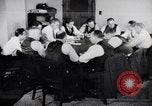
Film summarizing efforts by City of Dayton, Ohio to overcome labor shortage and meet defense production goals in World War II
The City of Dayton, Ohio's local war manpower and emergency committee members are seen gathered around a table to discuss what other than just more workers is needed to meet the war production goals set for the city during World War 2. An animated diagram superimposed on a drawing of a factory, charts the labor needs vs. labor supply. For the management side, the chart cites matters that need to be addressed, including: personnel management; plant layout; reduction in turnover, and absenteeism; and better working conditions, Regarding labor itself, the chart cites the following as needed: additional women; transfers from non-essential jobs; minority groups; part-time workers; and handicapped workers. Next, the emergency committee of community leaders is seen around a table. They are being addressed by Stanley C. Allyn, President of the National Cash Register Company, who notes that Dayton has partially solved its manpower shortage and expects to meet its war production goals.Camera pans over attendees, including labor leaders from AF of L and CIO; Government officials present, including Area Director and Deputy Regional Director of the War Manpower Commission, and Chief of Program Requirements for the Region; leading industrialists and retailers are shown. Local officials seen include the Mayor of Dayton and Secretary of the Chamber of Commerce as well as the Commanding Army Air Forces Generals of Wright Field and Patterson field. Mr. Allyn discusses further work to be done with as much emphasis on human relations as on the mechanics of production. An animated map shows Dayton and other areas of labor shortage, all over the United States. Workers in a factory are seen moving propeller blades across the floor by twirling them on end. Propellers assembled on their hubs are moved across the factory floor on wheeled stands. Artillery shells are seen protruding from containers. Browning aircraft machine guns moving along a conveyor belt. M3 Lee tanks being completed and moving across a factory floor. Glimpse of bombers in production. Army trucks lined up in formation at a factory yard. Closeups of General Dwight D. Eisenhower. (Narrator notes importance Eisenhower places on full support from the home front as essential to the war effort.)
CRITICALPAST.COM: About Us | Contact Us | FAQs - How to Order | License Agreement | My Account | My Lightboxes | Shopping Cart | Advanced Search | Featured Collections | Website Terms & Conditions | Privacy Policy ©2026 CriticalPast LLC.
License Agreement |
Terms & Conditions |
Privacy Policy
©2026 CriticalPast LLC.