


 Francais
 Deutsch
 Italiano
Refine Your Search
2nd-Rangers-D-Day stock footage and images
- Showing 3043 to 3048 of 13612 results more
more Hide
Hide
Travel by air, rail, and bus in Germany, circa 1936
Air and rail travel in Germany before World War II. View of snow-covered mountains and clouds. Flying above them is a German Lufthansa Junkers Ju 52 trimotor passenger airplane. It is named "Hans Wende" and displays registration "D-ADER" on its fuselage, and a swastika on its tail. Closeup of the forward part of the aircraft. View of passengers inside the cabin, enjoying the views out their windows. Body of water below. A passenger lights a cigar, and smokes. Another swings a typewriter down from the back of seat in front of her and prepares to type something. Views out plane's window behind left wing showing flaps slightly extended and as plane banks in right turn. Quick pan across copilot's position and back, showing corrugated metal on right wing. The city of Berlin is seen below. Passengers preparing to land. Aerial views of pre-war city of Berlin, from behind right wing, as aircraft descends to land. "Berlin" spelled out in large letters on ground at the airport, visible from the air. Aerial view of various buildings and landmarks, including the Berliner Dom (largest church in the city) seen below. The Lustgarten, two bridges leading to the Unter Den Linden boulevard below, with cars moving on it. The Zeughaus (Unter den Linden 2 10117 Berlin) and other buildings are seen along Unter Den Linden. As the aircraft passes over the Brandenburg Gate and forested park, below, the scene shifts to a zoom-in on the gate and transitions to a ground view of it with cars driving through the gate. Closeup of the “Quadriga” statue atop the gate, depicting the goddess of victory driving a chariot pulled by four horses. Camera moves through the gate and shows policemen, in white uniforms, directing traffic, including double-decker buses. Brief glimpse of the Victory Column (Siegessäule, Großer Stern 1, 10557 Berlin, Germany) on the Königsplatz across from the Reichstag. Pedestrians walking and trams passing along the street. Sightseeing bus carrying passengers along the road. View of the passengers inside the moving bus and the guide explaining the sights and landmarks of Berlin. They pass the Neue Wache war memorial. Scene shifts to a railroad train traveling in the city and rising up to an elevated track that passes through a building. View as the train approaches and passes through an elevated station. Brief view of the Wuppertal Schwebebahn (suspended railway). View of a German high-speed passenger train seen as it passes a bridge. Passengers relaxing inside the train. Some are eating and drinking. Several views of trains moving at high speed. Train signals in action along the railways.
Kingdom of Italy aircraft and crews surrender to Americans at Catania Air Base in Sicily, Italy, during World War II.
Italian aircraft and crews surrender to Americans at Catania Air Base, in Sicily, during World War 2, under terms of the Armistice of Cassibile , signed on September 3, 1943 and publicly announced on September 8th by U.S. General Dwight D. Eisenhower, on Radio Algiers. Under its terms, the Kingdom of Italy ceased hostilities against the Allies and Kingdom forces were to surrender to the Allies. An Italian SIAI-Marchetti SM79 ("Sparviero") Torpedo-Bomber is seen in flight over water, as viewed from another airplane. It carries the number 1NS-20. View of Catania Air Base, with U.S. B-25 Mitchel bomber, of the 340th Bombardment Group, landing, in background. The Italian SM79 is seen taxiing to the ramp, after landing at the Base. A Italian crew man opens the door and an officer exits using the aircraft ladder. He is followed by Giulio Cesare Graziani, torpedo bomber ace and winner of the Italian Gold Medal of Military Valor. (He is framed at 1:12.) Another officer also exits and the three shake hands with U.S. 9th Army Air Force officers on the ground. Commander of the 340th Bomb Group Lt Col Adolph "Tik" Tokaz appears in frame 1:05. The Italian officers present some documents and discuss them with the U.S. officers. The officers from both countries gather around the Italian seal, of the kingdom of Italy, on the tail of the plane and discuss it. The officers turn to watch another Italian SM79 land, taxi in, and park. Italian fliers exit this airplane and walk across the ramp to join the others, with whom they exchange salutes, and shake hands.
F-51 Mustangs of the South African Air force attached to the U.S. Air Force18th Fighter Bomber Wing in Korea.
F-51 Mustang aircraft of 2 Squadron, South African Air Force (SAAF), fly overhead, in two flights of 4 aircraft each, and peel off for landing. This Squadron, attached to the USAF 18th Fighter Bomber Wing, is operating at K-10, Chinhae (aka Jinhae) Air Base, where one of their F-51s, displaying SAAF markings is seen taxiing to park. Other aircraft of the 18th Wing are seen parked in the background. Another F-51D, with USAF markings, tail number 45-11736, and shark's teeth painted on its nose, taxis out of the parking area. This aircraft is from the 12th Fighter Bomber Squadron, and piloted by Lt. James Glessner. (Korean War)

Planning and training for invasion of North Africa (Operation Torch) in World War II
'Tunisian Victory' shows preparations during World War 2. Film opens showing a sailor in the crow's nest of a ship in a convoy of American warships. Aerial glimpse of the convoy. Sailors working on teletype machines in s communications center aboard an American warship. Ships exchanging light signals at night. Scene shifts to a British naval convoy moving across the sea. View from bridge of forward guns on British King George V-class battleship. A single stack Navy destroyer ship. HMS Rodney with 3 over 3 forward gun turrets leads another warship protecting the convoy. The aircraft carrier, HMS Illustrious in camouflage paint. An American Navy Douglas Dauntless dive bomber seen from a ship. A U.S. Navy Consolidated PBY Catalina aircraft over the convoy. Brief view of a four-engine bomber flying over the convoy. Scene shifts to sailors on ship's deck in the American convoy. The British flag on one of its convoy ships. Scene shifts to the White House on June 18, 1942. President Franklin D. Roosevelt arriving with British Prime Minister Winston Churchill in a car. Lights burning at night in the White House. Closeup of hats of the British and American staff officers on a rack. World Globe showing German army thrusts to the North by Field Marshal Fedor von Bock into Ukraine and the Caucasus, and another by Field Marshal Erwin Rommel South toward Egypt. In Asia, the conquests of Japan are shown. President Roosevelt and Prime Minister Churchill are seated at a desk. Behind them are Roosevelt's assistant, Harry Hopkins and two uniformed officers. View of relief map showing planned joint offensive. British and American staff officers seated at a planning table. Pertinent maps being printed for the offensive. Closeup views of woman's hands typing on typewriter. Tight closeup view of a teletype tape coming across a machine that reads "ANFO GAZE ACROBAT RE NO K" A typist at a teletype machine with tape being made. A busy military communications center. A plan marked "secret" moving across a sliding document mechanism or slide. American and British war production workers arriving at military equipment production factories for work; large groups of war production workers. Workers at military equipment plants and factories in the the U.S. and the U.K., including many women workers involved in war production. A document labeled "SECRET OCSigO" Staff officers in planning session. U.S. Army Chief of Staff, George C. Marshall, seated with British Field Marshal Sir John Dill. More views of the Combined Chiefs of Staff at work viewing wall maps and table maps and plans. Steel mills in operation. American army troops training and preparing in battle drills, firing machine guns, battlefield advance training, swimming under water below flamethrower flames and below oil slicks on fire, leaping into water, practicing paratrooper jumps into water. New ships including Liberty Ships and warships being launched at American shipyards. War production workers inside a plant building B-17 bomber aircraft. An early version of Sherman tank (external bolts showing) and Sherman tanks being built in factory. Shipboard twin anti aircraft guns being test fired. Giant yards filled with newly manufactured weapons, armor, trucks, tanks jeeps, searchlights. U.S. Army generals walk in a group inspecting equipment. War materiel and troops and tanks being transported on railroad trains in America and Britain. Covered Lockheed P-38 Lightning aircraft being towed by trucks past a watching British police (Bobby) at night. Ships being loaded at docks. Troops and war materiel being loaded aboard ships in the U.S. and Britain. Crowd on dock (mostly women) waving goodbye to soldiers on a ship. Soldiers look out portholes and from deck as troop transport ships get underway. Hand sets ship engine control to slow. Soldiers entertain themselves. Soldier playing piano on deck of ship as fellow soldiers listen and tap feet on top of console piano. Closeup view of hands on piano and a soldiers boot nearby on the piano case. Soldiers smile and enjoy the music.
The start and the finish of the U.S. Army Air Service Pan American Goodwill tour in 1926-1927
Glimpses of airplanes and crews that made the Pan American Goodwill flight that covered 22,000 miles to 21 Central and South American nations, in 1926. Aerial view of hangars and runway at kelly Air Base, Texas, as one of the five Loening OA-1 Amphibious aircraft takes off from the runway on Dec. 21, 1926.The five aircraft seen in flight over a city, are: The New York, with crew: Maj. Herbert Dargue and Lt. Ennis Whitehead; The San Antonio with crew: Capt. Arthur McDaniel and Lt. Charles Robinson; The San Francisco with crew: Capt. Ira Eaker and Lt. Muir Fairchild; The Detroit, with crew: Capt. Clinton Woolsey and Lt. John Benton; and The St. Louis, with crew: Lt. Bernard Thompson and Lt. Leonard Weddington. President Coolidge presenting the pilots with with citations for the Distinguished Flying Cross at Bolling Field, Washington, D.C., on May 2, 1927, at the opening of the Pan American Air Commission Conference.
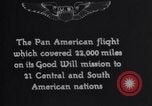
President Coolidge present pilots with citations after the successful goodwill mission.
Brief scenes from the U.S. Army Air Service Pan American good will flight that covered 22,000 miles on a goodwill mission to 21 Central and South American nations, during 1926-1927. A view of the hangar area and flight line of Kelly Air Field in Texas, as one of the five Loening OA-1 Amphibious aircraft, on the mission, takes off from the runway on Dec. 21, 1926. Five of the aircraft in formation over a large city. U.S.President Calvin Coolidge presents the aircrews with citations for the Distinguished Flying Cross, at Bolling Field, Washington, D.C., on May 2, 1927.
CRITICALPAST.COM: About Us | Contact Us | FAQs - How to Order | License Agreement | My Account | My Lightboxes | Shopping Cart | Advanced Search | Featured Collections | Website Terms & Conditions | Privacy Policy ©2026 CriticalPast LLC.
License Agreement |
Terms & Conditions |
Privacy Policy
©2026 CriticalPast LLC.