


 Francais
 Deutsch
 Italiano
Refine Your Search
2nd-Rangers-D-Day stock footage and images
- Showing 3151 to 3156 of 13612 results more
more Hide
Hide
Meeting of the Eighteen-Nation Disarmament Committee at the U.N Palace of Nations, Geneva Switzerland, in 1967
As film starts, the loud sound of jet airplanes is accompanied by views upward of clocks and the control tower at Geneva, Switzerland airport. The flag of the Canton of Geneva and that of Switzerland are displayed in tall flag poles. A jet passenger plane begins its takeoff roll in the background. An observation deck atop the airport building is filled with visitors. A Swissair Boeing 707 passenger plane is taxiing to the ramp after landing. Snow covered mountains fill the background. Narrator says "tomorrow, the 4 year old, 18 Nation Disarmament Conference, co-chaired by the Soviet Union and the United States, will once again, convene." Photographers ready cameras as a mobile stairway moves to the aircraft doorway. Closeups of spectators on the observation deck, including families with children. The American delegate, William C. Foster, Director, United States arms control and disarmament agency, is seen walking away from the airplane, across the airport ramp, accompanied by persons greeting him. Inside a building, Foster is mobbed by surrounding reporters and photographers. An interviewer asks him what is the most important item on the agenda for the United States. He replies: "The achievement of a Non-proliferation Treaty." Newsmen continue to press him about prospects of success in negotiations with the Russians. Scene shifts to the shore of Lake Geneva and the original League of Nations, Palace of Nations building there. Camera pans over the building to a tablet in its wall, memorializing U.S. President Woodrow Wilson, Founder of the League of Nations. View from a high hill overlooking the lake, shows the second home of the League of Nations built in 1936, adjacent to the original building. (It is now the European Headquarters of the United Nations.) Camera pans across the building and its grounds, where a flag and a large sculptured globe of the world are seen. Scene shifts to a parkway with several cars on it. The camera focuses on the shaded building of the Soviet Mission, just off the parkway. In downtown Geneva, the camera focuses on a large building of glass and aluminum, which houses the United States Mission, where the United States Disarmament delegation is headquartered. William C. Foster is seen at a large conference with the delegation staff. Closeup of him and staff members as they consider the best ways to approach the negotiations. Various closeups of Mr. Foster as he works over texts at his desk. He is heard saying: "The important thing is to get complete control of a possible exchange of nuclear weapons on a grand scale." Brief view of Lake Geneva at night. Next, the camera pans downward from the ceiling to the council chamber floor where delegate seats are arranged around a huge table in readiness for the next days activities. It is the next day, and an American flag flutters on the fender of a car carrying William Foster to the Council chamber for the day's session. Closeup of him in the back of the car. The camera also captures scenes outdoors as the car drives along the scenic lake front drive to the Palace of Nations. A daytime view from overlooking hill of the Palace of Nations and Lake Geneva. In the outer hall of the Palace of Nations building, some 200 reporters mill about discussing world events of the day. William Foster's car arrives at a curb and a white-capped officer greets him as he steps from the car. Other delegates, including a woman, are also seen arriving and entering the building. Inside the building, delegates are seen socializing (with many languages heard). Closeup glimpse of Mr. Foster among the group.

Farming, marketing and recreation activities of citizens in the town of Madison, Indiana, alongside the Ohio River in the U.S.
Life in the town of Madison, Indiana, on the banks of the Ohio River. Scenes in and around the town: View of the Milton-Madison bridge across the Ohio River (US-421, Milton, KY 40045, United States) ; the town of Madison on hillside across the river; Church steeples protruding above tree tops in view from above; tree lined and shaded sidewalk; a tower with ramparts; Italian Campanille- style tower; gothic doorway on a church; slate rooftops with chimneys protruding and towers and cupola building top visible; Greek-inspired column; a renaissance-style fountain with statuary. A fraternal building with ramparts; the Madison Fair Play Fire Company fire department building with Italian-style tower (403-405 E. Main St. Madison, IN 47250, USA); Roman columns on the Jackson safe deposit and trust Company “National Branch Bank” building. Children play in the fountain on a hot afternoon. A Stern-wheeler Riverboat plying the river with dense black smoke streaming from its twin stacks. Men from Greece, Ireland, Germany and other parts of the world have settled in Madison. They include a confectioner, a county agent and others. A Greek confectioner inside his shop. A journalist works on a typewriter in an office. He speaks on the phone during a telephone call. A county agent of Dutch descent speaks to clients. An elderly couple from Germany chat and have drinks at a restaurant. A toddler eats pasta while sitting on a highchair. An Italian family eats pasta together at a dining table. Effigy of James Madison, a founding father and the namesake of Madison, Indiana. Farming activities: Farms and houses. Farmer and other men harvest grapes from grapevines. Other farmers harvest tobacco. A woman brings eggs from a hen house. A farmer loads baskets and milk containers on a truck for market day. Market day activities: An open market is set up around the Madison courthouse. A produce merchant sells his products to customers. View of the main street. Buildings seen on either side of the street. Mountains in the background. Recreation activities: Citizens bowling in a club. Ball seen hitting pins up close. They drink at a bar and play billiards and checkers. They dance and watch a movie. Citizens outside the box office, beneath the movie theatre marquee. People inside a movie theater watching a movie. Faces of audience members as they watch the movie screen. Customers get refreshed at a corner drug store where a crowded soda fountain bar area and tables are shown. Students play band instruments during a school concert. View of churches. Parishioners enter a church gate. They worship and pray. A man holds a fishing rod. He walks towards a lake. (World War II period).Life in the town of Madison, Indiana, on the banks of the Ohio River, in the United States. Scenes in and around the town: Steel highway bridge across river; the town on hillside across the river; Church steeples protruding above tree tops in view from above; tree lined and shaded sidewalk; a tower with ramparts; italian-medieval style tower; gothic doorway on a church; slate rooftops with chimneys protruding and towers and cupola building top visible; Greek-inspired column ; a renaissance-style fountain with statuary. A fraternal building with ramparts; the fire department building with Italian-style tower; Roman columns on the Jackson safe deposit and trust Company building. Children play in the fountain. A Stern-wheeler Riverboat plying the river with dense black smoke streaming from its twin stacks. Men from Greece, Ireland, Germany and other parts of the world have settled in Madison. They include a confectioner, a county agent and others. A man works on a typewriter in an office. He speaks on the phone during a telephone call. A man and a woman chat and have drinks at a restaurant. A family eats dinner or another meal together at a dining table. Farming activities: Farms and houses. Farmer and other men harvest grapes from grapevines. Other farmers harvest tobacco. A woman brings eggs from a hen house. A farmer loads baskets and milk containers on a truck for market day. Market day activities: An open market is set up around the Madison court house. A produce merchant sells his products to customers. View of the main street. Buildings seen on either side of the street. Mountains in the background. Recreation activities: Citizens bowling in a club. Ball seen hitting pins up close. They drink at a bar and play pool and checkers. They dance and watch a movie. Citizens outside the box office, beneath the movie theatre marquee. People inside a movie theater watching a movie. Faces of people as they watch the movie screen. Customers get refreshed at a corner drug store where a crowded soda fountain bar area and tables are shown. Students play band instruments during a school concert. View of churches. Parishioners enter a church gate. They worship and pray. A man holds a fishing rod. He walks towards a lake. (World War II period)
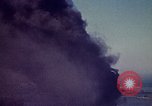
Sailors work to extinguish fire on Allied ships at the Tunis Port following aerial attack in North Africa Campaign.
Allied ships on fire in Tunis Port during the North African Campaign. View on shore as a U.S. Navy sailor and a camera man operating a moving image camera view the fire blazing in the harbor on a sunny day. Black and white smoke clouds arise from the ships. Flames leap upward on the ships. Sunken ships in the water. U.S. Navy sailors use water hoses to extinguish the fires at the bow of a ship. Charred gun on the bow of the ship. Sailors survey remains of burned ships and damage at harbor. Men extinguish the fire with water hoses. (This is possibly footage of the surprise day time raid by German Luftwaffe aircraft attacking Allied ships at Tunis harbor on May 19, 1943, six days after the Axis surrender in North Africa.)
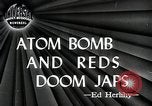
Allies demand the unconditional surrender of Japan in World War II. Entry of Soviets and use of atomic bomb ends the war.
Representatives of three nations, seated around table at Potsdam Conference held at Cecilienhof in Potsdam, Germany. British prime minister, Clement Attlee; President of United States, Harry Truman; and representative of Soviet Union, Joseph Stalin at the Potsdam Conference, July 1945. They deliver an ultimatum of unconditional surrender to Japan. Swarms of B-29 bombers and Aircraft Carrier Task Forces destroy Japanese homeland. Planes on carrier decks.Navy Grumman carrier-based TBF aircraft dropping bombs.. Destruction of ships at sea. Mushroom cloud due to atomic bombing. Chart depicts the power of one atomic bomb. Britain's 'grand slam' bomb, most destructive conventional bomb ever produced. Doctor Ernest Orlando Lawrence, inventor of the cyclotron (atom smashing machine). A man works at the Cyclotron at the University of California, Berkeley. General Leslie Groves, head of the project speaks. He is seated with Dr Vannevar Bush, government director of science and research, and Dr Richard Tolman, technical expert. Quantities of uranium shipped from Alberta, Canada are used in bombs. The atomic bomb process (Manhattan Project) is developed in widely separated areas; scenes from Hanford Project plant in Richmond, Washington. Project personnel exit cars and enter into the search area before starting their work day. Lieutenant colonel Franklin T Matthias with the army corps of engineers, appointed to the Hanford Project. Sign of 'Oak Ridge' in Tennessee. Largest of the three atomic bomb plants located near the Tennessee Valley Authority (TVA) dam. Employed personnel in atomic bomb plants are seen going to work. Man and woman employees at the plan read and smile at a Knoxville Journal newspaper in August 1945 with news headline "Power of Oak Ridge Atomic Bomb hits Japs" after the atomic bomb was dropped in Hiroshima. View of dense prefabricated home communities to house large number of Oak Ridge plant workers. View of families setting up their houses in trailer towns after the prefabricated homes were full. People come out from the Henebry's Jewelers and supermarket, among stores setup to meet the needs of the quickly built city. Scenes changes to show view of Soviet leader Joseph Stalin at conference. Russian artillery and troops in a parade at Red Square in Moscow, Russia (these parade scenes are from the May 1, 1945 May Day parade, just days before Germany's surrender). President Harry Truman reports on the latest developments regarding the war with Japan. He states that the United States is prepared to destroy every productive enterprise in Japan and the U.S. shall completely destroy its power to make war. He warns of an attack by the U.S. due to the rejection of the July 26th ultimatum at Potsdam. He warns that Japan "should expect a rain of ruin from the air; the like of which has never been seen on this earth." Truman notes that it will be followed by an unprecedented sea and land invasion of Japan.
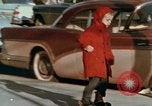
Children roller skating, playing, and people walking in 1950s street scenes in the United States.
Children roller skating on sidewalk past a volkswagen and a 1957 Buick Roadmaster car, parked at the curb. A little girl in a dress skipping along the sidewalk with an extremely rare 1956 Hudson Hornet (with an open trunk) in the background. A man helps a small child in a red snowsuit walk on snowy sidewalk. A woman and small child, both in red slickers and hats, walk along street on rainy day. Children play in a sandbox on a sunny day. A man and boy are passed by two young girls walking at an amusement area. Sign on building beind them advertises "Nate Eagles Midgets." A large tent ahead ot the girls displays sign reading:"Operated by East Bridgwater, Class of -- (unreadable). A mother and two little girls in dresses and bonnets on a sunny day. Two boys playing marbles on pavement. Man cleaning a delivery bicycle. A woman checking personal appearance in mirror outside a store. Buildings are reflected in the same mirror. Mother and daughter talk with man at a crosswalk. A red and blue mailbox is behind him. The girl wears a red coat, black boots, and carries a large leather schoolbag. Views of girl's and women's feet in motion, wearing sneakers; wearing high heels and boots (on rainy pavement); and wearing rubber boots in snow and slush.

Marshals seize produce with high amount of pesticide; farmers treat fields and orchards with pesticides in the United States
A combine harvesting wheat in the United States. Workers picking peaches from an orchard. A ‘Fruit Growers Express’ railroad train transporting produce by rail. Trucks carrying fruits driving on highway during day and at night. A Union Pacific railroad train leaves a train station with many train cars carrying produce. Grain is processed by a machine and piped into a storage hold for shipment. A barge sails past a flour milling plant. A Western Fruit Express wagon stands beside rail tracks. Sign in car front window reads “Deputy U.S. Marshal”. Marshal attaches a “Monition” notice to the seized Western Fruit Express wagon due to a pesticide violation. Film subject introduced as "The safe use of pesticides...Follow the Label." A man offloads crates of produce seized by the United States Marshal. Two farmers discover an infestation of caterpillars in their fields. The farmers inspect leaves from their infested crops. A Food and Drug Administration (FDA) inspector examines produce from a seized rail car due to presence of excessive pesticide residue applied by the farmer to get rid of caterpillars discovered late in the harvest. The FDA inspector carries samples taken from seized produce. The FDA inspector writes on the paper bag containing samples and seals the bag with tape. An African American scientist examines samples of produce for illegal pesticide content. A syringe is inserted into a machine for chemical analysis. An FDA District Director makes a call from his office. A General Counsel speaks to an FDA District Director over the phone. A United States District Court arrest warrant against seized illegal produce. A judge signs the arrest warrant and hands it over to a marshal. A farmer drives a tractor and parks in front of a shed. A farmer looks at pesticides inside the shed. The farmer grabs a pack of pesticide and placed it at the back of the tractor. Farmer drives a tractor sprayer to treat pesticide on a field. Sacks of pesticide inside a shed. Camera zooms into a pesticide sack to show warning that reads “DO NOT USE WITHIN 10-DAYS OF HARVEST’ which the farmer violated. United States marshals seize produce from a Great Northern Railway cargo. The seized cargo is buried in a landfill. United States Marshals oversees the destruction of seized produce. A bulldozer covers the produced with rubble and soil. Animation depicting a caterpillar and various bugs superimposed over farm pests and crops. A praying mantis feeds on a bug. A farmer wearing protective gear including goggles and gas mask or respirator drives a tractor sprayer in orchard as he applies pesticide, herbicide, or insecticide. Boy and girls exiting a school house. Children running out from school at the end of day. Farmers harvesting carrots. Tractor plowing to expose pests. A farmer releases wasps to control pests. A farmer breeding resistant variety crops. A farmer prepares pesticide inside a shed. An old weighing scale tilting. Farmer opens hose to fill water into the tank of a sprayer. The farmer pours pesticide powder into sprayer. Sprayer treats orchard with pesticide.
CRITICALPAST.COM: About Us | Contact Us | FAQs - How to Order | License Agreement | My Account | My Lightboxes | Shopping Cart | Advanced Search | Featured Collections | Website Terms & Conditions | Privacy Policy ©2026 CriticalPast LLC.
License Agreement |
Terms & Conditions |
Privacy Policy
©2026 CriticalPast LLC.