


 Francais
 Deutsch
 Italiano
Refine Your Search
2nd-Rangers-D-Day stock footage and images
- Showing 3157 to 3162 of 13612 results more
more Hide
Hide
Solemn ceremony honoring dead, at the Luitpoldarena during the Nazi Party 6th Congress at Nuremberg
A "Totenehrung" ceremony, honouring dead, held during the 6th Nazi Party Congress at Nuremberg, in 1934. The Luitpold Arena is seen filled with Nazi SA ( Sturmabteilung) and SS (Schutzstaffel) troops in precise formations, leaving only a wide pathway to the Ehrenhalle war memorial. Three figures are seen walking side-by-side along that path. View from behind guards standing at the Ahrenhalle, as the three persons approach. Three huge banners with swastikas are seen in the far background. Camera continues moving left, to behind a military band playing a slow dirge. Suddenly another camera from an elevated position, focuses upon the three persons approaching the Ehrenhalle. Soon they are recognizable, as Adolf Hitler, flanked by SS leader, Heinrich Himmler (in Black) and Viktor Lutze, head of the Sturmabteilung (SA). They pause on the terrace. From camera position, behind them a huge memorial wreath is seen on the terrace, as well as flames and smoke rising from open cauldrons, lining the Ehrenhalle terrace walls. Hitler, Himmler, and Lutze, all render Nazi salutes. Closeup of a stone swastika. The three principals turn and begin walking away from the Ehrenhalle, as soft strains of "Ich hatt' einen Kameraden" are heard. SA troops are seen with their banners tilted down, in salute to the fallen. The principal trio continue their walk along the path. The SA raise their banners, and a cadre of their buglers are seen as they sound in unison. Adolf Hitler stands at principal speaker's atop the main grandstand (Ehrentribüne) overlooking the scene. Units of SA begin to march towards and around the dais. Himmler seen on a lower dais to left of Hitler, and Lutze, likewise to his right. Huge Swastika banners form a backdrop. Spectators in a gallery above and behind the assembled troops. The marching continues, uninterrupted. Hitler standing with arms folded. Marchers snaking along as they reposition themselves closer to the speaker platforms. Closeup of Lutze, and of Hitler, with Rudolf Hess, close to his left. SS troops in black uniforms, begin to march, starting with their band. Glimpse of Himmler at their head. View from high above the field, shows the SS troops formed up in the walkway, their black uniforms contrasting with the white of the path. Closeups of the largest swastika banners and of German eagle sculptures. Buglers sound a call. Closeup of Lutze, saluting and presenting the SA troops to Hitler. He and they render three "Sieg Heils." Hitler speaks, and is hailed. Closeup of Hitler speaking. Glimpse of SS troops, now filling the pathway in front of the dais. Views of the entire scene from various locations as Hitler is speaking. More hails from the assemblage. Hitler concludes his remarks with a "sieg heil," and the troops respond. SA gunners commence firing an artillery field piece, as Hitler walks among SS units, shaking hands with their leaders. He does the same with SA troops and leaders.
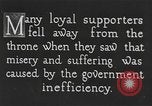
Several scenes of public demonstrations by Russian citizens in Petrograd during World War I
Scenes of unrest in Russia during World War 1. Crowds of Russians, disappointed with the war, their government and the general state of affairs, demonstrate in Petrograd, during the so-called February Revolution immediately preceding the beginning of the Russian Revolution. Some carry banners reading "Freedom and Equality, and similar slogans. (This event triggered the abdication of Tsar Nicholas II and formation of a Provisional Government.) In another sequence, a huge mass of Russians, mostly women, move through a street in Petrograd on International Women's Day, May 8th, during a period of labor strife and unrest. In final sequence, Russians are seen packed together on a warm day, possibly listening to a speaker. (These may be brief scenes from the July Days uprising, in Petrograd, When a peaceful demonstration by half a million people, was put down by armed troops resulting in some 700 deaths.) (World War I; World War 1; WWI; WW1)

Venezuelan baseball pitcher Alex Carrasquel plays in New York, 1939
This Spanish language newsreel clip highlights Alex Carrasquel -- the first baseball player from Venezuela to play in the U.S. major leagues. He played in New York on July 4, 1939, the day before Venezuela's Independence Day. Title cards read: "Especially for Venezuela. The great pitcher Alejandro Carrasquel plays in New York on the eve of the Venezuelan patriotic day." Shot of Simon Bolivar statue in New York's Central Park with 'Simon Bolivar El Libertador' written under it. Huge crowd at Yankee Stadium in New York to watch July 4 doubleheader between New York Yankees and Carrasquel's team, the Washington Senators. (NOTE: This crowd was mainly there to see the Yankees honor Lou Gehrig, their Hall of Fame first baseman, who had just been diagnosed with ALS.) Carrasquel (#14) pitches to Yankees in second game, gives up run-scoring triple, tags out another runner trying to reach first base. Carrasquel speaks to crowd through microphones in ceremony at home plate. Shot of Venezuelan flag on pole outside a building (Venezuelan embassy?). Men and women gathered at a cafeteria. Sign in large white letters reads 'Venezuela.'

A teenaged couple steals a bag from an unlocked car in a parking lot
A teenage boy smoking in a parking lot, accompanied by a girlfriend. The young man opens car door and steals a bag before walking away with the young woman. View of punch time clock in guard shack. A line chart showing the number of “Petty Larceny” cases committed each day of the week. Line chart showing the number of “Auto Theft” cases committed for each month, peaking in November. A line chart, with an analog clock beside it, illustrating the number of burglary cases committed for every hour of a day. A line chart, with an analog clock beside it, illustrating the number of “Preventable Crime” cases committed for every hour of a day.
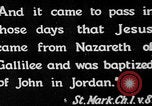
Landscape views showing the Jordan River, the Judaean Desert and its mountains in Palestine.
Slide reads “And it came to pass in those days, that Jesus came from Nazareth of Galilee, and was baptized of John in Jordan.St.Mark.Ch.1.v.8.”. View of the Jordan River in Palestine. Slide reads “Then the Spirit drove him immediately into the desert, ad in the desert he remained for forty days while Satan tempted him. St. Mark Ch.1. vv.12-13.”. View of the Judaean Desert, where Bible says Jesus Christ spent 40 days fasting. View of the Judaean Mountains, also known as the Hebron Mountains. View of the Mount of Temptation in the Judaean Desert.
U.S. President Eisenhower briefs press about his 2 1/2 week trip to nine countries during a press conference in Washington DC
U.S. President Dwight Eisenhower's 175th press conference in Washington DC, United States. Several correspondents from different nations arrive for the President's 175th press conference. Men prepare cameras mounted on tripod stands at the back of a hall. President Eisenhower with an official walks past the newsmen seated in the hall. The President makes an announcement of his two and a half weeks' trip starting from December 4, 1959. The newsmen taking notes. The President says that he would be visiting nine countries and would be making brief informal visits to Rome, Ankara, Karachi, Kabul and would be in New Delhi for the inauguration of the American Exhibit at the World Agricultural Fair on December 11. He says he will visit Tehran and Athens on his way to Paris for the Western Summit meeting. He gives details of the 3 main days. December 4 - when they would be developing legislative program for the coming year, December 11 - the beginning of the World Agricultural Fair, and December 19 - when he would be in Paris for a meeting. A newsman asks the President the purpose of this extensive visit. The President states the importance and need of being the first U.S. President to make an extensive visit to a strategic continent like Asia. He expresses his interest in visiting India and millions of people who are struggling to raise their standard of living. He says that he will visit Pakistan, Afghanistan, Iran and other nations on the way. The President further says that he hopes to build in that region of Asia and in many other parts, a better understanding of the United States. A correspondent asks the President whether Mrs. Eisenhower and his family members would be joining him for the visit. The President says that some of his family members would be joining him but may be not his wife.
CRITICALPAST.COM: About Us | Contact Us | FAQs - How to Order | License Agreement | My Account | My Lightboxes | Shopping Cart | Advanced Search | Featured Collections | Website Terms & Conditions | Privacy Policy ©2026 CriticalPast LLC.
License Agreement |
Terms & Conditions |
Privacy Policy
©2026 CriticalPast LLC.