


 Francais
 Deutsch
 Italiano
Refine Your Search
2nd-Rangers-D-Day stock footage and images
- Showing 3181 to 3186 of 13612 results more
more Hide
Hide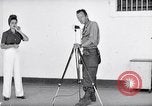
Interview with liberated female internee Georgette Kramer from the Los Banos camp in Manila, World War 2
Interview in Manila with freed female internee Georgette Kramer from the Japanese operated Los Baños internment camp (liberated 13 days before the interview). A microphone is set on a tripod stand for the interview. Ms. Kramer relates how she was wounded by a stray Japanese bullet during the February 23, 1945 liberation operation. During the firefight with Allied forces a bullet went through her mother's arm, through Ms. Kramer's abdominal wall, and into her friend's hand. Wounded, they were rushed to a tank. She says one other internee was also shot through the hip. When asked what she wants to do now that she is free she says she is not sure. A young girl, Ms. Kramer's sister, Aoife Kramer, runs up to the camera and says she wants to say something too. The interviewer lifts up the child in his arms. The girl says she wants to go to the United States. (World War II period).

View of University lecture theaters and students in Germany struggling to be students in post-war Germany after World War 2
College student life in Post-war Germany after World War II. A man sits and studies on a chair. Construction of a building seen as students sometimes must work in construction by day to earn money and board to be students at night. A bomb shelter in Bonn Germany converted into a dormitory. A man working near a microscope. A man wrapped in a blanket seen studying. Several books in a heap in a library and other books seen arranged. Many students sitting in Lecture theaters attending classes. Teacher seen in lecture theater with multiple rows of elevated sloped seating.
Liberated United States airmen prisoners at Stalag 7A in Moosburg, Germany (WW2)
Liberated United States prisoners (mostly military airmen) at POW camp called Kriegsgefangenen-Mannschafts-Stammlager (Stalag) VII A, located just North of Moosburg, Germany during World War II. The airmen cook food. Several are seen sunning themselves. Airmen seen shaving, shining shoes and cleaning clothes. A group of airmen around sign 'I Wanted Wings' and 'Luft 3'. These are some of the prisoners who were originally held at Stalag Luft III, in German Province of Lower Silesia, near the town of Sagan (now in Poland). (Note: Stalag Luft III is famous because the "Great Escape" took place there in March, 1944. Prisoners were forced to march from Sagan to Spremburg during the coldest winter in Germany in 50 years. There, they boarded a train of boxcars for a 3 day trip to Moosburg in January 1945, because the Russians were closing in. The addition of these prisoners to Stalag 7A, at Moosburg, led to serious overcrowding of the camp. On May 1, 1945, the New York Times reported that "The Fourteenth Armored Division liberated 110,000 Allied prisoners of war at Stalag 7A at Moosburg." This corrected an earlier report that 27,000 prisoners had been liberated.)

Newsreel "Australians and Americans drive Japs from Lae" during World War 2
American B-25 aicraft bomb Japanese positions in New Guinea in advance of operations by American and Australian troops. Explosions seen on ground as bombs impact targets. Low altitude aerial view of destroyed Japanese troop transport ships and cargo ships near the shores of New Guinea. Naval bombardment of Lae is seen from aboard Allied invading ships. Australian soldiers go ashore. General MacArthur confers Lieutenant General George Kenney and other officers. U.S. paratroopers on ground at an airfield prepare equipment and ready for jump into enemy territory. Scene with close up of General MacArthur smiling. Paratrooper C-47 aircraft lined in rows. U.S. Army paratroopers loading into aircraft and C-47s taking off. Aerial view from inside a C-47 as equipment and men jump toward target area of Lae. Hundreds of parachutes seen in sky. A serviceman holding a motion picture film camera films the view of parachutes through the open aircraft door. View on ground 5 days later as Australian Army troops join up with American forces on a captured Japanese airfield. Close up views of faces of Australian soldiers. The soldiers cut tall grass at landing fields to prepare for arriving DC-3 aircraft. DC-3 landing with supplies unloaded by Australian troops for use in the drive into Lae and Salamaua New Guinea.

A film titled 'The Warning' showing scenes of London as citizens prepare for air raids (WW2)
A film titled 'The Warning' from World War II. Narration in Japanese. Street scenes in London. Factory whistle blows announcing end of work day. People walking on the streets. Houses and city streets in view. Double decker buses and cars seen. Children playing beside a river (presumably the Thames). Boats and swan seen in the river. Newspaper headlines seen, including "War chiefs discuss mobilisation"; "Stocks Slump"; "All Navy Reserve Called Up" and "The Crisis: Latest" seen on The Evening Standard. People playing tennis, cricket and golf. Buildings seen. People sitting in a pub (bar). Antenna of transmitter on radio station. An air raid information message being transmitted from the British government on radio stations during the time of the German Blitz. British people at home and work seated and listening to their radios as the broadcast message is read. British military forces on shore of the English Channel readying anti-aircraft batteries. Japanese narration overlays clip.
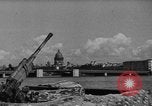
Russian people struggling and rationing during the Siege of Leningrad by German forces (WW2)
Snow covered grounds in Leningrad, Russia (present day Saint Petersburg, Russia). Soviet artillery in front of the Neva River and a road with moving streetcar. Ships stuck on frozen river. A man stands beside a Howitzer in front of St. Isaac's Cathedral. Soviet soldiers bring a tank and a barrage balloon. People on the frozen streets of Leningrad, Russia. A destroyed bus covered in deep snow on the street. A Soviet soldier’s moustache is covered with snow. Soviet soldiers in prone position to defend Leningrad from the German forces. German tanks and soldiers on the streets of Leningrad during World War II. No electricity and water supply. Russian civilians walk as streetcars remained out of service and covered in deep snow. People dig holes in frozen streets to gather water. A woman washing clothes on the street. Food is rationed during Leningrad blockade. A baker cuts bread into slices for rationing. A woman receives rationed bread. Women clean the rubble on streets. Aerial bombing of Leningrad by the Luftwaffe. A German Karl-Gerät “Thor” supermortar. German soldiers load and fire supermortar. A mortar fire hits a house, destroying it entirely. A building falls to the ground. German bombardment of Leningrad. Machines and Soviet war production workers build supplies weapons and ordnance in Leningrad. Women workers assemble mortars. Animated maps show Leningrad mostly surrounded by German territory. Shell manufacture. Supplies are brought in by truck, tracked vehicles, tractors, and railroad on ice across Lake Ladoga. German planes bomb trucks. Russians laying railroad tracks across frozen Lake Ladoga. Infirm and sick civilians, women, children board train out of Leningrad for medical treatment. A traffic enforcer waves flag on Lake Ladoga. Red Army soldiers in white suits advance in the battlefield. A tank advances. The arrival of spring. Melting snow in springtime. A wooden cross from a German grave is being washed away in a stream. Soviet trucks moving in convoy across flooded Lake Ladoga in spring. Russian children playing on the streets. People indulge in recreational activities. Civilians riding bicycles and taking streetcars. A woman cleans window. Russians crowd the streetcars of Leningrad. Soviet sailors clapping on deck. Russian dancers dancing traditional folk dances to celebrate. Soviet Navy sailors play music for the dancers. The sailors clap and applaud the performance. German prisoners of war enter Leningrad. A Soviet woman spits on the captured German soldiers. Russians marching in Leningrad.
CRITICALPAST.COM: About Us | Contact Us | FAQs - How to Order | License Agreement | My Account | My Lightboxes | Shopping Cart | Advanced Search | Featured Collections | Website Terms & Conditions | Privacy Policy ©2026 CriticalPast LLC.
License Agreement |
Terms & Conditions |
Privacy Policy
©2026 CriticalPast LLC.