


 Francais
 Deutsch
 Italiano
Refine Your Search
2nd-Rangers-D-Day stock footage and images
- Showing 3841 to 3846 of 13612 results more
more Hide
Hide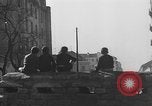
Spanish Civil War. Soldiers recruited to fight fascist rebels. President appeals to nation. Irrigation project undertaken
Fascist Rebel bombardment of Madrid, during Spanish Civil War, angers population and promotes recruitment into the Republican Army. A group of men march down a street with a small boy, who appears to be in boy scout uniform, in the front rank, carrying a flag. Recruits are seen being organized into marching groups. Sidewalk in front of a railroad station is filled with new recruits. They march under direction of Republican soldiers. Motorcade of automobiles carrying Manuel Azana Diaz, President of Spain, stops surrounded by an enthusiastic crowd, in Valencia. The President steps from his car, enters a building, and delivers a speech emphasizing the democratic election of the government and decrying the need to defend it and the soil of Spain from fascist rebels. Scene shifts to several men in rural area, discussing the need to complete new irrigation projects in time for new defense of Madrid. They already have their pump and must build the pump house. One man types on a typewriter while another sketches the plan to pump water from the Rio Tajo (Tagus River), to irrigate crops. View of horse-drawn wagon loaded with cement for construction. Two men discussion construction plans. Masons using rudimentary methods to erect a pump house. Later view of pump house as men work on the roof. Men digging irrigationl canal from the river and upward toward the agricultural fields. A soldier who hitched a ride on a truck, jumps off. View of a letter he wrote a few days ago, on May 4th. He arrives at his house and is greeted by his mother. Farmers trimming plants in field to be irrigated. A boy calls one of them, his father, to come home.
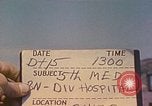
U.S. Marines carry wounded marines on stretchers towards hospital tents in Iwo Jima, Japan.
Medical units of U.S. military units in Iwo Jima, Japan during the Battle of Iwo Jima, World War II. U.S. Marines outside hospital tents. The marines with camo helmets and utilities carry a wounded marine on a stretcher. They enter a hospital tent. Other marines stand and walk in the area. A sign in the background reads: 'Officer of the day'. A wounded marine on a stretcher is unloaded from a parked vehicle in the foreground. Several marines near large tents and other small shelters in the background. A wounded marine on a stretcher is unloaded from a vehicle. Other marines walking in the area. They carry the stretcher towards a large tent.
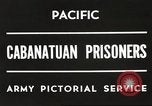
A man interviews two prisoners of war which were liberated from a Japanese prison camp in the Philippines.
Liberated American prisoners of war in the Philippines during World War II. Patients lying on hospital beds. A nurse gives medicines to the patients. A man interviews two of the prisoners of war from the Cabanatuan camp. One of the soldiers talks about the Bataan Death March. He states that they marched for three days and three nights. Food and water was not given to them. They were transported to prison camps in boxcars and some of the prisoners died and some were killed. Sergeant Donald Smith also talks about the conditions in the prison camps and treatment received from the Japanese.
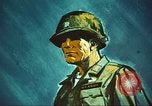
A man gets an admission letter from the West Point Military Academy in the United States.
A documentary film titled 'West Point, The Army Challenge' depicts the story of a young man who enters the West Point Military Academy in the United States. A cadet stands at attention with other cadets at the military grounds before receiving their graduation degree. Past events show the early life of the man and his entry to the West Point Military Academy. The man talks to his friends in his college. He is seated at a desk with his friends and they discuss amongst themselves. They discuss about their career. The man is advised by his friends to join the military academy. His college counselor tells him about the military academy. He says that it is a very good educational institution. He talks about the academic program of the academy and gives him a catalog. The man lying on his bed looks at the academy catalog. He looks at the syllabus and the background of the faculty. The man seated with officials at a desk and discusses to nominate him for the military academy. He goes for a medical check-up and does physical exercises. He receives his admission letter after some days. He discusses with his college counselor.
Peacetime activities and contributions by the U.S. Army in the United States.
Scenes from Army Day on April 6, 1934. Secretary of War George Henry Dern, in broadcast to the nation about importance of the Army, in peacetime. Brief glimpses of the Yellowstone River lower falls and Old Faithful and Beehive geysers erupting in Yellowstone Park, Wyoming. View amongst log buildings in Reproduction of Army Fort Dearborn, at the 1933 Century of Progress Exposition in Chicago, Illinois. A pioneer wagon; Native American Indians in ceremonial regalia; antique locomotives and trains at the Exposition. Army General Leonard Wood being sworn in as the Governor General of the Philippines. Closeup of General of the Armies, John J. Pershing, America's highest ranking Military officer. Headquarters of Walter Reed Army hospital, in Washington, DC, named for U.S. Army Major Walter Reed, who confirmed that yellow fever is transmitted by mosquito. Acting on this, the U.S. was able to complete the Panama Canal. View of French dredging equipment sitting idle in the water after Yellow Fever prevented them from completing the Panama Canal. Closeup of U.S. Army General William C. Gorgas, who, in 1904, headed the Sanitary Department that controlled mosquitoes and eradicated Yellow Fever, so the Panama Canal could be finished. View of alligator in swamp near the Panama Canal. Photograph of George Washington Goethals, Chief Engineer credited with making the canal happen. Explosives employed in Panama Canal construction. Earth and rocks being loaded into open rail cars. A steamship transiting the Panama Canal. The Washington Monument; U.S. Library of Congress; and the Lincoln Memorial, cited as examples of accomplishments by U.S. Army engineers. The Wilson Dam, under construction by Army engineers, in Muscle Shoals, Alabama and system of levees being built to control the Mississippi River. The raging Mississippi River during 1927 flood. Flood victims being assisted by U.S. Army soldiers, at a tent camp, receiving food and clothing. An Army airplane flying over a forest fire. Army personnel supervising men in the Civilian Conservation Corps or CCC. Mail being loaded aboard an Army airplane, as airmail service is being opened between Washington DC and New York City. President Woodrow Wilson talking with Army pilot Major Reuben H. Fleet. Mail being loaded into the nose of an airplane. U.S. Army Douglas World Cruiser airplanes in flight, returning from their trip around the world in 1924. A pilot sitting in front seat of a Douglas O-38 airplane, pulls a fabric hood over his cockpit to practice "blind flying". View of the aircraft in flight, with instructor pilot in the open rear cockpit. Army aviators taking a camera and a rifle aboard their airplane as they prepare to leave on an aerial mapping flight. Aerial view of skyscrapers of Manhattan Island, New York City. Army Signal Corps personnel working on communications devices. A cable laying ship operating at sea, in support of the U.S. Army's Alaskan cable and telegraph system. Men loading chemicals into hoppers on Army crop dusting airplane. Several views of Army airplanes crop dusting. Glimpse of boll weevil, the target of their efforts. Closeup of Karl Connell, who as a major in the AEF, in World War I, invented a superior gas mask known as the “Connell” or “Victory” mask. A group of miners wearing gas masks enter a smoky mine entrance. The Army invented tear gas, which is shown being used to thwart a bank robbery, in a staged demonstration. Brigadier General Hugh Johnson, appointed by President Franklin Roosevelt, as head of the Great Depression era National Recovery Administration, or NRA, is seen about to give a speech. Narrator cites him as an example of U.S. Army officers who also serve the country in civilian life. Scene shifts to cadets on parade at the United States Military Academy, West Point, New York.

People listen to the song 'God Bless America' sung by singer Kate Smith in the United States.
An American feature film 'This is The Army' depicts a performance by singer Kate Smith at the 21st anniversary of the armistice of World War I. Animated map shows Europe with fire in Poland. A man in the radio studio announces the name of Kate Smith on the stage, and noting the 21 anniversary of Armistice Day. A studio audience is present and applauds. Kate Smith introduces "God Bless America" as a new song, and then sings the song "God Bless America" with in-studio orchestra accompaniment. People watch the performance. An old man listens to the song, standing in front of his shop 'The Bugle Call.' He dusts a console radio with a feather duster and then goes inside and removes a bugle from a case labeled, ' Yip! Yip! Yaphank! 1918 ' At the Twardofsky business across the street, a man puts a small American flag into a basket as his father listens to the song on a small radio on the counter. People listen to the song in their houses and buildings. In a family living room: A couple seated in their living room listen to their console radio. A man, likely their son, seated at his desk listens to the song while studying. A woman looks at the photograph of a soldier, named Blake. Blake is then depicted listening to the same Kate Smith performance over a radio while stationed at Hickam Field in Hawaii. Characters Jerry Jones and Johnny Jones, played by actors George Murphy and Ronald Reagan are seen at the Jones and Jones production office. They listen to the radio. The character played by Ronald Reagan reads Variety Magazine.
CRITICALPAST.COM: About Us | Contact Us | FAQs - How to Order | License Agreement | My Account | My Lightboxes | Shopping Cart | Advanced Search | Featured Collections | Website Terms & Conditions | Privacy Policy ©2026 CriticalPast LLC.
License Agreement |
Terms & Conditions |
Privacy Policy
©2026 CriticalPast LLC.