


 Francais
 Deutsch
 Italiano
Refine Your Search
2nd-Rangers-D-Day stock footage and images
- Showing 3847 to 3852 of 13612 results more
more Hide
Hide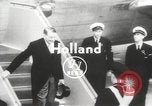
Queen Juliana and Prince Bernhard welcome President Rene Coty to the Netherlands
French President Rene Coty arrives at Amsterdam Schiphol Airport for a four-day official visit to the Netherlands. An airplane parked on Schiphol Airport (Evert van de Beekstraat 202, 1118 CP Schiphol, Netherlands). French President Coty comes out of the airplane. Pilots saluting. Soldiers and officials gather at the airport to greet the French president. Queen Juliana and Prince Bernhard of the Netherlands welcome President Coty. Flags of France and the Netherlands flying on flagpoles. Dutch people clapping. President Coty seated in a horse-drawn carriage with his wife, Germaine Coty. Rene Coty’s parade in Amsterdam. The carriage drives past on a street. People with small French flags gather along the sides of the street to greet President Coty. Children wave towards the French president. Dutch honor guard standing. Queen Juliana and Prince Bernhard walking. President Coty waves at Dutch children and adults in front of Garage Ben Maltha in Rotterdam. President Coty waves at people. Prince Bernhard accompanies President Coty.
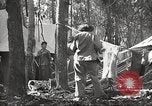
U.S. servicemen and women watch movies in Italy and various combat and occupation zones during World War II.
U.S. Army Nurses at their tent area in, Pacific combat zone, read notice of movie being shown at 7 PM on the airfield. They groom themselves in readiness to attend. Group of servicemen and women gathered at airfield outdoor movie, as C-47 airplane lands on runway beside them. U.S. Army aviators riding in a jeep to a U.S. Army Air Corps Theater, in Naples, Italy. View of servicemen gathering inside the theater. Sign outside the theater announcing the various films being presented that day. Part of the sign reads: "Movie, 3:30 and 7:30, 'Girl Crazy,'Sorry Joe, But No civilians may attend these shows (that includes girls!)" View of servicemen and women leaving the theater after the show. Army truck carrying movies to an outpost on the Italian front. Soldiers open the rear of truck and place announcement reading: "Now showing, 'Battle of Russia,' and Erol Flynn in 'Northern Pursuit.'" They set screen on side of truck and place projector on ground. U.S. troops gather to see the movie. U.S. Army 155mm guns firing on front lines in Italian campaign. Troops seated on a Sherman tank as others gather to watch a movie. In another location, troops gather to watch a movie on a screen set up on the front of a C-47 airplane. Building used for movie theater in a cold climate, with snow-covered mountains behind. Ambulatory wounded soldiers enter a cabin set up for showing movies, on a hospital ship. Audience of wounded servicemen and nurses tending them sit and watch a hollywood production. View of motion picture project being started. Smiling faces and expressions of the audience members as they laugh at comic scenes.
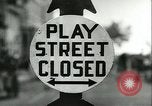
Children play games and receive instructions in handicraft during WPA supported play programs in New York City
Great Depression era Works Progress Administration (WPA) projects in New York City. A sign reads: 'Play Street Closed'. Children play various games and sports on a street in New York City that has been closed to traffic, under the supervision of WPA employees. A man instructs them. They play checkers, jacks, and a small court tennis game using ping pong paddles. They play round games holding hands and moving together. Children seen entering the toyery, an experimental program at the Heckscher Foundation For Children. A boy smiles as a woman in the toyery hands him a truck toy to borrow from the lending library of toys. Several children are shown trading in a toy for a different toy. Children seated in a room show each other flashcards to improve their reading skills, during remedial instruction time. Women in a Long Island City kitchen prepare school lunches for 800 needy children. A woman cook prepares a sandwich and a group of women wrap up batches of sandwiches. View of a day nursery, with a nap or rest area with small beds. A nurse in the nursery examines a child's mouth with a tongue depressor. Young children play with blocks in the nursery. They sit at tables in a dining room. Children drink milk and eat food.
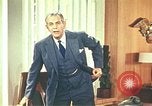
Construction of the DEW Line system of early warning radar sites
Narrator, actor Raymond Massey, sitting at a desk, covered with models of intercepter missiles, discusses the role played by the American Telephone and Telegraph Company and its subsidiaries, Bell telephone, and Western Electric, in creating the communications undergirding the North American Air Defense System. Scene shifts to arctic and view of a Dew Line site in the snow. A Pacific Western DC-3 airplane lands on snow runway, and a ship moves through icy waters, both carrying personnel and equipment for construction of the polar early warning system. A tractor hauls cargo for the project over snowy terrain. Supplies being air-dropped from a commercial C-82 Packet aircraft. Aerial view of a depot filled with supples for the DEW line project. Carpenters and other construction workers employed on the project in severe cold and windy conditions. A man making his way toward a wooden building, during a blizzard. Men installing tall steel towers at a DEW line site on a sunny day in summer. Exterior panels being placed on the geodesic dome covering a DEW line radar antenna.
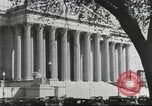
A map locates the flood affected areas in Ohio and the high and low pressure areas in the Ohio river during floods of 1937.
View of the United States National Archives Building (700 Pennsylvania Avenue, NW Washington, DC 20408-0001) in March 1936. in Washington, DC. Washington DC escapes damage from the great Potomac River flood. Next scenes cover damage caused due to a flood in Ohio, United States in January 1937. View of a weathervane in stiff winds. The level of the Ohio river rises. The flooded tributaries of the river. A map locates the flood affected areas. It depicts the high and low pressure areas. Map depicts heavy rains continuing for 20 days from January 6 to January 26, totaling 16 to 20 inches in the affected area.
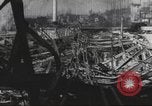
1937 Ohio Valley flood scenes, with major loss of property and life in the United States.
Damage caused by 1937 flood in the Ohio Valley area of the United States. A heavy loss of property due to a flood. Supplies being unloaded from trucks for the people. People being rescued from the areas affected by flood. Men aboard boats moving through buildings on the edge of the Ohio River that are submerged in water. Men moving a wooden casket. Destroyed houses and buildings in the areas. Flooded streets. A weather vane blowing briskly in wind. Narrator details how the weather bureau forecasts the weather and offers the information to help prevent losses from such disasters. Automatic typing machine records weather instrument readings. View of newspapers being printed at a printing press. A radio tower. People gather near injured flood victims. People lined up on the street to get supplies. Scenes of floodwaters below Memphis where flooding was effectively contained. Water rushing under the then new Bonnet Carre spillway of Lake Pontchartrain near New Orleans. Man opens a book published in Lisbon in 1605, now in the Library of Congress, written by Gabriel Lobo Lasso de la Vega, reporting on the exploration team of De Soto on leaf 300 of the book. De Soto's group, in 1543, reported on the flood they saw below current day Memphis, extending over 20 leagues of land, covering the tops of trees, but not overrunning the homes of the Native Americans who build shelter atop high poles. A view of submerged homes in the 1937 flood are shown as the narrator laments that more modern people did worse than the Native American Indians.
CRITICALPAST.COM: About Us | Contact Us | FAQs - How to Order | License Agreement | My Account | My Lightboxes | Shopping Cart | Advanced Search | Featured Collections | Website Terms & Conditions | Privacy Policy ©2026 CriticalPast LLC.
License Agreement |
Terms & Conditions |
Privacy Policy
©2026 CriticalPast LLC.